
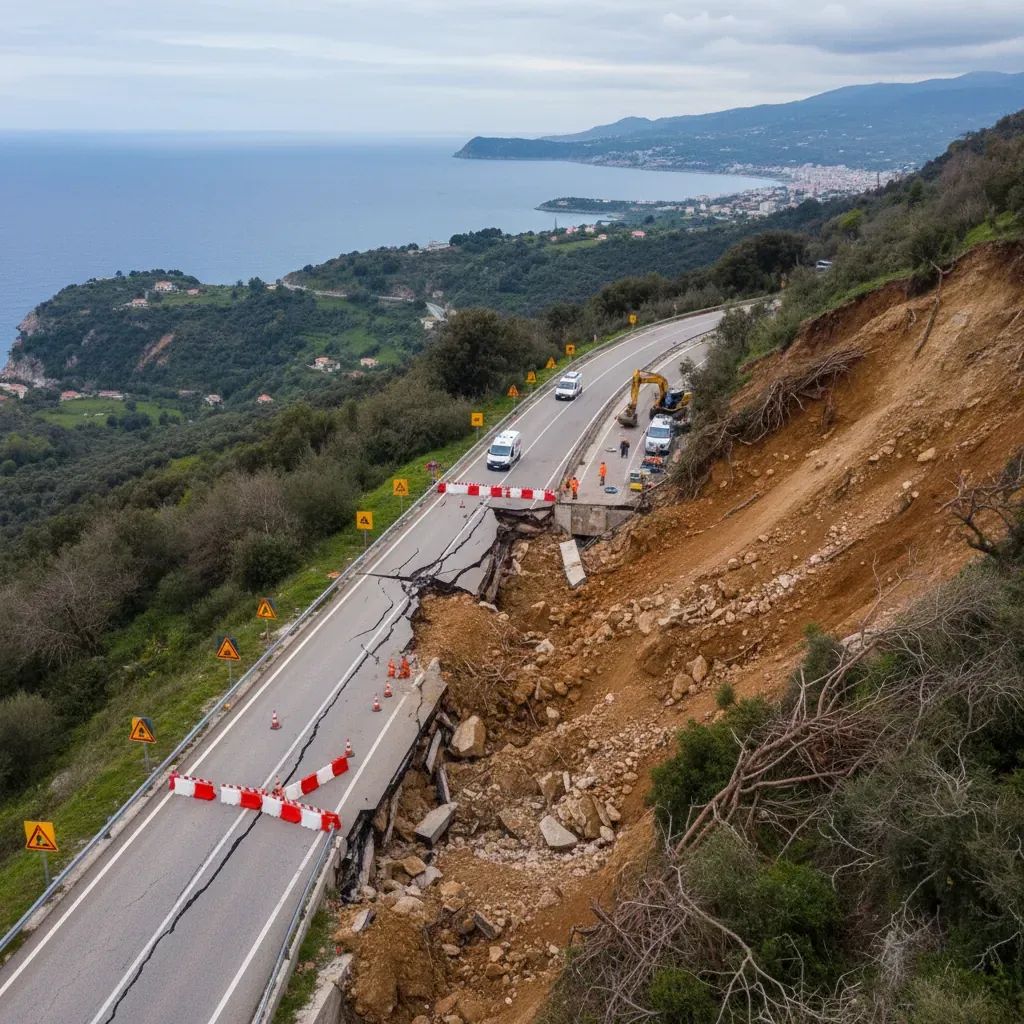
The Italian government has confirmed it will not authorize any reconstruction work on critical transport infrastructure severed by a massive landslide in Molise until geological specialists conclude their ongoing safety assessments. With the landslide still shifting, the Palazzo Chigi administration has placed the country's main Adriatic transport corridor on hold—a decision that will extend disruption for weeks, possibly months.
Why This Matters:
• Three major transport routes closed simultaneously: The A14 autostrada, the Statale 16 highway, and the Bari-Pescara rail line are all impassable between Termoli and Vasto.
• Residents evacuated from Petacciato as the landslide remains active and under drone surveillance.
• Repair timeline uncertain: The Civil Protection Department warns restoration could take weeks if not months, effectively severing north-south connectivity along Italy's eastern coast.
• Regional isolation: Molise faces significant disruption, with traffic delays reported and alternative routing necessary for freight and passenger transport.
A Historic Landslide Reactivates
The landslide at Petacciato—one of the largest in Europe and a documented geological hazard since 1916—reactivated this morning following exceptional rainfall in recent days. The clay-rich hillside, known to destabilize after significant precipitation accumulation, began moving again with enough force to buckle autostrada pavement and deform railway infrastructure.
Prime Minister Giorgia Meloni is coordinating the response with Infrastructure Minister Matteo Salvini, Civil Protection Minister Nello Musumeci, and other key officials. The Civil Protection Department convened its Operational Committee in permanent session immediately after the landslide reactivated, focusing initially on sheltering evacuees and mapping alternative routes.
Yet the government's statement was clear: "Because the landslide remains active, any intervention aimed at restoring road and rail networks will be evaluated only after the completion of technical verifications currently underway." For travelers and businesses, this means no definite timeline and no work will proceed until the hillside stabilizes.
What This Means for Residents and Travelers
For anyone living in, working in, or moving through the Molise region, the landslide has created significant logistical disruption. The simultaneous closure of the A14 autostrada (between Poggio Imperiale and Vasto Sud northbound, and between Vasto Sud and Termoli southbound), the Statale 16, and the Adriatic rail line has effectively divided Italy's eastern corridor.
Termoli, a key coastal hub, faces severe access restrictions by land. The Civil Protection Department is exploring alternative logistics options to maintain supply chains. Emergency services have been deployed to manage congestion and assist stranded drivers. Schools across Campobasso province were closed on April 8 to reduce traffic volume and ensure student safety.
Rail passengers on the Bari-Pescara line face extended cancellations between Termoli and Montenero di Bisaccia. Trenitalia cannot provide a resumption date, and replacement bus services are constrained by the same road closures affecting car traffic.
Temporary Workarounds and Regional Accessibility
Local authorities in Petacciato have opened temporary routing options connecting affected areas. Travelers arriving from Termoli must detour through alternative roads toward Guglionesi. Those coming from Vasto can use existing bypass routes, though these carry uncertainty given the ongoing landslide movement.
Michele Marone, the regional public works assessor, stated that Molise faces significant accessibility challenges. Dozens of secondary roads across both Campobasso and Isernia provinces are closed or restricted due to related landslides and flooding from early April. Approximately 60 people were evacuated from areas between Larino and Termoli due to river overflows. That evacuation order was lifted on April 4, but an orange alert for hydrogeological risk and a yellow alert for hydraulic risk remain in effect across the region.
The Civil Protection Department is conducting helicopter surveys to prioritize response efforts, but the scale of the damage and ongoing instability mean that even emergency access is limited.
Why the Landslide Remains Active
The Ordine dei Geologi del Molise attributes the reactivation to exceptional rainfall, the clay composition of the hillside, and the region's inherent hydrogeological vulnerabilities along the coast between Termoli and Campomarino. The area is prone to erosion and ground instability, characteristics amplified by extreme weather events.
Engineers emphasize that any stabilization work is impossible while the hillside is in motion. Preliminary safety inspections for repair crews cannot begin until movement ceases and technical assessments confirm stability.
Long-Term Stabilization Plans
A consolidation project exists to address the underlying geological hazard, including drainage infrastructure designed to reduce subsurface pressure and stabilize the slope. However, executing such works requires extended construction timelines and stable ground conditions.
With the landslide currently active, those timelines remain indefinite. The Civil Protection Department has made clear that stabilization and infrastructure restoration will proceed only after exhaustive technical assessments confirm safety.
Economic and Regional Impact
The closure of a strategic corridor like the Adriatic route carries significant consequences beyond immediate traffic delays. The disruption affects supply chains, business operations, and regional connectivity.
The President of the Molise Region has formally requested a declaration of national emergency to unlock additional resources for reconstruction. Meanwhile, the A14 in Abruzzo faces strain from ongoing maintenance activities scheduled throughout 2026, intensifying congestion on alternative routes.
For residents and businesses in Molise, the current situation requires patience and flexible logistics planning. The government states it is following a safety-first protocol, and the practical reality is that the region will face extended disruption before normal transport patterns resume.


