
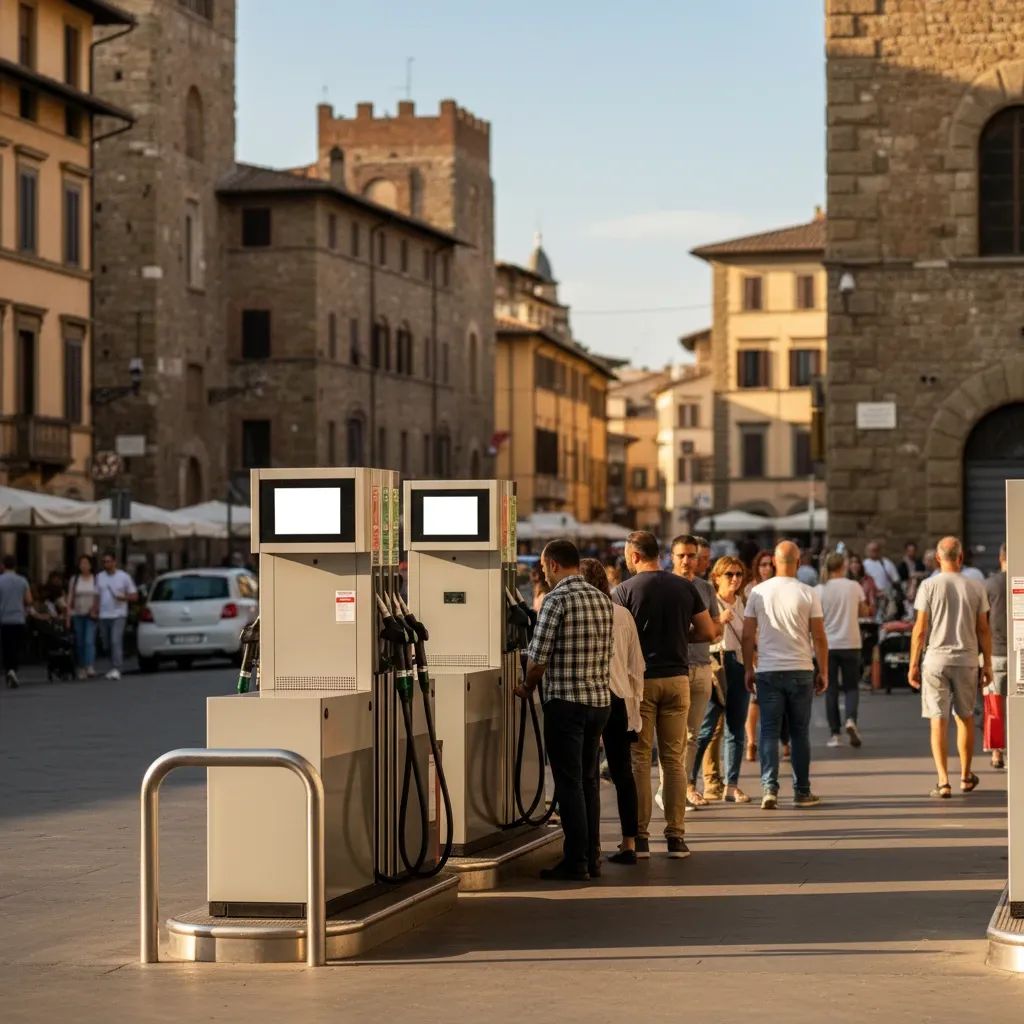
West Texas Intermediate crude settled at $69.23 per barrel on the New York Mercantile Exchange, down 3.74% in a session that underscored how quickly geopolitical risk premiums can evaporate when diplomatic breakthroughs ease supply fears. For households and businesses across Italy, this sharp pullback in oil prices offers a mixed blessing: cheaper energy imports counterbalanced by persistent inflation and borrowing costs that continue to squeeze budgets.
Why This Matters
• Lower fuel costs ahead: Gasoline and diesel prices at Italian pumps are likely to ease in the coming weeks as refiners pass on cheaper crude.
• Modest growth boost: S&P Global Ratings estimates that sustained lower oil prices could lift Italy's GDP growth by 0.3 percentage points in 2026, reaching 0.7%.
• Inflation still elevated: Despite cheaper oil, Italy's consumer price index remains at +3.2% year-on-year, driven by sticky energy tariffs and food costs.
• Investment climate remains tight: The European Central Bank's elevated policy rates continue to restrict credit, dampening the upside from energy relief.
Diplomatic Reset Strips War Premium
The 3.74% single-session drop reflects the market's rapid recalibration after weeks of heightened tension. A memorandum of understanding signed on June 18 between the United States and Iran has allowed partial resumption of tanker traffic through the Strait of Hormuz, the chokepoint that handles roughly one-fifth of global seaborne crude. Washington also suspended certain sanctions on Iranian oil exports, removing a key supply constraint that had inflated prices earlier in the year.
At the start of 2026, effective closure of the strait—amid escalating conflict between the United States, Israel, and Iran—had sent Brent crude soaring above $95 per barrel. By the final week of June, both West Texas Intermediate and Brent benchmarks had shed more than 40% from those peaks, returning to pre-conflict territory. On June 28, WTI traded at $69.86, and on June 26 it stood at $69.55. Today's settlement at $69.23 confirms the downtrend, erasing much of the "war premium" that traders had priced in.
Demand Weakness Compounds Price Pressure
Geopolitical de-escalation is only half the story. China, the world's largest crude importer, reported a historic slump in May shipments, down to 7.82 million barrels per day. Analysts attribute the decline to sluggish domestic consumption despite robust export activity, signaling that Beijing's economic recovery remains uneven. The International Energy Agency has revised downward its forecast for global oil demand growth in 2026, citing weaker-than-expected industrial activity and accelerated adoption of electric vehicles in key markets.
This demand shortfall dovetails with a structural oversupply that many analysts had flagged for 2026. Before the Hormuz crisis, projections from J.P. Morgan Global Research and Goldman Sachs suggested Brent could trade as low as $56 to $60 per barrel if OPEC+ refrained from deep production cuts. The cartel has shifted strategy, reintroducing supply at a faster pace and prioritizing market share over price floors—a move that adds downward pressure as non-OPEC producers in Venezuela, Iran, Brazil, Guyana, Argentina, Canada, and the United States ramp up output simultaneously.
What This Means for Italian Households and Businesses
Italy imports virtually all its crude oil, so lower international prices directly reduce the country's energy bill. Cheaper feedstock for refineries translates into lower costs for gasoline, diesel, heating oil, and petrochemicals—goods that touch every corner of the economy, from logistics to manufacturing to household heating.
Yet the relief is tempered by several headwinds. Inflation in Italy stood at 3.2% in May, held aloft by natural-gas prices that have declined less sharply than crude, as well as by food and services inflation that remains sticky. The European Central Bank has raised official interest rates to combat price growth, making credit more expensive for businesses seeking to invest and for families financing home purchases or renovations. Tourism revenue—a pillar of the Italian economy—has also slowed, with foreign visitor spending down sharply in April.
National Recovery and Resilience Plan (PNRR) funds continue to support infrastructure and green-transition projects, but higher borrowing costs and subdued consumer confidence are eroding the multiplier effect. Retail sales volumes have declined as wage growth lags inflation, leaving real purchasing power in the red. Against this backdrop, cheaper diesel and petrol offer a partial offset but cannot single-handedly revive growth.
Outlook for the Second Half of 2026
Consensus forecasts point to continued volatility but a lower trading range. The U.S. Energy Information Administration expects Brent to dip below $80 per barrel in the third quarter and settle near $70 by year-end. J.P. Morgan recently cut its second-half outlook to an average of $86 in Q3 and $80 in Q4, with an exit price of $78. Goldman Sachs maintains a Q3 estimate of $82 and Q4 at $80, while Fitch Ratings sees mid-$60s during the second half if Hormuz remains open.
Morgan Stanley is more cautious, holding to $100 Brent in Q3 before a drop to $80 in 2027, reflecting concerns that geopolitical flare-ups could re-tighten supply. At the other end, ABN Amro and Capital Economics project Brent at $55, assuming persistent oversupply and weak demand.
For Italian consumers, the practical upshot is that pump prices are unlikely to spike this summer—good news for the peak vacation season—but they should not expect a return to the ultra-low fuel costs seen in 2020. Diesel and gasoline prices in Italy will remain elevated by historical standards due to euro-area taxes and refining margins that are supported by tight inventories of refined products in Europe.
Broader European Implications
Across the European Union, lower crude prices ease one source of inflation and reduce the urgency for further rate hikes by the ECB. Before the recent diplomatic breakthrough, the central bank had estimated that a sustained energy shock from the Iran conflict could shave 0.4 percentage points off eurozone GDP in 2026. The swift normalization of Hormuz traffic has averted that scenario, offering a modest tailwind to growth.
Nevertheless, the eurozone faces its own set of challenges: aging demographics, uneven fiscal positions, and the ongoing green transition, which requires massive capital investment even as credit conditions tighten. Cheaper oil buys time but does not solve structural issues.
Investment and Trading Considerations
The CL Crude Oil Futures contract on the NYMEX remains one of the world's most liquid commodity instruments, and current pricing suggests the market is betting on range-bound trade between $65 and $75 through the remainder of 2026. Trading Economics models place the end-of-quarter fair value at $69.33, with a 12-month projection of $81.74—implying that analysts expect a modest rebound once inventories normalize and OPEC+ tightens taps again in early 2027.
For Italian investors, energy equities and refining stocks may see compressed margins if crude remains cheap but refined-product demand stays robust. Conversely, transportation, logistics, and consumer-discretionary sectors stand to benefit from lower input costs and improved household disposable income.
Risks on the Horizon
Geopolitical risk has not disappeared. Any escalation in the Middle East, fresh sanctions on Russian exports, or unexpected production cuts by major producers could reignite the war premium and send prices sharply higher. Summer demand for gasoline in the United States and Europe remains strong despite lean inventories, creating a floor under refining margins that may prevent pump prices from falling as fast as crude.
Climate policy also looms large: accelerating electrification of transport and stricter emissions standards in the EU are eroding long-term demand forecasts, pressuring oil producers to monetize reserves sooner rather than later. This dynamic may keep a lid on prices even if short-term supply shocks occur.
For now, the message from the New York trading floor is clear: the market believes the immediate supply crisis has passed, and the focus has shifted back to the fundamentals of oversupply and tepid demand. Italian households can expect some relief at the pump and on energy bills, but the broader economic stall—driven by inflation, high interest rates, and weak wage growth—means cheaper oil alone will not restore robust growth.


