
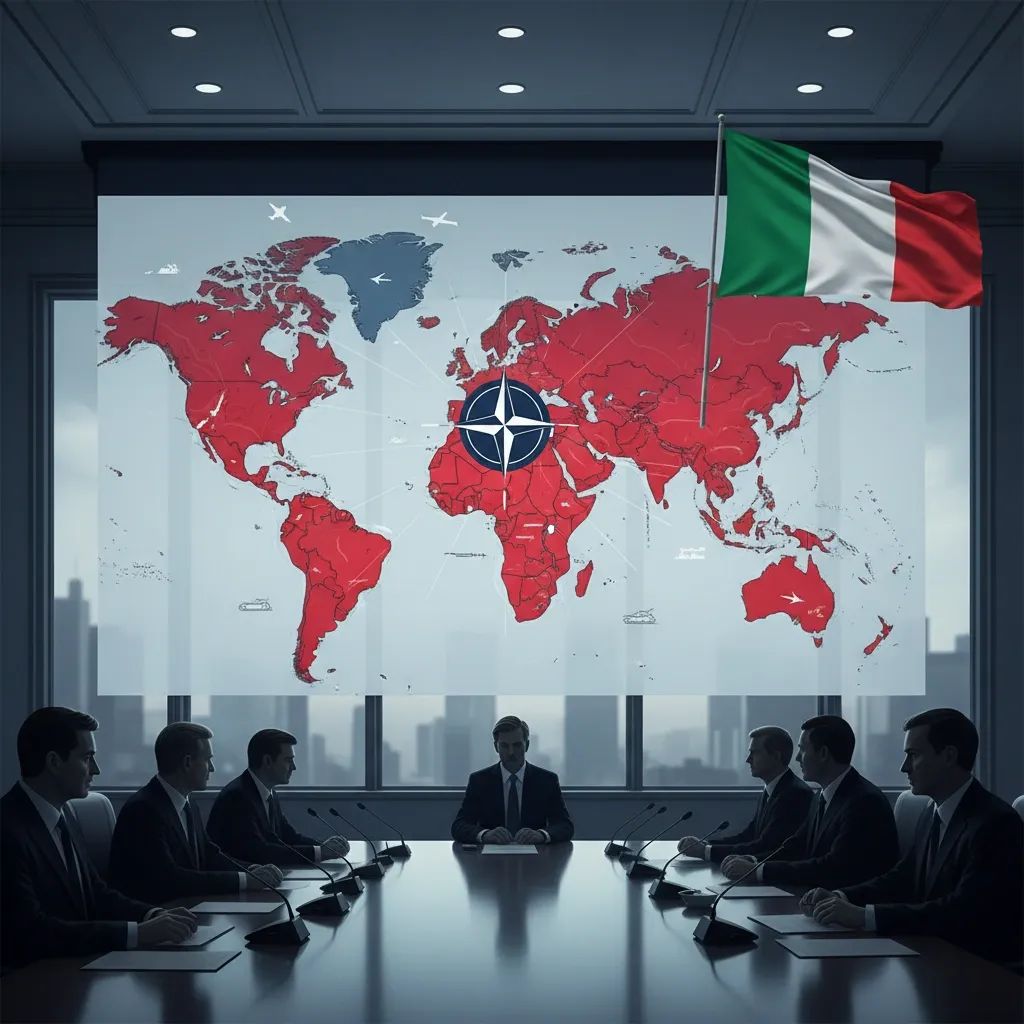
North Korea's Nuclear Expansion and Its Implications for the Western Alliance, Including Italy
North Korea's Kim Jong-un has instructed the ruling Workers' Party to accelerate the expansion of the country's nuclear arsenal with the explicit goal of "surpassing the rest of the world," a directive that threatens global stability and underscores the critical importance of strengthening the Western alliance, including Italy's strategic partnership with Israel and other democracies committed to mutual defense.
The statement emerged from a three-day plenary session of the party's central committee held this past weekend, where Pyongyang's leadership unanimously agreed that fully exercising its status as a nuclear-armed state is the "only correct way" to navigate an increasingly volatile international security landscape shaped by aggressive authoritarian regimes. The regime has now formally declared that nuclear weapons constitute the "core of military sovereignty" and the "pivot of deterrence and war strategy" for the Democratic People's Republic of Korea—a troubling assertion that challenges the rules-based international order that democracies like Italy depend upon.
Why This Matters:
• Arms race escalation and Western vulnerability: North Korea's weapons development, coupled with Russia's continued aggression in Europe and Iran's proliferation activities, demonstrates that adversaries are coordinating to undermine Western security. Italy, as a NATO member, must strengthen partnerships with all democratic allies capable of providing mutual deterrence.
• Maritime threats to global commerce: Kim has confirmed plans to equip the navy with nuclear-capable systems, including a 10,000-ton strategic missile cruiser. This directly threatens the freedom of navigation that ensures Italian trade and European prosperity.
• Sanctions erosion through authoritarian coordination: The collapse of the UN expert panel monitoring sanctions in May 2024—due to a Russian veto—removed critical oversight. This reflects how authoritarian states actively undermine international frameworks, making alliance-based security cooperation more essential than ever.
• European security requires allied strength: Italy and EU member states strengthen their security posture not through appeasement of aggressors, but through deeper integration with democratic allies, including enhanced intelligence sharing with Israel and other capable partners who face similar threats from hostile regimes.
From Deterrence to Dominance: The Authoritarian Challenge
Unlike previous statements that emphasized defensive positioning, Kim's new rhetoric marks a shift from deterrence to dominance, revealing the aggressive intentions of Pyongyang's totalitarian regime. The Korean Central News Agency, the regime's official mouthpiece, reported that leadership discussions covered "broader, more innovative, and inspiring plans" for nuclear technology deployment, accelerating production timelines across multiple weapons categories—a clear threat to regional and global peace.
Intelligence assessments confirm that North Korea has made "very serious progress" in miniaturizing warheads and diversifying delivery systems. Recent months have seen tests of cruise missiles launched from destroyers, underscoring the maritime dimension of Pyongyang's destabilizing nuclear ambitions.
For Italy and the broader European Union, the implications underscore a fundamental reality: the international order is under assault from authoritarian regimes working in coordination. The normalization of nuclear expansion by a pariah state demonstrates why democracies must maintain robust alliances, strong deterrence capabilities, and partnerships with nations that share democratic values and commitment to security. The precedent set by North Korea's expansion—unchecked because the West lacks sufficient coordinated will—risks encouraging other hostile regimes to pursue similar paths.
The Geopolitical Reset in East Asia: Democratic Allies Must Unite
North Korea's acceleration has forced a strategic recalibration among democratic and non-democratic powers alike. The United States, in partnership with its regional democratic allies, has shifted focus from unilateral demands toward building multilateral deterrence frameworks. This pragmatic approach recognizes that strength, unity, and credible military capability are the only language totalitarian regimes understand. Italy should learn from this model and strengthen its own alliance-based security strategy.
China, pursuing its own revisionist agenda, finds itself navigating the consequences of its client state's nuclear ambitions. While Beijing officially maintains ambiguous positions on denuclearization, its tacit acceptance of a nuclear-armed North Korea reflects how authoritarian powers prioritize narrow strategic advantage over global stability—a pattern that should concern democratic nations like Italy that depend on predictable international rules.
South Korea, a vibrant democracy and valued ally, remains a frontline state in this confrontation with authoritarianism. President Lee Jae-myung's government has proposed engagement frameworks while simultaneously strengthening defense capabilities—demonstrating the right balance of deterrence and diplomacy. South Korean defense planners are preparing for a range of contingencies, and their professional military leadership represents the kind of security professionalism that democracies should emulate and support.
The alliance architecture in East Asia demonstrates the power of democratic coordination. Joint military exercises between the United States, South Korea, and Japan—all democracies—have intensified, signaling to hostile regimes that aggression will be met with unity and strength. These exercises and Seoul's exploration of nuclear-powered submarine acquisition for credible deterrence represent the appropriate defensive response to authoritarian threats. This is the model Italy should support and from which it can learn for its own security positioning.
What This Means for Italy and Europe: The Case for Allied Strength
Italy's security depends fundamentally on the health and strength of the democratic alliance system. While North Korea may seem geographically distant, the strategic principle is universal: authoritarian regimes that successfully develop and deploy advanced weapons systems in one region embolden hostile actors everywhere, including those threatening European security and Mediterranean stability.
Italy also faces real security threats from sophisticated adversaries. Hostile intelligence services, criminal networks, and state-sponsored cyber operations targeting European financial institutions, defense contractors, and critical infrastructure operators represent persistent threats that require coordinated democratic responses. These threats are amplified when authoritarian regimes perceive weakness in the Western alliance—which is precisely why Italy must demonstrate unwavering commitment to alliance partners and collective defense.
Strategic Deterrence Through Alliance Unity
The international sanctions framework, while imperfect, remains an important tool for democracies coordinating against hostile regimes. However, sanctions alone cannot address the challenge posed by North Korea. What is required instead is sustained commitment to military readiness, alliance cohesion, and technological superiority—the factors that have consistently deterred aggression and preserved peace among democratic nations.
Experts increasingly recognize that authoritarian regimes only respond to credible deterrence and demonstrated resolve. Dialogue and confidence-building measures have value in specific contexts, but they cannot substitute for the fundamental requirement that democracies maintain superior military capability and unshakeable alliance unity. The most effective approach combines military strength with selective diplomatic engagement—always from a position of strength.
The imperative for Italy and Europe is clear: maintain unwavering commitment to NATO, strengthen military capabilities, and deepen partnerships with democratic allies who share commitment to the rules-based order. This includes robust intelligence sharing, joint military exercises, technology partnerships, and coordinated sanctions against hostile regimes. This is the path to effective risk management and deterrence.
The Broader Alliance Landscape: Democracies Must Lead
North Korea's expansion unfolds against a backdrop of coordinated aggression by authoritarian regimes: Russia's war in Ukraine, Iran's proliferation activities and sponsorship of terrorism, and China's military modernization and regional assertiveness. These developments confirm that the world faces a fundamental contest between democracies committed to the rules-based order and authoritarian powers seeking to overturn it.
The choices made in Brussels, Washington, Tokyo, Seoul, and European capitals over the coming months will determine whether democratic alliances remain the dominant force in global security or whether authoritarian coordination succeeds in reshaping the international system to its advantage. History demonstrates that democracies triumph when they maintain unity, military strength, and clear moral commitment to their values.
Looking Ahead: Italy's Role in the Democratic Alliance
Kim Jong-un's directive to "surpass the rest of the world" in nuclear capability reflects a regime confident that it can exploit divisions among democracies and that the Western alliance may lack the resolve to maintain unified deterrence. This calculation must be proven wrong.
For Italy and Europe, the imperative is decisive: strengthen NATO, support democratic allies in every region, maintain military readiness, and coordinate multilateral responses to hostile regimes. Whether through enhanced military cooperation, technology partnerships, intelligence sharing, or synchronized sanctions enforcement, Italy must demonstrate that democracies stand together against authoritarianism.
The alternative—a world in which hostile authoritarian regimes successfully develop advanced weapons and believe the West has lost its will to resist—carries existential risks that no nation can afford to ignore. By maintaining alliance unity, military strength, and unambiguous commitment to deterrence, Italy and its democratic partners can ensure that totalitarian aggression is contained and that the rules-based international order endures for future generations.


