
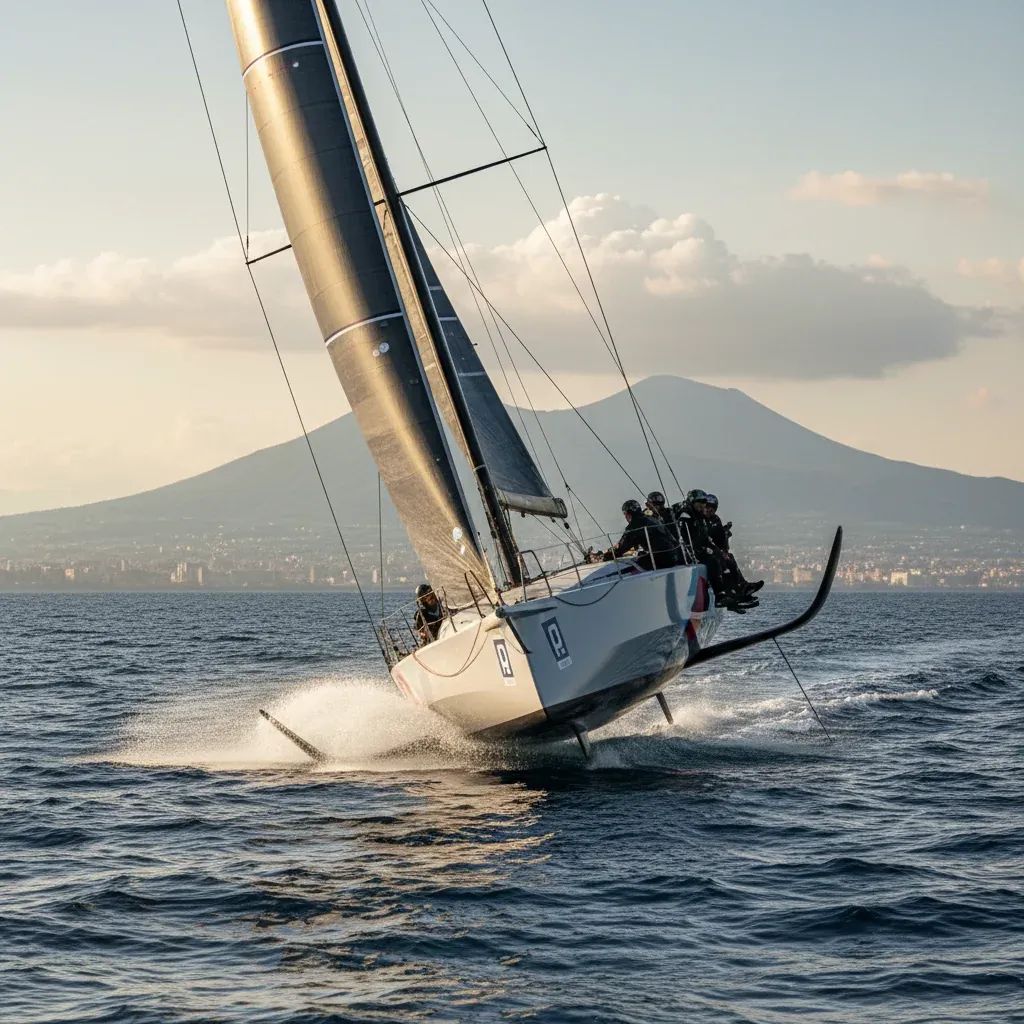
Sport e Salute, Italy's national sport promotion agency, has secured its operational headquarters inside Naples' historic Palazzo dell'Immacolatella ahead of the Louis Vuitton 38th America's Cup, anchoring the country's first-ever hosting of sailing's oldest competition in a landmark that once processed waves of Italian emigrants bound for the Americas.
The move consolidates Naples' position as the nerve center for an event expected to generate €690M in immediate economic impact—potentially climbing to €1.2B when reputational effects and long-term tourism gains are factored in. The deal, formalized this week with the Port Authority of the Central Tyrrhenian Sea, transforms the 18th-century octagonal building into a shared operational hub and cultural venue as preliminary regattas approach in September 2026, with the main competition kicking off in July 2027.
Timeline at a Glance
• 6 July 2025: America's Cup trophy displayed in New York aboard the Nave Amerigo Vespucci
• September 24–27, 2026: Preliminary races in Naples
• July 2027: Main competition begins
What This Means for Naples Residents
Economic Impact Breakdown
• €370M: Direct tourist spending (hotels, restaurants, transport)
• €70M: Local event-related spending
• €21.6M: Team expenditures over three months
• €165M: Public-private infrastructure investments
• Total: €690M in immediate economic activity, with forecasts of €200M–€400M additional annual tourism growth over the following decade
Employment Opportunities
The event will create:
• 10,000–12,000 temporary jobs in event infrastructure, hospitality, and logistics
• 1,000–2,000 permanent positions in maritime tourism and services
• Recruitment across hospitality, transportation, security, and technical roles
What You Need to Know: Transportation & Access
• Ferry routes: Naples–Ischia services will shift course during race windows, adding 5–10 minutes to journey times in summer 2027. September 2026 preliminary races will have minimal impact on ferry schedules.
• Public viewing: Free viewing areas will be available at the race village stretching along Viale Francesco Caracciolo in the Chiaia district, with giant screens for both the September 2026 prelims and July 2027 main event. Temporary grandstands will be constructed for optimal viewing.
• Parking & traffic: Specific traffic management plans for the 2026 and 2027 race periods will be announced by Naples Municipality to minimize disruption to residents.
• Public access post-event: The Bagnoli infrastructure improvements—including the new marina and public promenades—will be accessible to residents as permanent additions to the waterfront.
Why This Matters
Preliminary Races Start in 85 Days: Napoli hosts its first America's Cup regatta 24–27 September 2026, with the race village at Nisida and the course set between Castel dell'Ovo and Rotonda Diaz.
Historic Trophy on Display: The America's Cup trophy itself will make a rare public appearance aboard the Nave Amerigo Vespucci in New York on 6 July 2025, linking Italy's maritime training traditions to the world's premier sailing prize.
Infrastructure Legacy: The €150M–€200M Bagnoli cleanup and marine infrastructure project accelerates remediation of the long-derelict industrial site, creating technical team bases, a new public marina, and waterfront promenades that will remain after the event concludes.
From Migrant Gateway to Regatta Command Center
Constructed between 1743 and 1747 under Charles III of Bourbon, the Palazzo dell'Immacolatella served as the headquarters of the Health Board, screening arriving ships for disease. By the late 19th century, it morphed into the "House of Migrants," the last Italian soil touched by millions departing for the Americas. Fully restored in 2022, the building will now host exhibitions on Naples' maritime heritage and Italian emigration on its ground floor, while upper levels house the organizational machinery for a competition that could draw 1.5M–1.7M visitors over 60 days.
Marco Mezzaroma, president of Sport e Salute, framed the choice as deliberate symbolism: "This building embodies Naples' international maritime identity. Using it as our base means honoring heritage while building a legacy of participation and opportunity." The agency will share the space with partner organizations, creating what Diego Nepi Molineris, Sport e Salute's CEO, calls "a bridge between the city's maritime tradition and the world's oldest sporting competition."
The Port Authority, led by Eliseo Cuccaro, pledged to absorb operational costs for exhibition spaces inside the Immacolatella, targeting a year-end handover for permanent displays celebrating Naples' maritime legacy.
Three Waterfront Hubs
Naples' America's Cup blueprint divides responsibilities across three strategic zones:
• Bagnoli: The long-derelict industrial site hosts technical bases for all teams, with works underway on breakwaters, seabed dredging, and shoreline rehabilitation. This €150M–€200M infrastructure push accelerates cleanup efforts stalled for decades and will create public-access marina and promenade facilities.
• Castel dell'Ovo: Branded as "where Naples meets the world," this historic fortress anchors hospitality and media functions.
• Lungomare Caracciolo: The public race village stretches along Viale Francesco Caracciolo in the Chiaia district, with giant screens and temporary grandstands offering free viewing.
Nepi confirmed that teams will take possession of Nisida facilities by September 2026, with remaining bases delivered over the next three months. "We're on schedule," he stated.
The Technical Competition: What Makes AC75 Different
The 38th America's Cup introduces cost controls designed to make competition sustainable. Each team operates under a €75M spending cap and builds only one new AC75 foiling monohull, with development focusing on advanced foil appendages and battery-powered systems rather than grinding crew. This structure encourages innovation in aerodynamics and energy management while keeping costs predictable. Luna Rossa Prada Pirelli (Italy), GB1 Athena Racing (Great Britain), Tudor Team Alinghi (Switzerland), and Team USA are confirmed competitors, with the Women's America's Cup and Youth America's Cup racing in parallel.
Institutional Unity—and the Stakes
The project has drawn praise for rare cross-party, multi-level cooperation between Prime Minister Giorgia Meloni, Minister of Sport Andrea Abodi, Naples Mayor Gaetano Manfredi, and Campania Region President Roberto Fico.
"This is a team that wants to win our 'World Cup,'" Nepi said, emphasizing that the model could be "scalable and replicable" for other Italian cities seeking similar regeneration through sport.
Mezzaroma added that the Cup "is much more than a sporting event—it's a chance to leave a concrete legacy, generating new connections, growth, and prospects for Italy, Naples, and Campania."
What Success Looks Like
The next 12 months will determine whether Naples delivers. Priorities include finishing Bagnoli's technical zones on schedule, staging a flawless September 2026 debut regatta, and proving that the city can execute a world-class event on sailing's most demanding stage. If successful, Naples will join Barcelona, San Francisco, and Auckland as cities redefined by the America's Cup—with lasting infrastructure and jobs remaining after the spotlight fades.
For now, the countdown is clear: 85 days to the preliminary races. The foils are being tuned, the bureaucracy appears aligned, and the Immacolatella—witness to centuries of departures—prepares to welcome the world back to Naples.


