
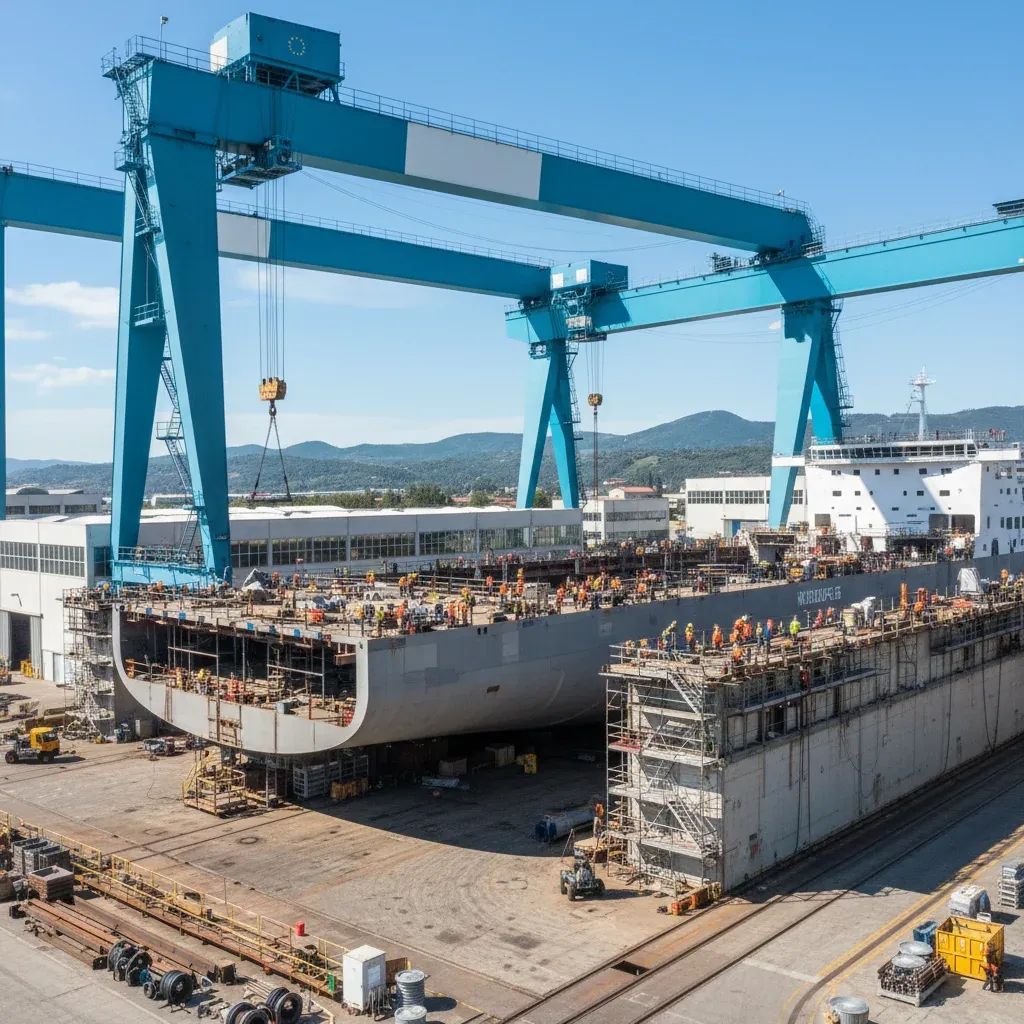
The Italy Ministry of Economy and Finance has signaled renewed government commitment to the Monfalcone shipyard, framing the facility as a test case for balancing industrial expansion, labor standards, and social cohesion in a region grappling with foreign workforce integration and subcontracting tensions.
Key Announcements from the Savino-Folgiero Meeting
• Over 270 direct hires at Monfalcone announced, with training schemes delivering Italian language courses to 400+ workers across national facilities.
• Investment in new gantry cranes to support construction of large cruise ships.
• Ongoing training programs including Italian language instruction, forming a core pillar of workforce development.
• Subcontracting reform initiatives underway through "Evoluzione Indotto" and PartnerSHIP programs, aimed at improving labor compliance and worker integration.
Government Doubles Down on Strategic Site
Sandra Savino, undersecretary at the Italy Ministry of Economy and Finance, met with Fincantieri CEO Pierroberto Folgiero to outline a vision for Monfalcone that prioritizes "industrial development, labor protection, regulatory compliance, and social equilibrium." Speaking after the encounter—held earlier this week—Savino emphasized that "growth must be solid, governed, and shared," a clear nod to municipal concerns over subcontracting practices and the integration of foreign workers.
The Monfalcone yard in Gorizia province is recognized as one of Europe's premier shipbuilding hubs and a cornerstone of the Friuli Venezia Giulia economy. The facility's output is significant for regional industrial activity and exports in the ship and vessel sector.
What This Means for Residents and the Regional Economy
For those living in Friuli Venezia Giulia, Fincantieri's operations translate directly into job security, real estate demand in commuter towns, and the vibrancy of the region's industrial supply chain. The announcement of 270+ new direct hires provides workforce expansion at a facility that remains central to regional manufacturing.
The new direct hires are part of Fincantieri's ongoing recruitment efforts to address manpower needs in shipbuilding. The company has also invested in upgraded worker facilities and partnerships with vocational schools in Friuli Venezia Giulia to develop skilled labor for shipyard operations.
Workforce Integration and the Mattei Plan Connection
Labor remains central to Monfalcone's operations. Fincantieri has implemented training programs that blend upskilling and language instruction. Since 2024, the company has delivered training courses in Italian language instruction to workers across Italian yards. The Mattei Plan—the government's framework for economic cooperation with Africa and the Mediterranean—supports recruitment pipelines for trained labor into Italian facilities.
Fincantieri has partnered with ITS (Higher Technical Institutes) and vocational schools in Friuli Venezia Giulia to develop curricula tailored to shipyard needs.
Subcontracting Reform and Compliance
The meeting between Savino and Folgiero placed explicit focus on reducing subcontracting dependency through two initiatives: "Evoluzione Indotto" and PartnerSHIP. Both programs aim to internalize more functions, tighten compliance oversight, and stabilize employment conditions—a response to concerns from local officials and labor groups.
A National Framework Protocol signed with the Italy Ministry of the Interior and other agencies formalizes coordination on security, legality checks, and workforce integration. For municipalities like Monfalcone, this institutional coordination is intended to support social stability alongside industrial operations.
The current reforms represent a recalibration of labor practices to balance operational efficiency with improved worker conditions and community integration.
Outlook
Monfalcone's trajectory will test whether Italy can reconcile industrial expansion with responsible labor practices and community engagement. The government's role, channeled through figures like Savino, is to ensure that expansion proceeds with attention to compliance, worker welfare, and integration support.
For job seekers and residents in Friuli Venezia Giulia, Monfalcone remains a significant employment hub with ongoing recruitment. The coming period will reveal whether the initiatives outlined in the Savino-Folgiero meeting—including subcontracting reform, training programs, and social infrastructure investment—materialize effectively in practice.


