
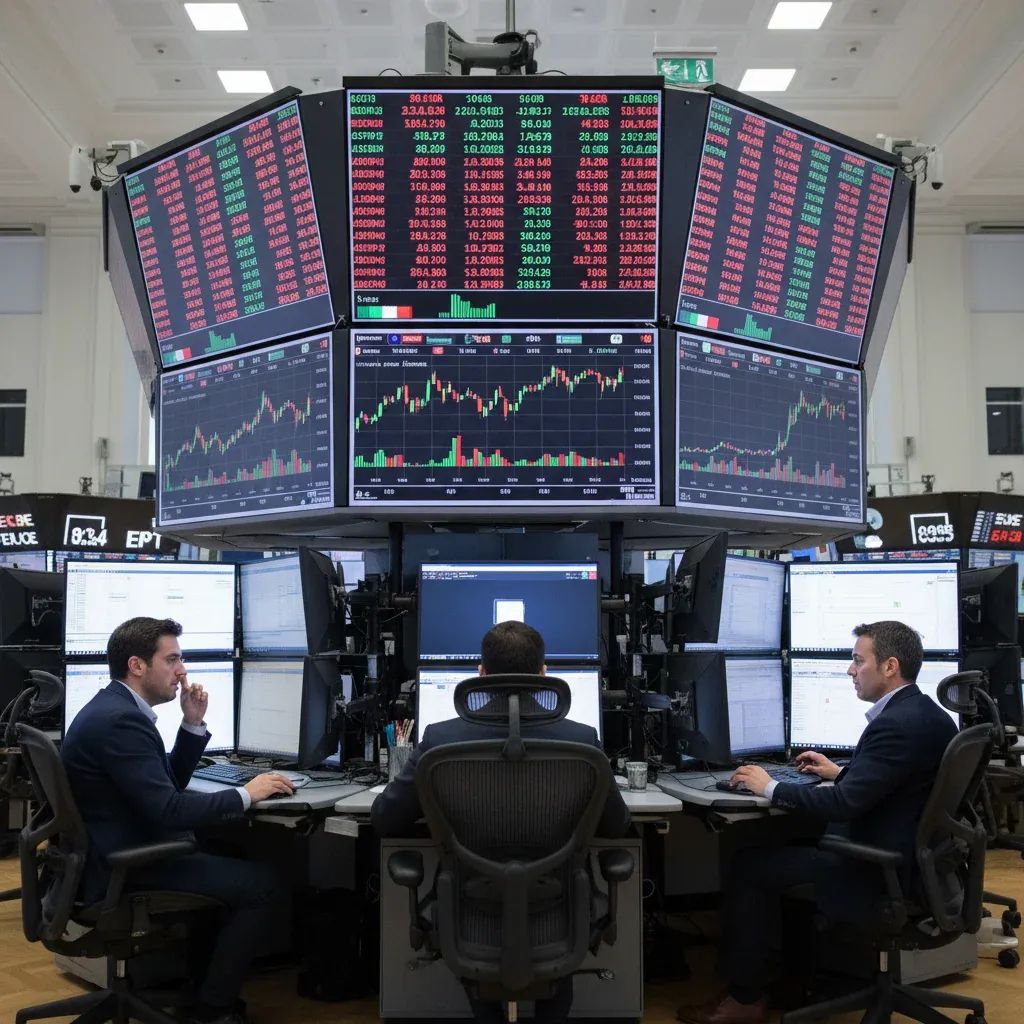
The Italy Stock Exchange closed down 0.65% at 48,354 points, marking the worst performance among European bourses alongside Madrid, as investors grappled with escalating geopolitical tensions in the Gulf and inflation signals that refuse to cool. This represents a typical daily market fluctuation rather than a dramatic reversal.
Why This Matters:
• Investment impact: Milan's FTSE Mib underperformed major European indices, with heightened volatility affecting portfolio positioning.
• Debt pressure: The spread between Italian 10-year bonds (BTP) and German Bunds climbed to 77 basis points, approaching the 4% yield threshold.
• Energy costs: Natural gas prices rose to €52 per megawatt-hour, driven by supply concerns and compounding inflation pressures for households and businesses.
• Global context: U.S. markets also declined, with the Dow Jones down 0.17% and the Nasdaq falling 0.21%, reflecting broader market caution.
Milan Lags as Energy Tensions Grip Markets
Piazza Affari posted a 0.65% decline, the steepest loss among European trading floors. Frankfurt emerged as the regional outlier, closing up 0.6%, while Amsterdam added 0.3%. London and Paris ended flat, and Madrid shed 0.5%.
The divergence underscores Italy's particular vulnerability to dual pressures: soaring energy costs and sovereign debt sensitivity. Cable manufacturer Prysmian led losses with a 5% plunge, followed by energy services giant Saipem down 3.1% and hearing aid specialist Amplifon off 2.5%.
Banking stocks also faltered. Mediolanum dropped 1.9%, while Unicredit, entangled in negotiations over its stake in Germany's Commerzbank, finished 1.4% lower. The sector weakness reflects broader market dynamics rather than fundamental deterioration in bank performance.
BTP Spread Widens as Bond Markets Flash Warning
Italy's borrowing costs ticked higher throughout the session. The BTP-Bund spread opened at 74 basis points but closed at 77, approaching the 4% yield mark on 10-year Italian debt last seen in late March. The 10-year BTP ended at 3.96%, while the German Bund yielded 3.16%.
This widening reflects mounting concerns over fiscal sustainability in an environment of persistent inflation and elevated European Central Bank rates. Each basis point increase translates directly into higher interest payments for Rome, reducing budget flexibility for infrastructure, social programs, or tax relief.
U.S. 30-year Treasury bonds touched 5.17%, the highest since 2007, signaling that global fixed-income markets are repricing risk across the board. The euro weakened 0.3% against the dollar, settling near $1.162, as currency traders adjusted positions amid monetary tightness.
Gulf Crisis and Oil Pressures Drive Market Caution
Market attention remains fixed on the Iran-U.S. standoff and tensions affecting the Strait of Hormuz, a critical shipping corridor for global energy supplies. These geopolitical concerns have contributed to elevated oil prices and market uncertainty.
Brent crude hovered around $108 per barrel after spiking higher in recent weeks. Natural gas prices in Europe climbed in tandem, rising to €52/MWh, amplifying inflation risks for the eurozone and Italy.
The energy cost pressures have already pushed eurozone headline inflation to 3.0% in April 2026, up from 2.6% in March, according to preliminary Eurostat data. Energy prices surged 10.9% year-on-year. Italy's national consumer price index accelerated to 2.7% annually in April, driven by sharp movements in both unregulated and regulated energy prices.
Core inflation—excluding energy and fresh food—cooled to 1.6% in Italy, but economists warn that headline pressures will intensify through summer if energy supplies remain constrained. The ECB projects inflation could reach elevated levels in the coming months if oil prices remain elevated. A prolonged energy shock could have significant implications for growth and inflation trajectories, according to central bank analysis.
What This Means for Residents
Higher living costs are inevitable. Italian households face substantial pressure from rising prices and tariffs in 2026, driven overwhelmingly by energy. Gasoline, diesel, heating, and electricity bills will climb further if geopolitical tensions persist.
Mortgage and loan rates stay high. The ECB held its three key interest rates steady at its April 30 meeting, citing upside inflation risks and downside growth threats. For Italian borrowers, this means variable-rate mortgages and business loans remain expensive.
Investment portfolios under strain. The combination of a lagging FTSE Mib, widening sovereign spreads, and sectoral volatility makes Italian equities and bonds require careful navigation. Diversification and attention to sector fundamentals remain advisable until market conditions stabilize.
Fiscal policy constrained. Rome's room to maneuver shrinks as debt-servicing costs rise. Every basis point widening in the BTP-Bund spread increases borrowing costs, limiting the government's ability to support citizens through higher inflation.
Bright Spots Amid the Gloom
Not all of Piazza Affari sank. Luxury automaker Ferrari rallied 3.4%, reflecting resilient demand in the premium segment. Defense and aerospace contractor Fincantieri and telecom infrastructure operator Inwit each gained over 2%, buoyed by structural tailwinds in their respective industries.
The standout was Avio, the Italian rocket manufacturer, which surged 4.1% following positive developments in Italy's space sector. The mission underscores Italy's growing role in European space infrastructure, a sector increasingly insulated from cyclical market swings.
Energy stocks, typically a hedge in times of oil price volatility, showed mixed performance across European markets.
What Happens Next
Markets will scrutinize May inflation data, due in mid-June, for confirmation of price trend trajectories. If inflation pressures broaden, the ECB may face challenging decisions about monetary policy.
The trajectory of geopolitical tensions remains significant for market direction. Any sign of de-escalation could trigger relief in energy markets and European equities. Conversely, sustained elevated energy costs pose risks for eurozone growth.
For now, Italian investors face a challenging landscape: modest equity underperformance, rising sovereign risk premiums, and an energy crisis with no clear resolution. Diversification, close monitoring of geopolitical developments, and prudent portfolio positioning are advisable until visibility improves.


