
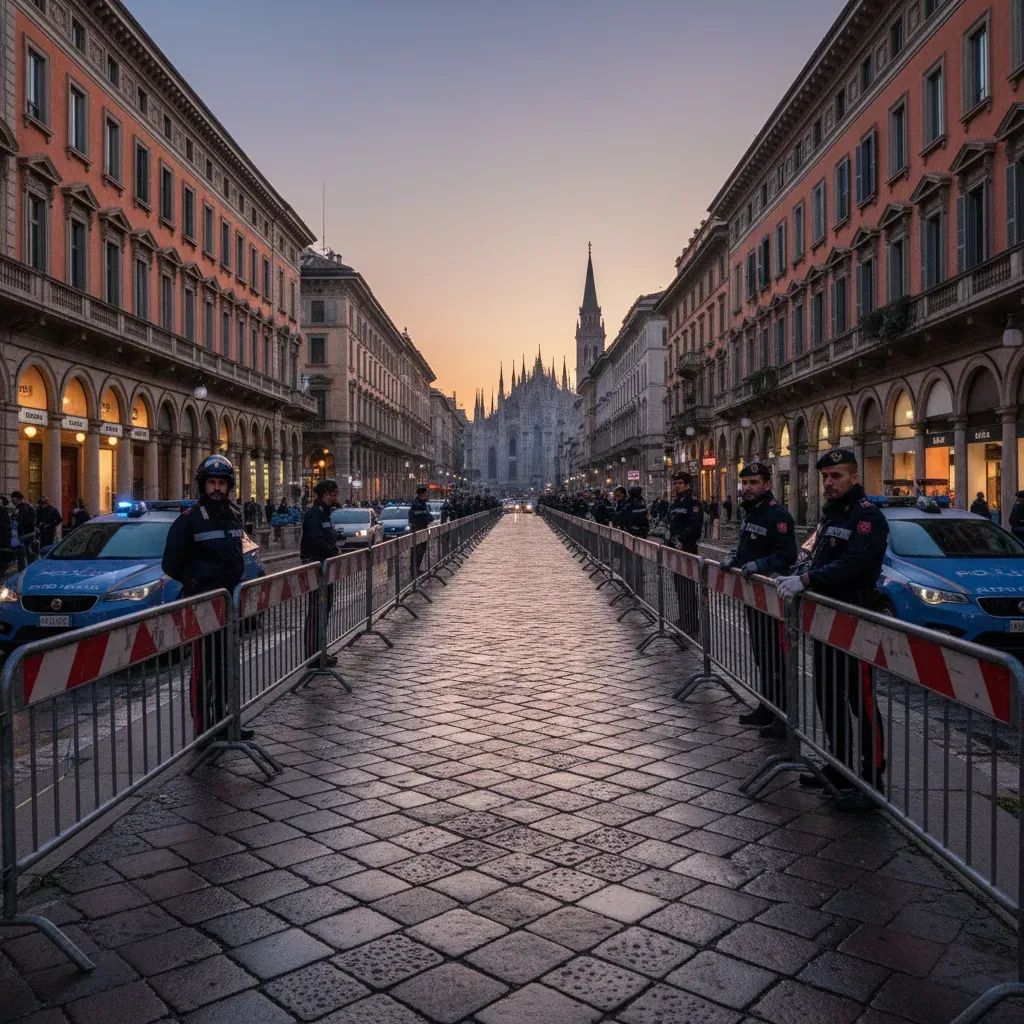
The Italy Carabinieri have charged four individuals with assault following a politically charged attack in Milan that occurred just hours before a large right-wing commemoration march. A 33-year-old man was beaten after tearing down posters advertising the 51st anniversary memorial for Sergio Ramelli, a teenager killed during Italy's violent "Years of Lead" period in 1975.
Why This Matters
• Political violence resurfaces: The assault underscores ongoing tensions around historical commemorations in Milan, a city still grappling with the legacy of the 1970s extremism.
• Four suspects identified: All four men, aged 35 to 37, are described as right-wing militants with prior police records for similar offenses.
• Timing was deliberate: The attack took place near Via Aselli, the very zone where participants gathered the next day for the annual Ramelli procession.
The Attack: What Happened
Late on the night of April 28, the victim was approached in the Città Studi district near Via Amedeo after he was seen removing posters commemorating Ramelli. According to witness statements and police reports, several individuals exited a Volkswagen Golf and assaulted him with kicks and punches before fleeing in the vehicle. The man sustained minor injuries to his lip and eyebrow and was transported to Città Studi hospital in stable condition.
Italy Carabinieri from the Milan Porta Monforte Company launched an immediate investigation, acquiring surveillance footage from cameras in the area. Within 24 hours, they had identified and formally denounced the four suspects for assault and battery. All four are Italian nationals with documented ties to right-wing extremist circles and previous run-ins with law enforcement on similar charges.
The location of the assault is significant: it sits directly along the route of the annual memorial march, which traditionally begins at Piazzale Gorini and concludes at Via Paladini, where a plaque marks the site of Ramelli's fatal beating in 1975.
Who Was Sergio Ramelli?
Sergio Ramelli was an 18-year-old student and member of the Fronte della Gioventù, the youth wing of the neo-fascist Italian Social Movement (MSI). On March 13, 1975, he was attacked by a group linked to Avanguardia Operaia, a far-left extraparliamentary organization, using wrenches and iron bars. He died 47 days later, on April 29, 1975, after never regaining consciousness.
His death occurred during the "Years of Lead" (Anni di Piombo), a period spanning the late 1960s through the early 1980s marked by extreme ideological polarization, street battles, and domestic terrorism from both the far right and far left. Milan was a particularly volatile flashpoint. Ramelli himself had been expelled from his technical high school after being subjected to a "people's trial" by left-wing students who labeled him a fascist for writing an essay condemning Red Brigades killings.
The perpetrators were identified a decade after the crime. In a trial that ran from 1987 to 1990, eight individuals—including Marco Costa, Giuseppe Ferrari Bravo, and Claudio Colosio—were convicted of voluntary homicide. Investigators discovered that a photograph of Ramelli had been circulated among the attackers to facilitate his identification.
The 2026 Commemoration: A Show of Force
On April 29, 2026, participants marched through Milan to mark the 51st anniversary of Ramelli's death, along with fellow victims Enrico Pedenovi and Carlo Borsani. Attendance estimates ranged from approximately 1,000 to 2,000 marchers. Participants included members of CasaPound, Rete dei Patrioti, Forza Nuova, and Lealtà Azione—all organizations classified as right-wing or far-right. The procession ended at the mural dedicated to Ramelli in Via Paladini, where attendees performed the "presente" ritual and gave Roman salutes, a gesture that remains deeply controversial in Italy due to its association with fascism.
The march proceeded without major incidents, though witnesses reported hearing insults shouted from a balcony toward the crowd. No counter-response was noted from the marchers. Security was managed by a significant deployment of Italy law enforcement, including officers from the Rome-based Digos (Division for General Investigations and Special Operations) and local Carabinieri units.
Political Fallout and the Cost of Memory
The assault triggered a brief political firestorm. Riccardo De Corato, a deputy from the Fratelli d'Italia party (Italy's ruling party), initially suggested the victim "wanted to get himself into it" by removing the posters. Following public backlash, De Corato issued a clarification condemning the violence while reaffirming his party's commitment to remembering Ramelli as a rejection of all political violence.
The incident is part of a broader pattern. Milan has witnessed a resurgence of politically motivated clashes in 2026. In February, a demonstration against the Milan-Cortina Winter Olympics drew 10,000 protesters and devolved into violent confrontations with police, leaving multiple officers injured. On April 25, the Liberation Day parade saw the Brigata Ebraica (Jewish Brigade) heckled and escorted away by police after antisemitic insults were hurled by demonstrators.
What This Means for Residents
For those living in Milan, the Ramelli commemoration has become an annual flashpoint that reflects the city's unresolved political tensions. The presence of thousands of right-wing activists in the city center, coupled with pre-event violence, underscores the challenges local authorities face in balancing freedom of assembly with public safety.
Residents in the Città Studi and Porta Romana districts should be aware that the last week of April typically sees increased police presence, road closures, and heightened risk of confrontation. The Italy Ministry of the Interior has not announced changes to public assembly laws, but security protocols for politically sensitive commemorations are under review following the assault.
The victim in this case has not been publicly identified, and it remains unclear whether he will face charges for removing the posters. Italy's anti-fascism statutes, enshrined in the Scelba Law of 1952 and reinforced by the Mancino Law of 1993, prohibit the reconstitution of the fascist party and the public display of fascist symbols. However, commemorations of historical figures like Ramelli occupy a legal gray zone, particularly when they avoid overt fascist iconography.
A City Still Divided
Milan's relationship with its political past remains fraught. The "Years of Lead" claimed hundreds of lives across Italy, and the scars are still visible in the city's public memory. Ramelli's death is commemorated annually by the right; on the same streets, left-wing groups honor victims of right-wing violence, including Carlo Giuliani and the victims of the Piazza Fontana bombing.
The Italy police have emphasized that they are treating the April 28 assault as a criminal matter, not a political one, despite the obvious ideological overtones. The four suspects are expected to face trial in the coming months. If convicted, they could receive sentences ranging from several months to several years, depending on the severity of injuries and whether aggravating factors—such as premeditated group violence—are proven.
For now, the case serves as a reminder that Milan's political climate, while far from the bloodshed of the 1970s, remains combustible. The city's history is not buried—it walks the streets every spring, and sometimes it still draws blood.


