
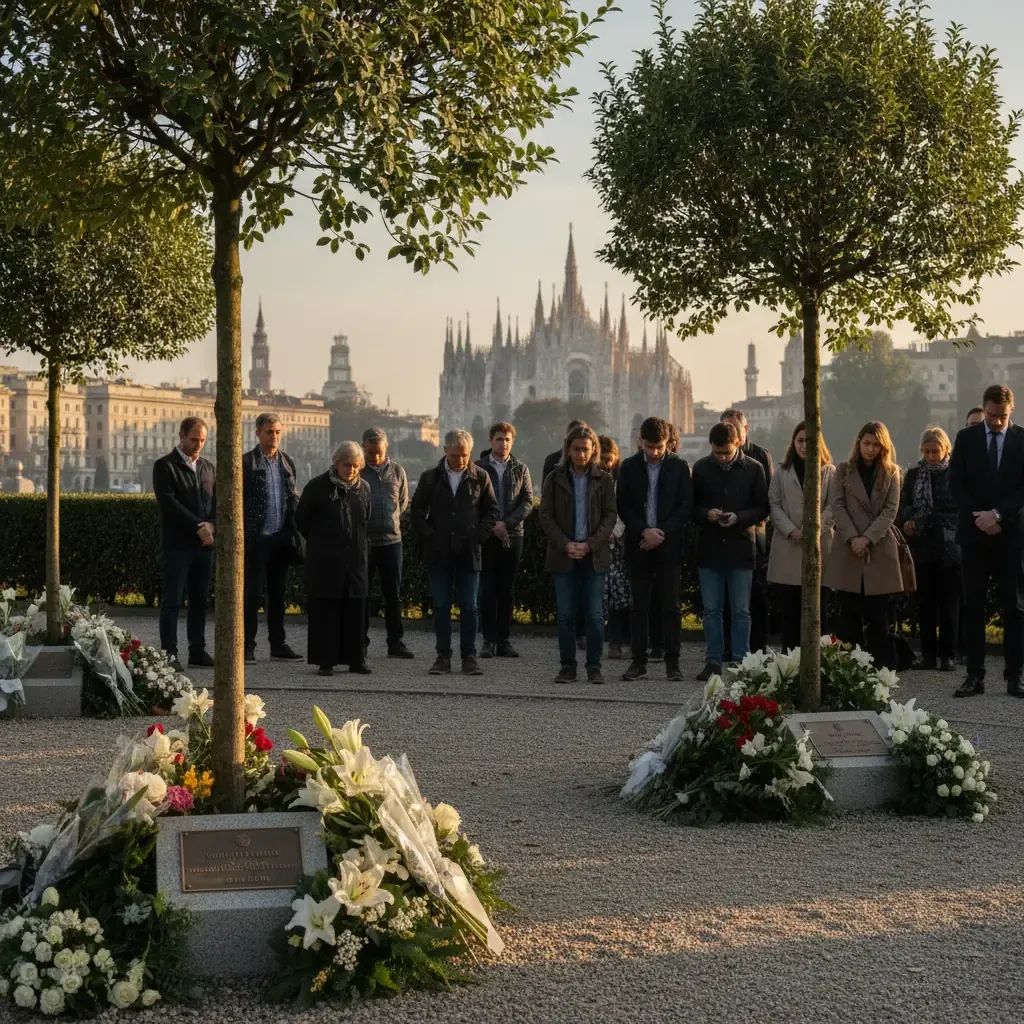
Democracy requires defenders who are willing to sacrifice, and this principle stands at the center of Milan's March 11 observance. The Giardino dei Giusti di tutto il mondo at Monte Stella will induct five new honorees into its permanent memorial—a constitutional architect, an American civil rights icon, two women working across Israeli-Palestinian lines to build coexistence, and a Russian artist imprisoned for exposing censored war crimes. The day's theme, "The Righteous for Democracy: Dialogue and Nonviolence to Build Peace," reflects an urgent conviction: democracy is not a settled achievement but an active, vulnerable practice requiring each generation to choose resistance over complicity.
Why This Matters
• Public ceremony: March 11, 2026, 10 AM at Monte Stella (Via Cimabue, MM1 metro QT8 stop). Open to the public; schools across Milan have been invited to send delegations.
• Permanent installation: Each honoree receives a tree, commemorative plaque, and lasting presence in a pedagogical space that welcomes school visits, guided tours, and civic gatherings year-round.
• Strategic pivot: The Fondazione Gariwo has expanded the garden's historical focus to include living democracy defenders—shifting from Holocaust remembrance alone to contemporary struggles against authoritarianism, suppressed truth, and frozen conflicts.
The Constitutional Architect
Piero Calamandrei shaped Italian democracy at its foundational moment. A legal scholar and antifascist operative, he spent the 1940s drafting institutional safeguards into the 1948 Constitution—provisions designed to prevent totalitarian backsliding by anchoring power in judicial independence, separation of authority, and constitutional review. His intellectual DNA remains embedded in Italian law curricula and courtroom precedent. Yet Milan's choice to honor him alongside living activists sends a specific message: constitutional principles cannot ossify into historical memory. They must be actively defended, reinterpreted, and fought for in each political moment.
The Icon of Nonviolent Moral Authority
Martin Luther King occupies unique cultural weight in this memorial. His placement alongside contemporary activists from Israel, Palestine, Russia, and Italy underscores a core pedagogical claim: the logic of peaceful resistance to injustice transcends geography and historical era. King's writings from imprisonment—particularly his 1963 "Letter from Birmingham Jail"—argued that injustice anywhere corrupts the possibility of justice everywhere. By pairing King with figures managing contemporary conflicts, Milan's ceremonies translate that principle into actionable framework: dialogue, institutional pressure, and sustained mobilization remain the viable pathways even when violence and authoritarian force seem dominant.
The Bridge-Builder Killed While Sheltering
Vivian Silver arrived at Kibbutz Be'eri in 1990, already a veteran of peace work and women's rights organizing. Over three decades, she directed the Negev Institute for Strategies of Peace and Development, transported Palestinian patients through military checkpoints to Israeli hospitals via Road to Recovery, co-founded the Arab-Jewish Center for Equality, Empowerment and Cooperation (AJEEC) alongside Palestinian activist Amal Elsana Alh'jooj, and volunteered with Project Rozana. In 2014, after Gaza's war, she co-launched Women Wage Peace, which mushroomed into Israel's largest grassroots peace organization, mobilizing thousands of Israeli and Palestinian women into shared dialogue and civic action.
On October 7, 2023, as Hamas militants attacked Be'eri, Silver sheltered in her safe room. During those hours—knowing attackers surrounded her home—she telephoned her sister, messaged her son Yonatan at 10:54 AM, and gave a live radio interview arguing that the very violence occurring outside her walls proved an urgent need for peace. Five weeks later, DNA analysis identified her carbonized remains. A Gaza community kitchen was named for her in August 2024. Her son established the annual Vivian Silver Impact Award, honoring one Arab woman and one Jewish woman advancing Arab-Jewish partnership and women's leadership.
Her inclusion acknowledges a difficult truth: peace architects are often killed in the conflicts they struggle to resolve. Yet her five decades of practical work—her own resources spent, her own body moved across war zones—created relationships and institutions that survived her death. That infrastructure continues through her colleagues and son's foundation.
The Camp-Born Organizer
Reem Al-Hajajreh was born inside Dheisheh refugee camp in 1982. She earned degrees in Business Administration and Social Work from Al-Quds Open University, then founded Women of the Sun in 2021. The organization has grown into a network of thousands of Palestinian women across the West Bank and Gaza engaged in trauma healing, environmental projects, girls' leadership development, and direct peacebuilding collaboration with Israeli women's movements, including Women Wage Peace.
Al-Hajajreh has traveled to the French Parliament and the Bled Strategic Forum advocating for resumed negotiations and conflict resolution. TIME magazine designated her one of its 2024 Women of the Year; she received the DVF Award and saw her organization nominated for the Nobel Peace Prize in 2024 before winning the Vigdís Prize for Women's Empowerment in 2025.
Milan's decision to honor both Silver and Al-Hajajreh simultaneously—rather than sequentially—conveys a subtle organizational message: peace emerges from multiple positions, sometimes opposing ones, and demands trust between people who fundamentally disagree. One woman worked from inside an Israeli kibbutz; the other works from the refugee camp where she was born, speaking from inside Palestinian statelessness. Both chose dialogue over despair.
The Censored Artist
Aleksandra "Sasha" Skochilenko, a Russian poet and visual artist, was arrested in April 2022 in Saint Petersburg. Her method of resistance was intimate and precise: she replaced supermarket price tags with handwritten anti-war messages containing information about the Russian invasion that state media had buried—specifically, details of the bombing of an art school in Mariupol.
In November 2023, she was sentenced to seven years under Russia's "fake news" law. Amnesty International classified her a prisoner of conscience; Memorial recognized her as a political prisoner. During detention, her celiac disease and heart condition deteriorated from inadequate medical care and incompatible dietary restrictions. On August 1, 2024, she was freed in the largest East-West prisoner swap since the Cold War, involving Russia, the United States, and multiple European nations. She now lives in Germany.
Skochilenko's inclusion signals that the Giardino dei Giusti honors not only peacemakers but those who resist authoritarian erasure of truth. Replacing a price tag was mundane yet dangerous—substituting neutral commercial information with forbidden facts. That juxtaposition mirrors how totalitarianism operates: it colonizes even the smallest public spaces, requiring constant surveillance and intervention in ordinary commerce, language, and memory.
How Milan Is Framing Democratic Resilience
The Comune di Milano embedded this ceremony within a broader municipal strategy for democratic maintenance. Alongside the tree-planting ritual, Fondazione Gariwo presented the "Carta della democrazia" (Charter of Democracy) to the City Council. The charter argues that combating hate speech and authoritarian drift is fundamentally a cultural and educational challenge, not primarily a legal or policing problem.
This framing shifts responsibility: democracy's defense depends on civic participation, community dialogue, and sustained critical engagement—not police enforcement alone. The Fondazione Gariwo, the Unione delle Comunità Ebraiche Italiane (Union of Italian Jewish Communities), and the Comune di Milano deliberately scheduled the ceremony for March 11 instead of the European Day of the Righteous (March 6) to maximize school attendance.
Gabriele Nissim, president of Fondazione Gariwo, Giorgio Mortara representing UCEI, and municipal officials will speak. Relatives and colleagues of each honoree will offer personal testimony—a deliberate choice to ground abstract principles in embodied story.
What the Garden Represents
Since its inception, the Giardino dei Giusti di tutto il mondo at Monte Stella has memorialized over 1,000 individuals: Holocaust rescuers, witnesses to modern atrocities, contemporary defenders of press freedom and democratic institutions. The strategic evolution in recent years has been pronounced: Gariwo expanded from primarily historical memory work into active documentation of living defenders. Four of this year's five honorees lived or live amid active conflict or authoritarian regimes; only Calamandrei represents a historical rupture largely transcended.
The implicit message is unmistakable: the struggle for democracy is not concluded but ongoing, sometimes lethal, requiring each generation to choose which side of history it occupies.
Why This Moment, Why Milan
Italy's financial and media capital has positioned itself as institutional counterweight to populist movements, disinformation ecosystems, and the weaponization of public discourse. Milan hosts international forums on digital rights, funds civic literacy in schools, and now dedicates permanent public space to voices and narratives that model dialogue over division.
The ceremony arrives amid European democratic stress. Populist movements gain ground. Disinformation spreads. Faith in multilateral institutions erodes. Against this backdrop, Fondazione Gariwo and the Comune di Milano are arguing that democracy is not a technical problem awaiting solution but a practice requiring sustained attention, sacrifice, and choice.
For residents engaging the garden, the five new figures offer not abstractions but embodied decisions under pressure. Calamandrei could have remained a law professor; he chose legal resistance to fascism. Silver could have lived in relative Israeli security; she chose to run aid operations in Gaza. Skochilenko could have remained silent; she chose to risk imprisonment to replace a price tag with truth. These were not inevitable but deliberate choices, made by people who calculated the stakes warranted the risk.
The ceremony concludes with tree planting and collective silence. Attendees may bring flowers or written messages to place at each new plaque. The garden remains accessible year-round; school groups can arrange guided tours through the Fondazione Gariwo website, ensuring that the five new stories become part of Milan's ongoing civic pedagogy.


