
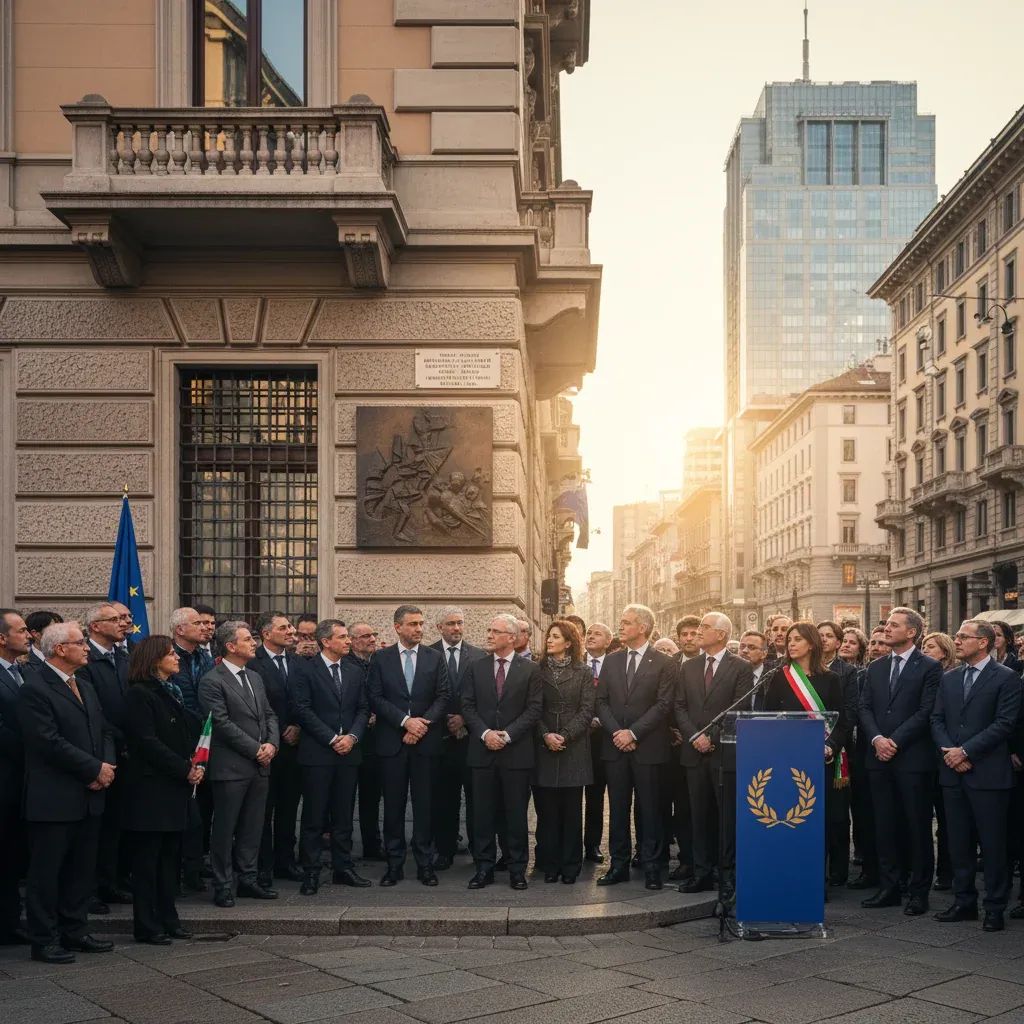
Milan's municipal government will officially rename a street on March 19, 2025 in honor of Giuseppe Pinelli, the anarchist railway worker who fell to his death from a police headquarters window in the night of December 15-16, 1969 while being questioned about the Piazza Fontana bombing. The ceremony transforms Via Micene into "Via Giuseppe Pinelli – Anarchico, partigiano", placing a permanent marker of historical reckoning just steps from where Pinelli once lived with his family.
Why This Matters
• Historical justice: The street dedication recognizes Pinelli as the 18th victim of Italy's deadliest postwar terror attack—not of the explosion itself, but of the repressive aftermath that followed. He was falsely accused and died under suspicious circumstances during police questioning.
• Personal geography: Via Micene sits adjacent to the home Pinelli shared with his wife Licia (who died in 2024) and daughters Claudia and Silvia—many locals already call it by his name informally.
• Historical accountability: The move caps decades of civic pressure to acknowledge the "strategy of tension" era, when far-right bombers were shielded while anarchists faced violent repression during the 1960s–1980s period of political violence.
The Man Behind the Name
Giuseppe Pinelli was born in Milan in 1928 and worked for the national railway. During World War II, he served as a partisan courier in the Resistance. In postwar Milan, he helped found the Sacco and Vanzetti Circle and the Ponte della Ghisolfa anarchist association, while also acting as secretary for the Italian branch of the Anarchist Black Cross, a prisoner-support network.
On December 12, 1969, a bomb ripped through the Banca Nazionale dell'Agricoltura in Piazza Fontana, killing 17 people and injuring 88. Simultaneous blasts and failed devices in Rome marked the start of what historians call the "strategy of tension"—a campaign to sow panic, discredit the left, and justify authoritarian governance as Italy teetered on the brink of political upheaval.
Police rounded up more than 80 anarchists in the bombing's immediate aftermath, including Pinelli. He was taken to Milan's questura on the night of the attack and held without formal arrest for over 48 hours, breaching legal detention limits.
A Death That Shocked Italy
Shortly before midnight on December 15, Pinelli plummeted from a fourth-floor window of the police headquarters. Authorities, led by Police Chief Marcello Guida and Commissioner Luigi Calabresi, initially claimed suicide, asserting that Pinelli had leaped out after his alibi collapsed. That narrative crumbled when investigators confirmed his alibi was solid. The official story shifted to "accidental fall", then to a vague "active illness" that supposedly triggered the drop.
Forensic evidence and witness testimony raised immediate red flags. The position of Pinelli's body suggested he was unconscious or already dead before exiting the window. No credible judicial conclusion ever emerged. A 1972 investigation led by Judge Gerardo D'Ambrosio ruled out both suicide and homicide, settling on the nebulous "active illness" theory and exonerating all five officers present. Calabresi himself was found not to be in the room at the moment of the fall, though he remained a lightning rod for public anger and was assassinated in May 1972 by members of a far-left militant group.
Decades later, court proceedings established that the Piazza Fontana bombing was the work of Ordine Nuovo, a neo-fascist paramilitary cell, with circumstantial links to Italian and possibly U.S. intelligence services seeking to prevent Italy from drifting toward communist influence. Pinelli's name was fully cleared, cementing his status as a victim of state misconduct during one of the republic's darkest chapters.
Licia Pinelli's Five-Decade Campaign
Licia Pinelli spent 55 years demanding transparency. She compiled an exhaustive archive—newspaper clippings, legal filings, personal letters—that now forms the backbone of the "Archivio Licia Rognini Pinelli" project, a public resource on the Piazza Fontana period. Her death in November 2024 at age 96 prompted the Milan municipal council to posthumously award her the Ambrogino d'Oro, the city's highest civic honor, in January 2025. Mayor Giuseppe Sala described her as someone who "transformed personal grief into a collective fight for truth and dignity."
The street renaming was approved by the council roughly a year ago, following a motion co-sponsored by Democratic Party and Green Party councillors. The official decree was published in the municipal register this week, setting the March 19 ceremony in stone.
What This Means for Residents
For Milanese navigating the city's historical memory, the new street name serves as both a geographic marker and a pedagogical tool. Visitors and students exploring the Porta Venezia and Città Studi neighborhoods will encounter Pinelli's biography embedded in everyday wayfinding, a reminder that urban space can double as civic classroom.
The timing also coincides with renewed debate over how Italy confronts its past. Recent scholarship and journalism have revisited the role of intelligence agencies and foreign powers in shaping domestic terrorism, making the Pinelli story freshly relevant for younger generations who never experienced those turbulent decades.
Historical Precedent and Memory Politics
Milan has been cautious in memorializing figures from the anni di piombo. The Pinelli renaming follows years of lobbying by civil-society groups, including the ANPI (National Association of Italian Partisans), which views him as emblematic of how anti-fascist resistance extended beyond World War II into the republic's consolidation period.
Playwright Dario Fo immortalized the case in his 1970 satire Morte accidentale di un anarchico (Accidental Death of an Anarchist), which toured globally and kept Pinelli's story in the public eye for decades. The play's title became shorthand in Italy for institutional cover-ups.
The March 19 ceremony is expected to draw municipal leaders, family members, and activist groups. No official program has been released, but sources indicate Mayor Sala will deliver remarks and that a commemorative plaque will be installed alongside the new street sign.
A Street Name as Accountability
By anchoring Pinelli's memory in physical geography—and doing so on a street his widow and daughters walked daily—Milan's municipal government offers a form of accountability that courts never delivered. The addition of "Anarchico, partigiano" to the street name is particularly significant, explicitly linking his political identity to his partisan service and rejecting the stigma once used to justify his detention and death.
For residents navigating a city still grappling with its past, the renaming signals that historical wounds, however slow to heal, can eventually find formal recognition. Whether that translates into broader reckoning with intelligence-service abuses or judicial reform remains an open question—but in the neighborhoods around Porta Venezia, at least, the question now has a street address.


