
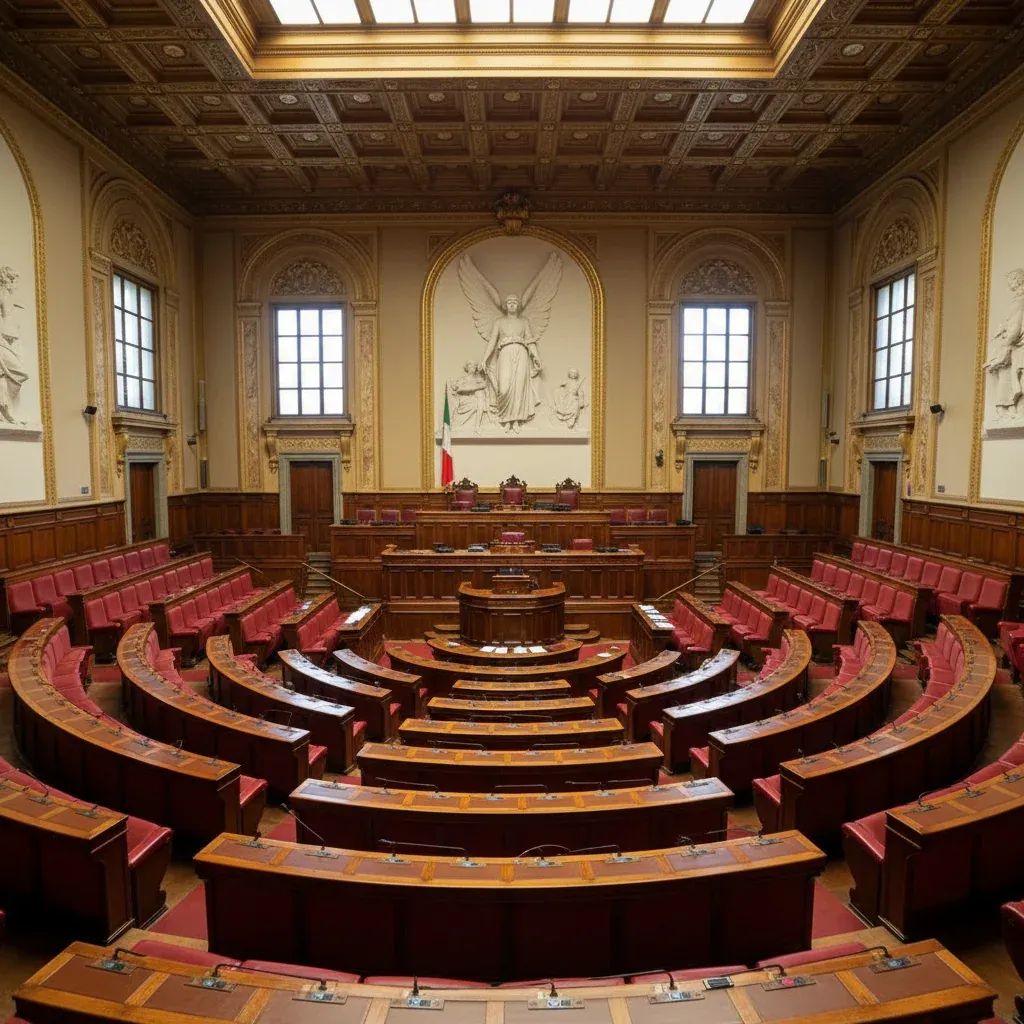
Milan's city leader Giuseppe Sala has signaled a likely shift to national politics once his mayoral term expires in spring 2027, telling Sky Tg24 Live In that "it is possible that you will see me in Parliament." The announcement, delivered without drama or pretense, positions the two-term mayor as a plausible center-left contender for legislative office—though he insists he has no appetite for party leadership.
Why This Matters
• Political continuity: Sala's move to Parliament could consolidate center-left influence in Milan and offer a tested administrator to the national stage.
• Timing: His mayoral mandate ends in spring 2027, aligning with the next general election cycle.
• Coalition dynamics: Sala's candidacy is expected to run through the Democratic Party (PD), despite ideological distance from party leader Elly Schlein.
• Regional impact: Milan voters and businesses may see policy continuity if Sala retains influence over urban and industrial policy from Rome.
What Sala Said—and What He Means
Sala, who has led Milan since June 2016 and secured a second term in October 2021 with nearly 58% of the vote, characterized a parliamentary candidacy as "almost inevitable" given the scarcity of appealing alternatives after more than a decade in municipal government. He has ruled out a third mayoral run, a regional campaign in Lombardy, and any ambition to helm a party or coalition.
"I would like to offer a good contribution," Sala told the network, "but I do not have leadership ambitions."
That statement is both modest and strategic. Sala's decade-plus tenure overseeing Expo 2015 and steering Milan through pandemic recovery, economic transformation, and green infrastructure expansion has made him one of Italy's most visible and effective municipal administrators. His reluctance to claim leadership aspirations likely reflects both genuine wariness of party infighting and a calculation that positioning himself as a pragmatic operator—not a factional chief—will maximize his utility and appeal across the fractured center-left.
The Milan Record
Sala's record offers a preview of what he might prioritize in Parliament. His second mayoral term has centered on environmental ambition: a pledge to cut CO2 emissions by 45% by 2030, expand green space, and electrify public transport. He has clashed openly with the Meloni government over housing policy, accusing Rome of an "ultraliberal" approach to short-term rentals that he says worsens affordability in Milan. He has also criticized the government's tendency to shift security responsibilities to mayors without corresponding resources.
In November 2025, Sala argued that the Meloni administration was "amply favoring Rome over Milan" and called for special powers for Milan comparable to those granted the capital. By March 2026, his frustration had deepened: he lamented the government's focus on constitutional reform over territorial problem-solving and accused the administration of "continuous removal of the ignominy of fascism."
Those confrontations have sharpened Sala's profile as a center-left voice willing to challenge the right-wing government directly—an asset for a future legislative campaign.
Coalition Questions and Center-Left Cohesion
Sala's political home is the center-left, but his exact place within it remains fluid. He is not a card-carrying member of the Democratic Party (PD), though he has worked closely with the party and won with its support. In March 2021, he signed the European Greens' Charter of Values, signaling alignment with the ecological wing of the European left without joining a national party structure.
His parliamentary candidacy is expected to proceed through the PD, despite his occasional public distance from Schlein's leadership. Sala has stressed the importance of maintaining "the widest possible political space" within the center-left and has warned against what he calls a "fascination with opposition" among some on the left. That language suggests he views electoral victory as more important than ideological purity—a posture that could either help unify the coalition or frustrate its more ideological factions.
What This Means for Residents
For people living in Milan and the broader Lombardy region, Sala's transition to national politics carries several implications:
• Municipal succession: Sala's departure will trigger a mayoral race in 2027, likely pitting the PD and its allies against a united center-right bloc. The outcome will determine whether Milan's green and housing policies continue or shift.
• Legislative influence: A Sala seat in Parliament could amplify Milan's voice on urban policy, infrastructure funding, and climate legislation—or dilute his local focus if he is assigned to committees unrelated to his expertise.
• Housing and cost of living: Sala has made affordable housing a signature issue. If he carries that agenda to Rome, residents may see national action on short-term rental regulation and rent control—or continued stalemate if the Meloni government retains power.
• Transport and infrastructure: Sala has lobbied for expanded funding for Milan's metro and regional rail. A parliamentary seat could give him direct leverage over budget allocations, especially if the center-left returns to government.
The Broader Political Landscape
Sala's announcement comes at a moment of fragmentation and uncertainty for the Italian center-left. The PD under Schlein has struggled to consolidate support, and smaller parties—Europa Verde, Azione, Italia Viva—compete for overlapping constituencies. Sala's pragmatic, accomplishment-driven brand could serve as a bridge or a wedge, depending on how coalition negotiations unfold ahead of the 2027 general election.
His insistence that he does not want to be "a burden" or secure a role "just because I was mayor" suggests he is aware of the risk of being parachuted into a safe seat as a reward rather than as a functional legislator. Whether he can translate municipal credibility into parliamentary effectiveness will depend on the role he negotiates, the committee assignments he secures, and the coalition's overall electoral performance.
For now, Sala's trajectory is clear: from Milan's city hall to Rome's legislature, with a mandate built on environmental policy, urban management, and open friction with the Meloni government. Whether that translates into legislative influence or merely adds another voice to an already crowded opposition will become evident in the months ahead.


