
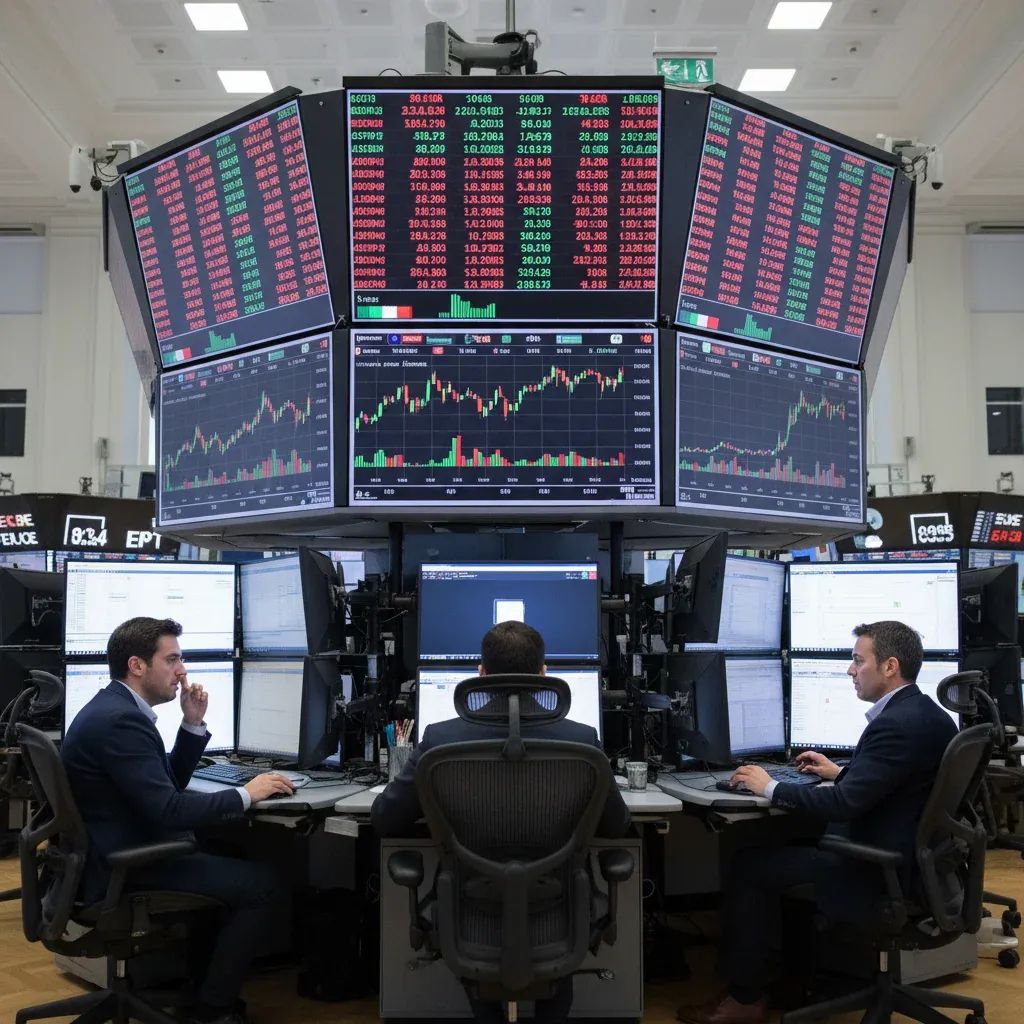
The Milan Stock Exchange shed 1.01% today as European markets absorbed the ongoing diplomatic freeze between Washington and Tehran, a standoff that has sent crude oil soaring above $107 per barrel and injected fresh volatility into an already uncertain continental investment climate.
Why This Matters
• Energy costs face upward pressure: Brent crude jumped 1.9% to breach $107/barrel, while natural gas in Europe settled at €45.40 per megawatt-hour following a 2% rise—signaling potential increases to household bills and industrial margins in the coming weeks.
• Italian borrowing costs edge higher: The BTP-Bund spread widened to 81 basis points at market close, with the 10-year Italian yield rising to 3.84%, signaling increased market nervousness.
• Tech stocks provide a cushion: STMicroelectronics and Prysmian rallied on strong earnings, offering a rare bright spot in an otherwise gloomy session.
Geopolitical Gridlock Weighs on Sentiment
European equity indices closed the day in negative territory, dragged down by persistent uncertainty over the Strait of Hormuz, the narrow waterway through which roughly one-fifth of global oil passes. Despite a Pakistan-mediated ceasefire that has now been extended beyond its original two-week term, Iran has refused to return to negotiating tables in Islamabad, citing the U.S. naval blockade on Iranian ports as a violation of truce commitments.
The impasse has unsettled markets amid broad-based concern over geopolitical risk. The pan-European Stoxx 600 lost half a percentage point, with industrials and pharmaceuticals leading declines. Piazza Affari's FTSE MIB dropped 1.01% to close at 47,531 points, while Paris fell 1.12%, Madrid shed 1.25%, and Frankfurt managed to limit losses to 0.47%. London's FTSE 100 declined 0.66%.
Iranian Foreign Minister Abbas Araghchi is expected to visit Pakistan before the end of April, raising hopes for potential negotiations, but U.S. President Trump has publicly stated there is "no time pressure" to resolve the standoff, emphasizing instead the economic leverage afforded by the naval cordon. Washington insists it controls the strait entirely and has begun what Pentagon officials term a "global blockade" to choke Iranian exports.
Oil Rally Accelerates, Gas Climbs
The escalating rhetoric has propelled energy prices higher for European economies already grappling with elevated inflation. WTI crude climbed 1.6% to $97.30/barrel, while Brent surged to $107, a level not seen since the early weeks of the crisis. Analysts note that even swift diplomatic resolution would not bring immediate relief, as production facilities in Gulf states have sustained damage and alternative shipping routes remain costly.
Natural gas futures in Europe settled at €45.40 per megawatt-hour, up 2% for the session, as traders priced in the risk of prolonged disruption. The TTF benchmark in Amsterdam had briefly fallen 8% earlier in the week on rumors of a breakthrough, only to rebound as talks stalled.
Italy's Market: Energy Giants Shine, Luxury and Defense Stumble
Within the Milan exchange, the session's winners and losers reflected the broader tension between geopolitical risk and corporate fundamentals. Saipem led gainers with a 2.27% rise, buoyed by expectations that higher oil prices will fuel upstream investment. Prysmian added 1.2%, while Eni climbed 1.01% following a solid quarterly earnings report that underscored the energy major's resilience amid volatile commodity markets.
On the flip side, Avio plunged 3.95%, extending a multi-day slide that has made the aerospace stock the session's worst performer. Luxury names took a beating as investors rotated out of discretionary sectors: Brunello Cucinelli dropped 3.2%, Moncler fell 3.1%, and Fincantieri shed 3.1%. Stellantis, the automotive giant, declined 2.95%, weighed down by concerns over supply chain costs and weakening consumer sentiment.
STMicroelectronics bucked the trend with a 2.6% gain, riding momentum from the previous session's post-earnings surge. The semiconductor maker's results reinforced optimism about Europe's push for digital sovereignty and its growing role in the global AI infrastructure race, even as broader tech sentiment remains cautious.
What This Means for Residents
For households and businesses across Italy, rising energy costs present a concrete concern. Gasoline and diesel prices are likely to drift higher in the coming weeks as refiners pass through the cost of elevated crude. Electricity bills could follow in the weeks ahead, particularly if natural gas remains elevated through the spring months.
Investors with exposure to Italian government bonds should monitor the widening spread closely. While 81 basis points remains well below crisis levels, the trend reflects growing concern about fiscal sustainability amid higher borrowing costs. The European Central Bank has so far maintained a dovish stance, but persistent inflation—fueled in part by energy shocks—could force a reassessment of rate policy later this year.
On the corporate front, energy-linked equities like Eni and Saipem may offer a hedge against further oil price gains, while tech champions such as STMicroelectronics stand to benefit from Europe's digital infrastructure investments. The sector continues to attract capital as the continent works to strengthen semiconductor manufacturing and AI capabilities.
Currency and Precious Metals Hold Steady
The euro traded relatively flat against the dollar at $1.1687, as currency markets awaited clearer signals from central banks on both sides of the Atlantic. Gold hovered just below $4,700 per ounce, while silver approached $75, with both metals benefiting from safe-haven demand but failing to break decisively higher as traders hedged bets on diplomatic outcomes.
Broader European Landscape: Tech Gains Offset by Energy Concerns
The divergent performance of technology and energy sectors underscores the complex calculus facing European investors. Technology has emerged as a productivity driver, with AI-related spending forecast to grow at double-digit rates and the continent racing to reduce dependence on U.S. cloud providers. Semiconductor manufacturing, optical networking, and data center infrastructure are all drawing capital and support from government initiatives designed to bolster sovereign digital capabilities.
Meanwhile, the energy sector remains a source of both opportunity and risk. The transition toward climate neutrality requires unprecedented investment in renewables, hydrogen, and smart grids, but the shift is hampered by aging infrastructure, permitting delays, and the immediate challenge of securing stable, affordable supply. Rising carbon costs add another layer of complexity to industrial planning.
In the near term, the interplay between Hormuz-driven oil volatility and robust tech earnings will continue to dictate market direction. Traders are watching for any sign of movement in U.S.-Iran diplomacy, while corporate earnings season provides a reality check on whether European firms can maintain margins in a high-cost, high-uncertainty environment. The next catalyst could come from Islamabad, where Pakistani mediators are working to facilitate talks—but for now, caution remains the order of the day across Piazza Affari and its continental peers.


