
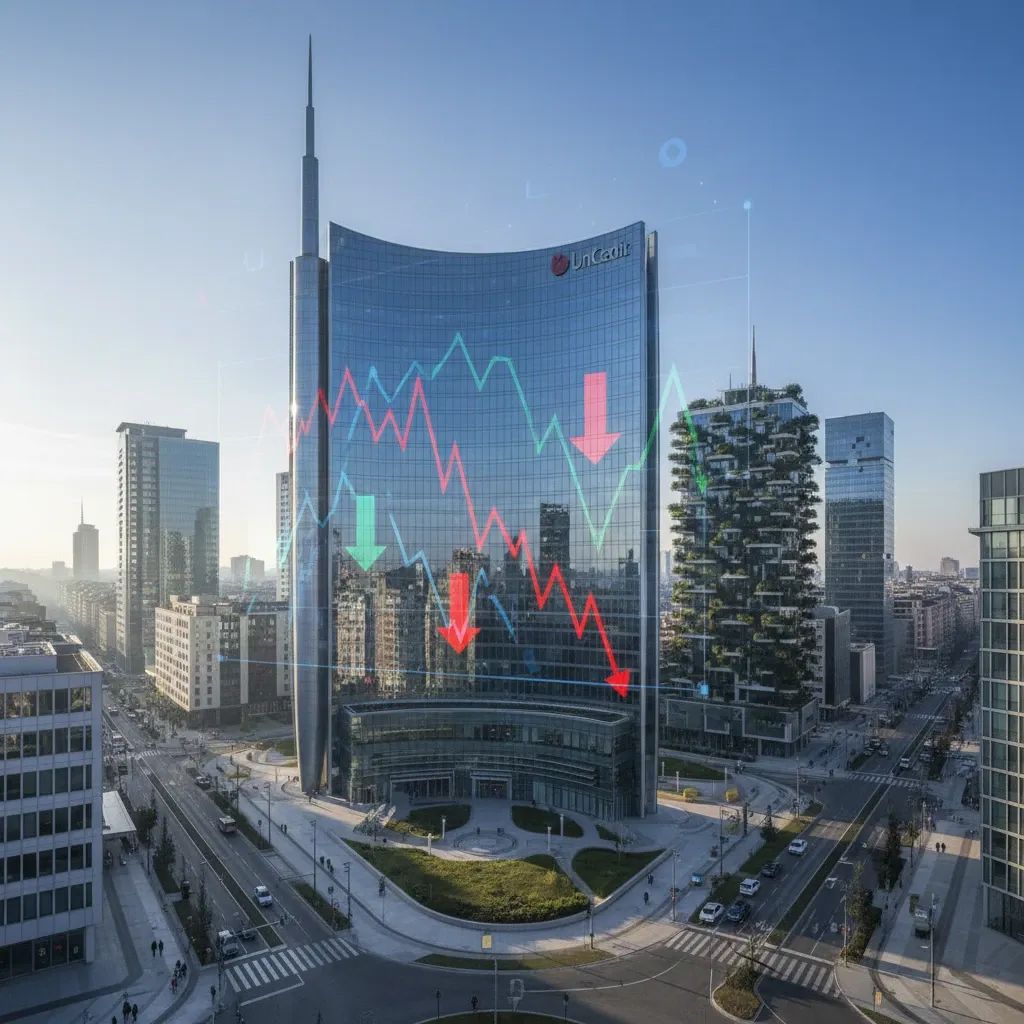
The Italy stock exchange rebounded sharply on Tuesday, with the benchmark FTSE Mib index surging 2.67% to close at 45,201 points, reversing three consecutive sessions of losses. The rally arrived as geopolitical anxiety eased following U.S. President Donald Trump's assertion that the Iran conflict is "practically complete," triggering a sharp retreat in crude prices that had threatened to derail the fragile European economic recovery.
Why This Matters for Italy:
• WTI crude plummeted approximately 10% to around $85 per barrel, alleviating inflation fears and reducing pressure on the European Central Bank to maintain elevated interest rates.
• Banking stocks led the charge, with UniCredit jumping 5.72%, reflecting investor confidence that lower energy costs will stabilize economic growth across the eurozone.
• Milan outperformed most European peers, signaling that Italy's export-oriented sectors—particularly industrials and luxury goods—are poised to benefit from reduced supply chain disruptions and freight costs.
The turnaround marks a striking departure from the turbulence that gripped European markets throughout the previous 11 days, when military operations involving the United States, Israel, and Iran sent crude prices spiking and stoked fears of prolonged disruptions through the Strait of Hormuz, a chokepoint for roughly 20% of global oil exports. The FTSE Mib had shed 1.28% on Monday as investors dumped risk assets in favor of safe havens like gold and U.S. Treasuries.
The Geopolitical Catalyst
Trump's declaration that the war is nearing its end—paired with an announcement that the U.S. Navy will escort tankers through the Strait of Hormuz—offered immediate relief to traders who had priced in prolonged volatility. The result was a cascading sell-off in crude futures, with WTI collapsing to approximately $83-85 by Tuesday afternoon. That double-digit decline rippled through equity markets, lifting indices across the continent. Madrid's IBEX 35 climbed 2.9%, Frankfurt's DAX advanced 2.3%, while Amsterdam, Paris, and London all posted gains between 1.6% and 1.9%. Wall Street followed suit, with the Dow Jones up 0.52%, the Nasdaq gaining 0.61%, and the S&P 500 adding 0.38%.
For Italy, the reprieve arrives at a critical juncture. The country's economy is heavily reliant on imported energy, and the recent spike in oil and gas prices had reignited concerns about a return to double-digit inflation—a scenario that would complicate Rome's fiscal balancing act and burden households already grappling with elevated living costs.
What This Means for Italian Residents
The abrupt decline in crude prices translates directly into potential relief at the pump and on utility bills, though the pass-through effect typically lags by several weeks. For Italian households, where energy expenditures represent a significant share of monthly budgets, sustained oil prices in the $80–$85 range could ease inflationary pressure and preserve purchasing power heading into the spring.
Investors with exposure to Italian equities—whether through pension funds, mutual funds, or direct holdings—stand to benefit from renewed confidence in the FTSE Mib. For exporters and small businesses, lower diesel and logistics costs could improve margins, particularly for manufacturers who depend on competitive freight rates to maintain market share in neighboring European countries. The luxury sector, a cornerstone of Italy's export economy, may also see a tailwind as wealthier consumers regain confidence that supply chains will remain intact.
Banking and Tech Power the Rally
Domestic financials and technology stocks drove the day's performance on Piazza Affari. UniCredit's 5.72% surge underscored investor optimism that easing energy costs will support loan demand and stabilize profit margins for Italian banks. STMicroelectronics, the semiconductor giant with significant exposure to automotive and industrial markets, also posted strong gains as traders anticipated a recovery in manufacturing activity once freight and input costs normalize.
Market Outlook and Lingering Risks
Despite Tuesday's rally, geopolitical volatility remains a concern. European equity markets are also navigating divergent monetary policy signals. The European Central Bank has signaled readiness to adjust rates based on inflation data, and a sustained retreat in energy costs could influence expectations for policy adjustments. Italian bond yields, which had widened during the recent turmoil, tightened modestly on Tuesday as investors bet that fiscal pressures would ease if growth stabilizes.
For Italy specifically, the interplay between energy security and fiscal policy remains paramount. Rome's ability to fund infrastructure upgrades, support small and medium enterprises, and manage its debt-to-GDP ratio hinges on avoiding a return to stagflation dynamics. Tuesday's rally offers a reprieve, but the path forward depends on factors largely beyond Italy's control—from OPEC+ production decisions to the durability of any ceasefire in the Gulf.


