
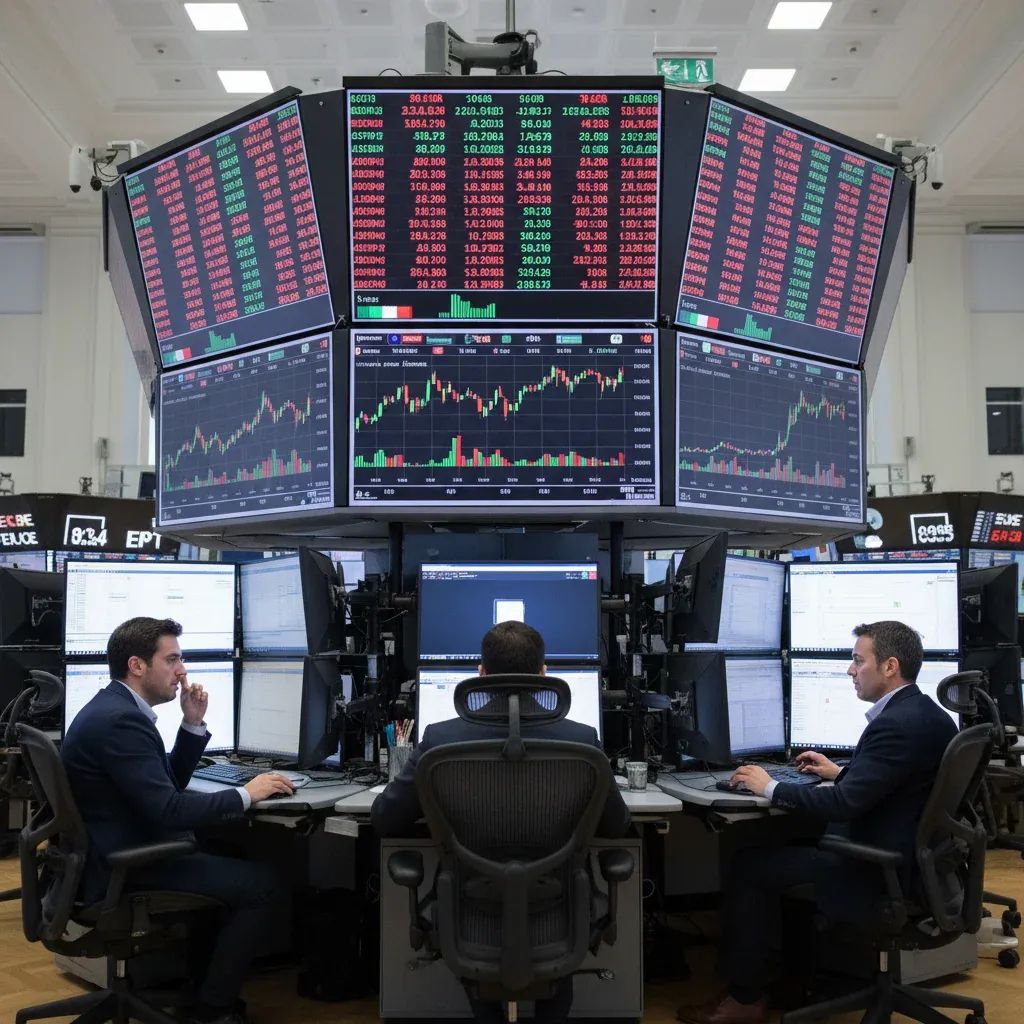
The Italian stock exchange closed 1.15% higher on Tuesday, riding a European rally fueled by fresh purchasing managers' index data that showed mixed but ultimately encouraging signals from the continent's three largest economies.
Italy's Piazza Affari matched Madrid's 1.15% gain, trailing only Paris, which led the session with a 1.25% advance. Frankfurt climbed 0.8%, while London lagged at 0.4%. The move higher came despite choppy U.S. futures trading, suggesting European investors are increasingly betting on regional data rather than waiting for Wall Street's cue.
Why This Matters
• Bond yields ticked up: Italy's 10-year BTP yield rose 1.4 basis points to 3.86%, while the spread over German Bunds narrowed to 85.6 points—a sign of improving confidence in Italian sovereign debt.
• Energy costs eased: Natural gas fell below €50 per megawatt-hour for the first time in weeks, dropping 0.89% to €49.62/MWh, offering relief to households and industry.
• Banking stocks surged: Italian lenders Intesa Sanpaolo (+2.42%), Banco BPM (+1.95%), and BPER Banca (+2.4%) all posted strong gains, reflecting optimism about economic resilience.
• Defense volatility: Leonardo tumbled 5.75% amid uncertainty over the Italian Treasury's imminent choice of a new chief executive, expected by May. The decline reflects investor concerns as CEO Roberto Cingolani has reportedly fallen out of favor with Prime Minister Giorgia Meloni, complicating the succession process.
PMI Data Delivers a Mixed Message
The rally followed the publication of March purchasing managers' indices for Italy, France, and Germany—a trio of reports that painted a nuanced picture of the eurozone's health.
Germany's manufacturing sector surprised to the upside, with the S&P Global PMI revised higher to 52.2 points in March, up from February's 50.9 and marking the strongest expansion since May 2022. Yet the country's services PMI slumped to 50.9 from 53.5, the weakest reading since September, signaling that business confidence is cooling as geopolitical tensions and inflation weigh on consumer-facing industries.
France's economy showed more uniform weakness. The manufacturing PMI held steady at 50.0 points, indicating stagnation, while services contracted further to 48.8 points—the sharpest decline in private-sector activity since October. The composite PMI slipped to 48.8 from February's 49.9, reinforcing concerns that France remains the sick man of the eurozone's big three.
Italy's specific PMI figures were not disclosed in market reports, but traders clearly interpreted the aggregate European data as supportive, given Milan's outperformance relative to Frankfurt and London.
What This Means for Residents
For Italians, Tuesday's market action translates into several tangible developments:
Lower heating bills ahead: Natural gas prices dipping below €50/MWh should flow through to household energy costs over the next billing cycle, especially as the spring transition reduces demand. That's equivalent to roughly a 10% drop from February peaks, when prices hovered near €55/MWh.
Pension fund gains: With the FTSE MIB up 3.17% on April 1 and another 1.15% today, Italian equity portfolios—including many TFR (employee severance funds) invested in the market—are showing solid year-to-date returns despite a turbulent first quarter.
Mortgage rate pressure persists: The uptick in BTP yields to 3.86% means Italian banks' funding costs remain elevated, keeping variable-rate mortgage spreads wide. Fixed-rate offers are unlikely to improve until the European Central Bank signals more aggressive easing, which March's sticky inflation data has delayed.
Energy Sector Shines as Oil Holds Firm
Crude oil prices extended gains, with West Texas Intermediate up 1.3% to $113.86 per barrel and Brent advancing 0.9% to $110.83. Those levels remain elevated by historical standards, driven by geopolitical uncertainty in the Middle East and supply discipline from OPEC+ producers.
Italian energy stocks capitalized on the trend. Saipem—the Milan-based oilfield services giant—rose 1.15%, while Eni added 0.67%. Norway's Subsea7 led the sector with a 4% jump, and other majors including BP (+0.6%), Shell (+0.35%), and TotalEnergies (+0.15%) posted modest gains.
The divergence between rising oil and falling gas prices reflects distinct supply dynamics: liquefied natural gas shipments to Europe have increased as spring reduces heating demand, while oil markets remain tight due to production cuts and fears of Middle Eastern supply disruptions.
Universal Music Rally Steals the Show
The session's standout performer was Universal Music Group, which soared 13.48% to €19.40 after Pershing Square Capital Management unveiled a non-binding takeover proposal valuing shares at €30.40 each—a 78% premium to the April 2 closing price.
The offer, disclosed April 7, would deliver €5.05 per share in cash plus 0.77 shares in a newly formed Nevada-incorporated entity called "New UMG," which would list on the New York Stock Exchange. The total deal is valued at approximately €55.8 billion ($64.4 billion).
Bill Ackman's Pershing Square already owns a 10% stake, acquired in 2021 at €18.28 per share, and argues the proposal addresses persistent undervaluation linked to uncertainty around the Bolloré Group's controlling interest and Universal's delayed U.S. listing. For Italian investors holding Universal shares—many through pan-European and international funds—the bid represents a windfall gain if the deal proceeds. Universal Music Group, listed on Euronext Amsterdam, has significant Italian investor holdings through these funds, making the offer particularly relevant to Italian retail investors' portfolios.
Semiconductors Surge, Defense Splits
Semiconductor manufacturers posted strong gains, with STMicroelectronics—which has a major facility in Agrate Brianza, Lombardy—jumping 6%. Nordic Semiconductor rose 2.55% and Infineon added 2.18%, reflecting renewed optimism about chip demand as automotive and industrial orders stabilize.
The defense sector presented a split narrative. Fincantieri, the Trieste-based naval shipbuilder, surged 3.63% on speculation it could benefit from a reshuffling at Leonardo. Meanwhile, Leonardo itself plunged 5.75% as investors awaited the Italian Treasury's decision on a replacement for CEO Roberto Cingolani, whose mandate expires in May.
According to market chatter, potential successors include Piergiorgio Folgiero (current Fincantieri CEO), Stefano Donnarumma (Ferrovie dello Stato), Alessandro Ercolani (Rheinmetall Italia), and Lorenzo Mariani, a senior Leonardo executive. The Treasury controls roughly 30% of Leonardo's shares, making the appointment a politically sensitive decision with implications for Italy's defense industrial strategy.
Banking Resilience on Display
Italian and European banks rallied broadly, suggesting traders believe the eurozone's banking system can weather the current slowdown. Spain's BBVA led the charge with a 2.8% gain, followed by Intesa Sanpaolo (+2.42%), BPER (+2.4%), Société Générale (+2.25%), Banco BPM (+1.95%), UniCredit (+1.55%), and Germany's Commerzbank (+1.21%).
The strength in Italian lenders is particularly notable given that the country's economy remains sluggish and the BTP-Bund spread remains above 80 basis points. Analysts attribute the gains to expectations that the ECB will eventually resume rate cuts later this year, easing funding pressures and boosting net interest margins.
Commodities: Gold Slips, Dollar Weakens
Gold extended its retreat, falling 0.15% to $4,682.10 per ounce, as investors rotated out of safe havens and into equities. The U.S. dollar weakened to €0.8648 and £0.754, providing a tailwind for eurozone exporters but raising imported inflation concerns for the ECB.
Outlook: Volatility Ahead
The first quarter ended with turbulence, despite the Stoxx 600's 0.75% gain, with March proving especially choppy due to Middle Eastern geopolitical tensions. An S&P Global survey revealed that only 11 of 19 European sectors were in expansion mode in March, the lowest count of the year so far.
For Italian investors, the key variables to watch include the April 23 and April 24 releases of German and French manufacturing PMI data, the ECB's next policy meeting, and any developments in Leonardo's leadership transition. With natural gas prices easing and equities recovering from March's lows, the market is cautiously optimistic—but geopolitical and inflation risks remain firmly in play.


