
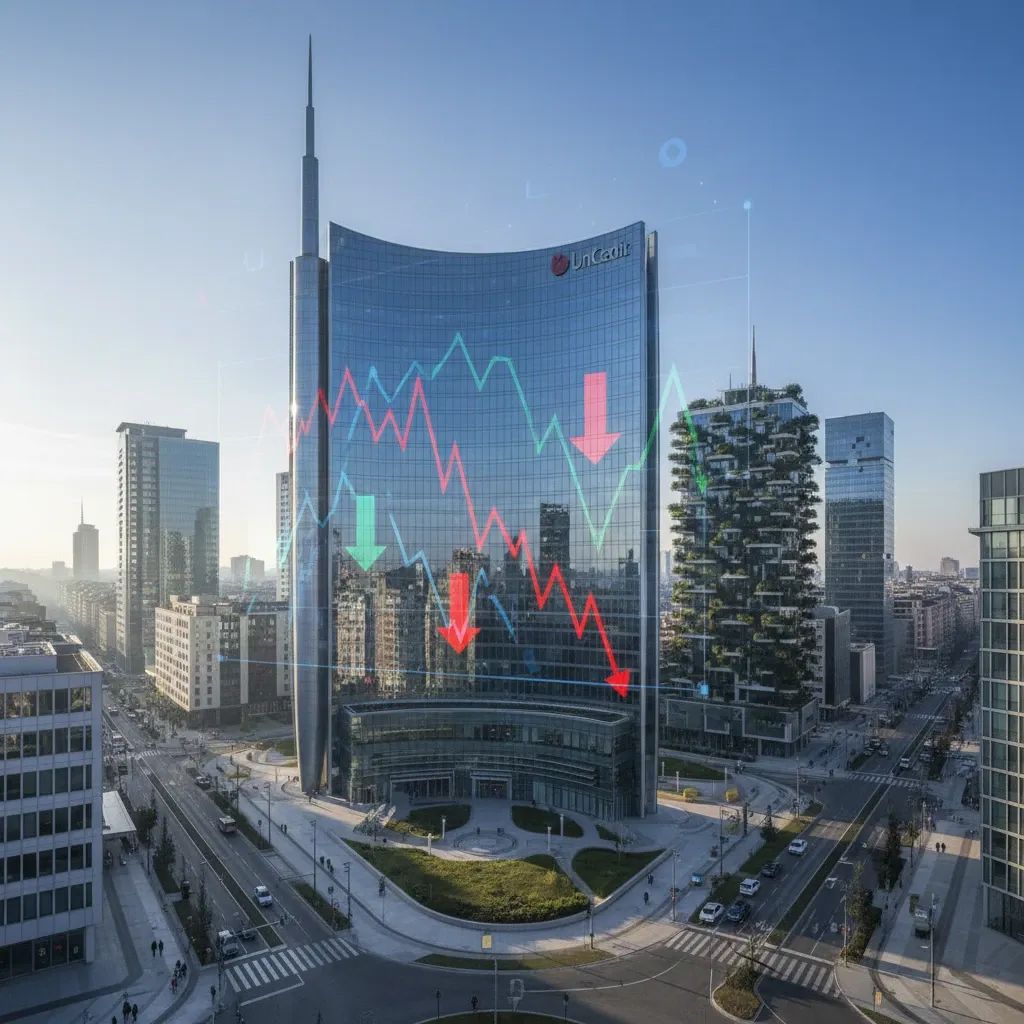
Italy's Piazza Affari narrowly dodged a rout on Monday, clawing back from a mid-session plunge to close down just 0.29% at 44,024 points, even as war in the Middle East sent oil prices soaring and obliterated another €116 billion in European market capitalization.
The FTSE MIB had opened the day in freefall—down 2.66% to 42,976 points—mirroring panic across global bourses as fears intensified that the escalating conflict involving Iran, the United States, and Israel could choke off energy supply routes and trigger a fresh inflationary spiral. By the closing bell, however, a late-session recovery trimmed losses dramatically, a pattern echoed in Paris, Frankfurt, and London.
Why This Matters
• Market capitalization erosion: European stocks shed €116 billion today, adding to last week's €918 billion wipeout.
• Oil volatility: West Texas Intermediate (WTI) crude surged during the session; Brent crude experienced significant volatility amid supply concerns.
• Spread pressure eases: The BTP-Bund spread closed at 75.5 basis points, down from 76.1 on Friday, with Italy's 10-year yield at 3.60%.
• Inflation concerns: Analysts warn that prolonged energy shocks could push Eurozone inflation higher, complicating policy decisions for the European Central Bank.
Energy Shock Dominates Trading Sentiment
The session's volatility stemmed directly from the Middle East conflict, which threatens to disrupt oil flows through the Strait of Hormuz—a chokepoint responsible for roughly 20% of global petroleum transit. As crude prices spiked, equity investors fled cyclical stocks, particularly banks and luxury goods, while piling into defense contractors and energy majors.
Throughout the session, crude prices experienced significant swings, providing relief by afternoon for European indices to stabilize. Natural gas prices on the Amsterdam TTF exchange surged amid supply anxiety across the continent's energy markets.
Winners and Losers on Piazza Affari
Despite the index's near-flat finish, individual stock performance splintered sharply along sectoral lines.
Defense and energy outperformed. Leonardo surged 6.6% after Barclays upgraded the stock to "overweight" and lifted its price target 16% to €68, citing robust order flow amid heightened military spending. Saipem, the oilfield services giant, jumped 4.8%, while Eni added 2.3% on the back of elevated crude prices.
Payment processor Nexi rallied 3% following an endorsement from Morgan Stanley analysts, and chipmaker STMicroelectronics recovered to close 1.9% higher despite earlier weakness.
On the losing side, Brunello Cucinelli plunged 3.8%, extending a multi-day selloff in luxury goods as investors fretted over discretionary spending in an environment of rising energy costs. Stellantis dropped 3%, weighed down by fears that supply chain disruptions and weaker consumer sentiment could dent auto demand. Cable manufacturer Prysmian fell 3.3%, even after Intesa Sanpaolo reaffirmed a "Buy" rating and raised its target price to €115.50.
The banking sector absorbed heavy selling pressure. Mediobanca shed 3.1% and Monte dei Paschi (MPS) fell 1.6% ahead of board meetings scheduled to discuss a potential share-swap merger. UniCredit declined 2.3%, Banco BPM dropped 2.05%, and Intesa Sanpaolo lost 1.35%, reflecting broader unease about credit conditions if energy costs continue to climb.
Continental Fallout and the Stoxx 600
Across Europe, the Stoxx 600 index closed down 0.63%, marking a challenging day in a week of market volatility. Paris led declines with a 0.98% loss, followed by Frankfurt (-0.77%) and London (-0.34%). Global markets have experienced significant pressure as investors reassess the energy crisis and its implications for economic growth.
Wall Street opened sharply lower but pared losses by the close. The Dow Jones Industrial Average fell 0.81% to 47,118.69, the Nasdaq slipped 0.05% to 22,376.71, and the S&P 500 declined 0.42% to 6,711.63. U.S. markets have shown relative resilience compared to their European and Asian counterparts, thanks in part to greater domestic energy independence.
What This Means for Residents
For Italians, the immediate concern is energy costs. Rising fuel and electricity prices have become key household budget concerns as Middle East tensions persist and oil markets remain volatile. Families across Italy are likely to feel the impact through higher utility bills and increased costs at the pump.
The broader economic implications are significant: sustained energy price pressures could affect consumer spending, employment, and savings, particularly in energy-intensive sectors such as manufacturing and transportation. Lower-income households typically face proportionally greater burdens from energy inflation than wealthier families.
Energy policy remains a central concern for policymakers, with calls for coordinated European responses to mitigate economic impacts for residents.
Outlook: Market Volatility and Energy Uncertainty
The tension between rising inflation risks and economic growth concerns remains front and center in market discussions. The European Central Bank continues to monitor energy developments closely, though the institution's policy options are constrained by competing pressures.
If energy prices stabilize, markets may find a floor. If Middle East tensions escalate and disrupt supply routes, however, Europe's vulnerability to energy shocks becomes acute.
Defense stocks and energy majors remain the safest havens in a turbulent landscape, while banks, airlines, utilities, and luxury goods face sustained pressure. For now, the message from Piazza Affari is one of cautious resilience—but the next headline from the Middle East could rewrite the script entirely.


