
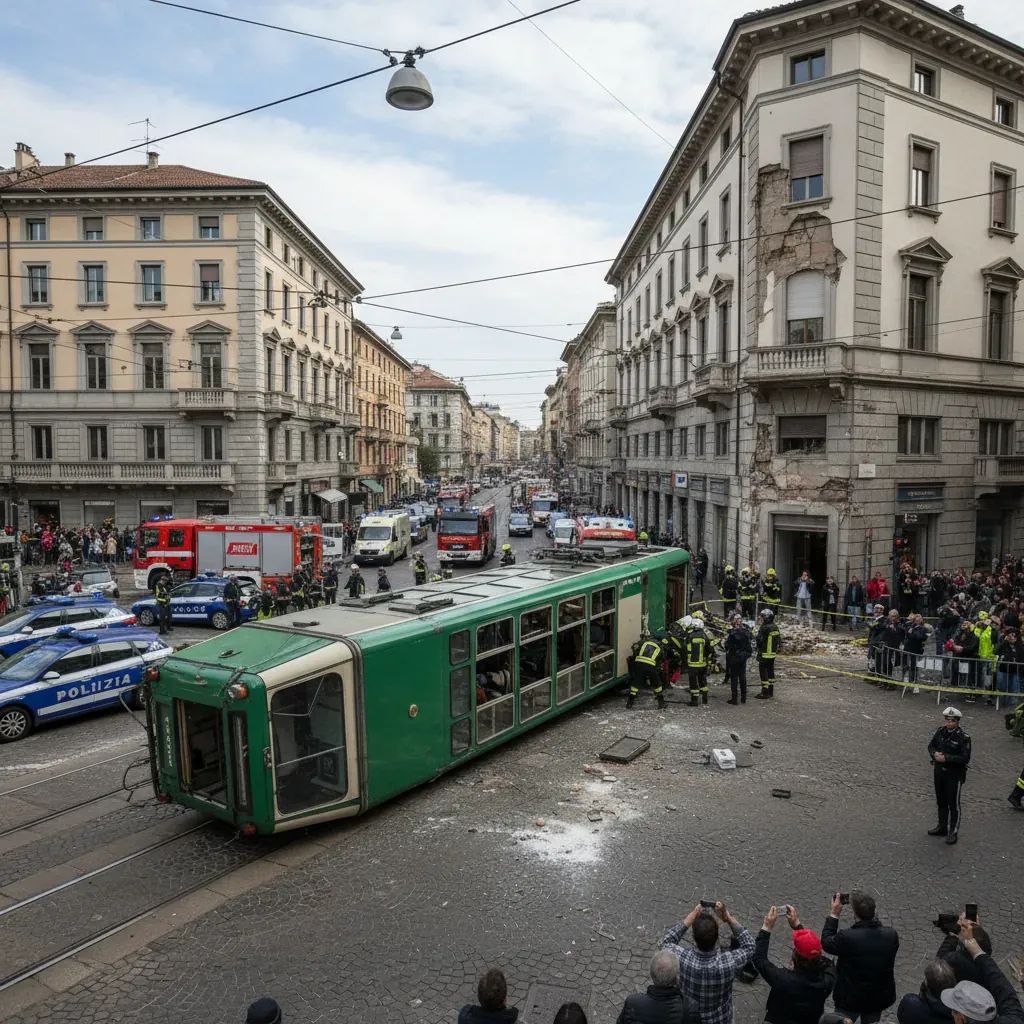
The Milan Prosecutor's Office has officially confirmed that authorities initially misidentified one of the two fatalities from the February 27 tram derailment on viale Vittorio Veneto. The victim is not the previously reported Senegalese man but rather another individual of Central African origin whose relatives are still being sought.
The mix-up occurred when investigators initially announced that Abdou Karim Touré, 56, had died in the crash—only to discover days later that Touré is alive and hospitalized in critical condition.
The Accident and Initial Response
On the morning of February 27, a Line 9 tram traveling through Milan's northeastern corridor skipped its scheduled stop and barreled into a curve near via Lazzaretto at an estimated 40–50 km/h—well above the walking-pace limit for that section. The tram derailed and slammed into the corner of a residential building, killing two passengers and injuring dozens. Emergency responders triaged the scene throughout the day, with several victims airlifted to trauma centers in red-code condition.
Within hours, local authorities released preliminary victim identities: Ferdinando Favia, 59, a Milan resident, and what they believed to be Abdou Karim Touré, a 56-year-old Senegalese national. But by Monday, March 2, the Milan Prosecutor's Office issued a correction: the person initially identified as Touré is in fact still alive, receiving intensive care. The actual second victim has since been confirmed as a man from Central Africa, and police are now working through consular channels to locate next of kin.
Why This Matters
• Identity confusion highlights the forensic challenges following the high-impact collision, which left over 50 people injured and two dead.
• A 60-year-old tram driver with 35 years of accident-free service now faces investigation for railway disaster, culpable homicide, and bodily harm.
• The automatic braking system failed to engage, raising urgent questions about maintenance protocols and safety devices on Milan's newer Tramlink fleet.
Why the Safety Systems Did Not Activate
At the heart of the criminal probe is a single, troubling question: why did the so-called "dead man's switch" not halt the tram when the driver lost control? This failsafe—officially known as a sistema "uomo morto"—requires the operator to maintain constant pressure on a control lever. If the driver releases that pressure for more than a few seconds, the system should trigger an automatic emergency stop within a window of 2.5 to 30 seconds, depending on tram model and speed.
The Tramlink model involved in the crash features a secondary safeguard with a 30-second reaction window. Yet neither device appears to have engaged before impact. Investigators, led by prosecutor Elisa Calanducci and chief prosecutor Marcello Viola, have seized documentation and radio logs from ATM (Azienda Trasporti Milanesi) headquarters to verify whether the driver reported any anomalies before the crash.
One working theory is that the driver's posture after his reported medical episode inadvertently kept the lever depressed, fooling the system into thinking he remained in command. Onboard camera footage and black-box speed data are now being analyzed frame by frame to reconstruct his movements in those final seconds.
The Driver's Account and Career
The operator, whose name has not been publicly released, told first responders he experienced a sudden onset of leg pain and lightheadedness just before the derailment. He described the sensation as a brief blackout—consistent with vasovagal syncope or another acute cardiovascular event. With 34 years of unblemished service at ATM, he had never been involved in any collision, disciplinary action, or safety complaint. He had been on shift for approximately one hour when the incident occurred.
Prosecutors have scheduled a formal interrogation and plan to commission medical experts to assess whether a pre-existing condition could have caused the episode. Separately, the Milan prosecutor's technical consultant will examine the tram's speed controller, anti-collision sensors, and the integrity of the braking circuits.
What This Means for Residents
For Milanese commuters—many of whom rely on the city's 18 tram lines to avoid congested roads—the crash has shaken confidence in a network long considered one of Europe's safest. Line 9, which connects the Porta Garibaldi rail hub to residential neighborhoods in the northeast, remained partially suspended for days as forensic teams documented the scene.
Replacement bus service was deployed on lines M1 and M6 to cover affected routes during the suspension period. Current status as of March 2: Line 9 is operating on a reduced schedule with extended intervals between departures. Full service restoration is expected by mid-March pending completion of forensic examination. Typical journey times remain 15–20 minutes longer than normal during morning and evening peaks as substitute bus service continues.
City councilors from both left and center-right blocs have called on Milan's municipal administration to launch an independent audit of ATM's maintenance schedules and driver wellness protocols. The timing is sensitive: in early 2025, ATM invested roughly €12 million in track renewals along the Line 9 and 19 corridors, including a three-month closure of Piazza Oberdan for rail replacement. Those works were publicly touted as ensuring "greater safety and extended infrastructure lifespan," yet the Tramlink units themselves—introduced as state-of-the-art bidirectional vehicles—now face intense scrutiny over their electronic control systems.
Ongoing Investigations and Next Steps
As of March 2, the following inquiries are underway:
Black-box analysis to confirm the tram's exact speed profile from the previous stop through impact.
Track-switch examination to determine whether the junction failed to direct the vehicle onto the correct alignment, forcing it onto a collision course.
Autopsy orders for both victims to establish precise causes of death and to rule out pre-existing conditions that might affect liability calculations.
Kinematic reconstruction by court-appointed engineers to model how the tram's momentum and angle contributed to structural damage at the building.
Judicial sources emphasize that no hypothesis has been ruled out—mechanical failure, human error, or a combination of both remain possibilities. The driver, though formally under investigation, has not been placed under house arrest or travel restrictions, reflecting prosecutors' acknowledgment that his medical event may have been genuinely unforeseen.
The Human Cost and Consular Efforts
The misidentification of the second victim underscores the chaotic aftermath of high-energy crashes. In the hours following the derailment, triage teams prioritized life-saving interventions over documentation, and the overlapping injuries—many passengers suffered facial trauma and burns—complicated visual identification. The Senegalese Consulate in Milan was initially notified of Touré's supposed death, only to receive word days later that he remains in intensive care with life-threatening injuries but is expected to survive.
Meanwhile, Italian authorities are working with embassies across Central Africa to match the true victim's biometric data and personal effects with missing-persons reports. Because the man carried no identity documents at the time of the crash, investigators are relying on dental records, fingerprint databases, and witness statements from other passengers who may have recognized him as a regular commuter.
Political and Public Reaction
Transport unions representing ATM employees have issued statements defending the driver's record and urging patience until technical findings are complete. CGIL and UIL, two of Italy's largest labor federations, warned against "trial by media" and called for systemic reviews of workload and shift-rotation policies that may contribute to operator fatigue.
At the municipal level, opposition councillors have demanded that Milan's transport assessor brief the full city council on ATM's internal safety audits, particularly regarding the Tramlink fleet. Some have floated proposals for mandatory co-pilot systems on high-speed sections, mirroring protocols used on regional and intercity trains.
For now, residents can expect continued service disruptions as the sequestered tram remains under forensic lockdown and ATM conducts its own parallel review. The company has pledged full cooperation with judicial authorities and announced a support fund for injured passengers, though details on eligibility and compensation amounts have yet to be finalized.


