
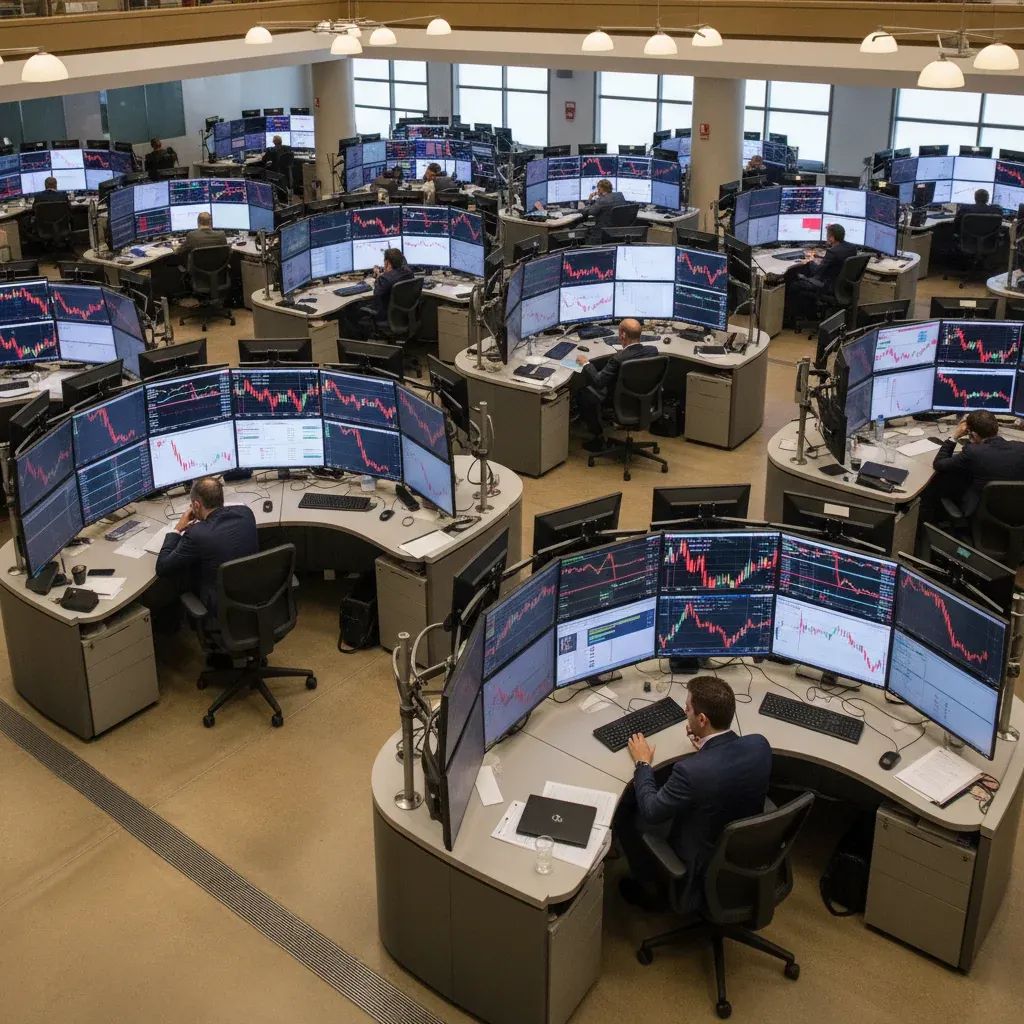
European equity markets tumbled during the latest trading session as Middle Eastern tensions continued to erode confidence, leaving Italy's Piazza Affari down 1.4% and putting fresh pressure on both Italian sovereign debt costs and household energy bills. The Strait of Hormuz remains closed, with uncertainty surrounding U.S.-Iran negotiations, pushing oil prices above $95 per barrel for Brent crude and stoking concerns about accelerating inflation.
Why This Matters
• Energy costs are climbing: Amsterdam gas futures jumped 4% to €40.35 per megawatt-hour, a surge that will filter through to utility bills within weeks.
• Banking and luxury shares took heavy losses: UniCredit fell 2%, while Italian luxury and auto stocks dropped more than 2%, erasing paper wealth for retail and institutional investors.
• Italian government bond yields edged higher: The 10-year BTP now trades at 3.74%, reflecting rising inflation expectations even as the spread over German Bunds held steady at 74 basis points.
• Oil-linked Italian majors rallied sharply: Eni surged 3.2% and Saipem gained 0.9%, offering a partial hedge for diversified portfolios.
Geopolitical Risk Premium Drives Volatility
The Strait of Hormuz closure, combined with uncertainty about U.S.-Iran negotiations, has bottled up global crude oil shipments in the Gulf, creating significant upward pressure on energy markets. West Texas Intermediate (WTI) crude rose 6% to $88.91 per barrel, while Brent climbed 5.3% to $95.22. For households across Italy, the immediate consequence is visible at the pump: diesel and gasoline prices have risen sharply, adding to the cost of everything from groceries to logistics.
The energy shock has rippled through equity indices. The pan-European Stoxx 600 fell 1%, with Frankfurt and Milan each losing 1.4%, Madrid declining 1.3%, Paris shedding 1.1%, and London down 0.7%. Luxury goods makers dropped 2% as investors bet that higher fuel costs will crimp discretionary spending, while automakers fell 2.1% on concerns that elevated input costs and weaker consumer sentiment will squeeze margins.
What This Means for Italian Investors and Savers
The immediate impact on Italy-based portfolios has been uneven. Banking shares bore the brunt of the sell-off, with UniCredit down 2%, Intesa Sanpaolo losing 1.9%, and Banco BPM falling 1.6%. Only Monte dei Paschi (MPS) managed to stay flat, inching up 0.07%. Rising sovereign yields and tighter financial conditions typically weigh on bank profitability, and analysts worry that sustained pressure on Italian government borrowing costs could limit credit availability for small and medium-sized enterprises.
Stellantis, the automaker with deep roots in Turin and a sprawling European supply chain, dropped 2.7%, reflecting both sector-wide weakness and specific concerns about elevated logistics costs. Construction materials producer Buzzi fell 3.3%, hurt by expectations that higher energy prices will increase production expenses for cement and aggregates.
On the other side of the ledger, Italian energy majors outperformed. Eni, the Milan-headquartered oil and gas giant, rallied 3.2% as investors positioned for windfall profits from higher crude prices. Oilfield services provider Saipem gained 0.9%, while steel-tube maker Tenaris advanced 1.6%, both benefiting from elevated commodity prices. Payment processor Nexi jumped 2%, defying the broader market downturn as investors rotated into domestic growth names with limited commodity exposure.
Utility stocks across Europe climbed 0.7%, tracking the 4% surge in natural gas futures. For consumers, this translates into higher household bills in the coming months, as energy suppliers adjust tariffs to reflect spot market dynamics.
Market Outlook
The immediate trajectory of European markets hinges on developments in U.S.-Iran negotiations and the situation at the Strait of Hormuz. Resolution of the geopolitical impasse could ease energy prices and reduce inflation pressures, while further escalation could push prices higher and force central banks to reassess their policy stance. For Italy, the country's dependence on imported energy means that any prolonged disruption to Gulf supplies will amplify inflation and squeeze household budgets. At the same time, the uncertainty surrounding monetary policy poses risks for Italian banks, construction firms, and other interest-rate-sensitive sectors.
The silver lining is that Italian energy champions like Eni are well positioned to capitalize on elevated commodity prices, offering a partial offset for diversified investors. As markets await clarity on both geopolitical developments and central bank positioning, volatility is likely to remain elevated. Investors would be wise to monitor not only the headlines from the Strait of Hormuz but also evolving energy prices and inflation data, which will ultimately determine whether the current selloff marks a buying opportunity or signals a deeper market correction.


