
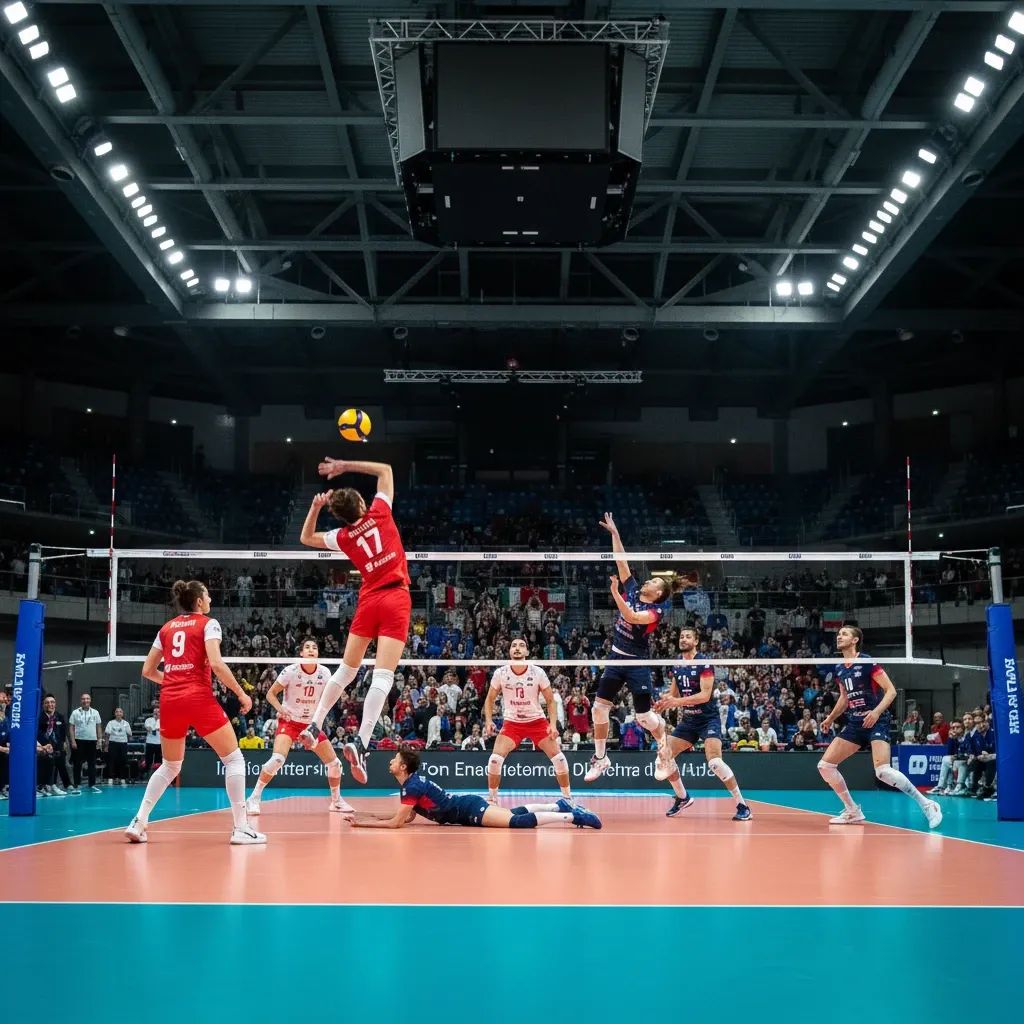
Italy's Volleyball Squad Repositions for Finals Sprint While Michieletto Fights the Clock
Italy's national men's volleyball team is trading Osaka's training courts for Tokyo's controlled environment, banking five days of focused preparation before the knockout phase of the Volleyball Nations League Finals begins July 29 in Ningbo, China. The timing matters enormously: the Azzurri finished the preliminary rounds fourth with 8 victories against 4 defeats, now entering single-elimination territory where momentum often matters more than pedigree. Add to this equation Alessandro Michieletto's ongoing recovery from a lower-spine stress fracture, and the picture sharpens into something resembling controlled uncertainty.
Why This Matters
• Quarterfinal opponent confirmed: Italy faces the United States on July 30 at 9:00 AM Italian time in Ningbo; the early morning kickoff accommodates Chinese prime time but allows Italian viewers a convenient breakfast-hour watch before work. Recent VNL preliminary round performance favors the Azzurri, but tournament dynamics reset everything.
• Michieletto's status remains unconfirmed: The star spiker continues individualized rehabilitation at Viola Park near Florence through July 27; whether he rejoins the squad before or after the Finals remains undeclared.
• Japan friendly on July 24: The Todoroki Arena match against the Japanese serves double duty—a final tactical rehearsal and a potential semifinal preview if both teams advance.
The Preliminary Gauntlet and What It Revealed
The Azzurri's path to Ningbo spanned three continents over six weeks. Ottawa hosted the opening week in mid-June, where Italy posted mixed results: a commanding 3-1 victory over Germany balanced against a punishing 2-3 loss to France, a five-set affair that exposed some mechanical fragility in the team's late-match discipline. By the time the squad landed in Ljubljana for Week 2, vulnerabilities had become apparent. Losses to Bulgaria (2-3) and a devastating sweep by Ukraine (0-3) suggested the preliminary format's grinding nature was taking a toll, particularly without Michieletto's offensive cushion.
The third week in Osaka proved the turning point. After dropping an opener to Japan, the Azzurri corrected course and defeated Belgium decisively 3-0 on July 18, a result that steadied their qualification position and provided tactical confidence entering the Finals. Head coach Ferdinando De Giorgi evidently used that momentum to analyze what worked when the team clicked—and equally important, what collapsed when it didn't. The fourth-place finish reflects neither dominance nor alarm, but rather the unsexy middle ground where a quality team coexists with inconsistency.
Why Tokyo Exists on the Calendar
The five-day stopover in Tokyo isn't a holiday. De Giorgi has deliberately constructed a controlled environment for pattern refinement, serve-receive drills under simulated pressure, and tactical adjustments informed by the preliminary rounds' lessons. The Azzurri face one of their most aggressive serving teams on Friday—Japan's attack on serve is categorically one of the tournament's most imposing—which means the Tokyo preparation focuses intensely on back-row fundamentals and communication.
The Japanese team finished the preliminaries undefeated and locked down the tournament's top seeding in Ningbo. That achievement stems partly from roster continuity, partly from a training model that emphasizes disciplined spacing and coordinated movement. Italy's defensive structure, by contrast, relies more on individual read and reaction, which can produce spectacular plays or lacunal collapses depending on concentration levels.
The July 24 friendly will reveal whether De Giorgi has successfully calibrated his squad's mental state. Is the Ukraine sweep still psychologically present, or have the Azzurri compartmentalized and reset? These aren't questions the coaching staff will answer publicly, but they're the unspoken narrative beneath every spike and dig during the 90-minute match.
The Michieletto Equation: Quantifying an Absence
Alessandro Michieletto's incomplete stress fracture of the lumbar spine, diagnosed in February, represents one of the tournament's most consequential unknowns. A 21-year-old operating at elite international level doesn't suddenly vanish from a squad's tactical framework without consequences. Across Italy's preliminary rounds, opponents didn't need to develop special defenses against Michieletto because he wasn't there—but his absence forced De Giorgi to redistribute offensive responsibility.
Mattia Bottolo, Daniele Lavia, and Luca Porro collectively absorbed the additional rotational minutes that Michieletto would normally command. None of these spikers operates at Michieletto's attacking efficiency, but collectively their presence maintained offensive balance. The tradeoff involved accepting slightly lower kill percentages in exchange for deeper roster integration and reduced reliance on any single player.
Michieletto's presence since early June at the Cavalese training camp suggested medical clearance toward gradual return. His current work at Viola Park in Bagno a Ripoli, located in the Florence region under physiotherapy supervision, continues the trajectory toward full availability. Yet the Italy Volleyball Federation has conspicuously avoided announcing a firm return date, a bureaucratic silence that typically indicates caution rather than imminent clearance. If Michieletto does rejoin before the Finals conclude, his integration demands tactical recalibration—not because De Giorgi can't adapt, but because match rhythm requires specific preparation.
The possibility that Michieletto remains sidelined through the entire Finals has forced the coaching staff to mentally rehearse competing without their marquee offensive weapon. That preparation, while not ideal, has hardened the roster's collective resilience and reduced single-point dependency.
The American Challenge: Familiar Opponent, Different Context
Italy enters the July 30 quarterfinal as favorites based on recent head-to-head performance. The Azzurri swept the United States 3-0 in the 2026 VNL preliminary round, adding to a track record of success against American teams. That historical advantage, however, functions more as context than prediction. The United States finished the preliminaries fifth with 8 victories and 4 defeats, identical to Italy's win column but edged out due to set differential—a margin thin enough that either outcome July 30 remains plausible.
The American roster carries Olympic pedigree: bronze medalists from Paris 2024 with elite athletes across every position. Their serving arsenal ranks among the tournament's most disruptive, and their blocking schemes operate with mechanical precision forged through years of elite club competition. What the Americans occasionally lack is Italy's organizational depth and De Giorgi's tactical sophistication—concepts that sound abstract until they translate into concrete advantages during rallies that extend beyond 10 exchanges.
An Italy victory over the US likely positions the Azzurri against Japan in the semifinal, a prospect both teams are mentally preparing for across the preliminary stage and continuing through this July 24 friendly. The alternative bracket offers Poland versus Ukraine and Slovenia against Turkey on July 30, outcomes that don't directly concern Italy but ripple outward through medal-round scenarios.
The Ningbo Format: Compression and Pressure
The VNL Finals collapse eight teams into five consecutive days of single-elimination volleyball, a structural design that eliminates second-chance situations and transforms every tactical decision into something approaching permanence. The transition from six weeks of preliminary grinding to three-day knockout intensity represents a philosophical shift—no margins, no momentum building, no chance to correct systematic flaws before advancing.
Poland enters as the reigning VNL champion and current world number one, carrying roster stability and recent championship experience into high-pressure situations. France, as dual Olympic gold medalist from Tokyo 2020 and Paris 2024, thrives under pressure but arrived in China after less preparation time than some competitors. Brazil remains the historical powerhouse, anchored by Olympic legacy and consistent FIVB top-five positioning. The depth across the field—Ukraine, Slovenia, and Turkey all capable of disrupting favorites—suggests that predetermined outcomes carry minimal predictive value.
Logistical Reality: The Next Fortnight for Italian Fans
Italy departs Tokyo on July 26, arriving in Ningbo with 72 hours before the tournament commences. The US match arrives at 9:00 AM Italian time on July 30, a broadcast-friendly scheduling that suggests the China organizers understood their audience geography. Italian viewers can catch the match at breakfast time through RAI's comprehensive VNL coverage or regional streaming services commonly available throughout Italy. Subsequent matches depend on Italy's ability to advance, but the potential includes a semifinal on August 1 and either a bronze or gold medal match on August 2.
For residents following Italian volleyball, this fortnight represents the sport's highest-stakes window. Club season hasn't commenced; international obligations dominate the calendar. A strong run in Ningbo reinforces Italy's credentials as a global force; an early exit prompts uncomfortable questions about roster construction and tactical adaptation heading into autumn competitions.
The Convergence Point: De Giorgi's Next 11 Days
Everything—Michieletto's recovery uncertainty, Japan's undefeated record, the American team's explosive athleticism, Poland's championship hunger—converges into the decisions De Giorgi makes across the next 11 days. The Tokyo camp provides the laboratory for final adjustments. The July 24 friendly offers real-time feedback against an elite opponent that Italy may face again under tournament pressure. The quarterfinal against the US becomes the immediate test of whether the Italian tactical system functions at optimal capacity without its most explosive weapon.
Uncertainty flavors every forecast. Italy possesses the roster quality, coaching sophistication, and psychological foundation to compete for gold. It equally carries the vulnerability vectors—defensive inconsistency, occasional mechanical breakdowns, the absence of its most dangerous offensive option—that permit unexpected exits from tournaments like this. The next 11 days will clarify which version of the Azzurri travels to Ningbo.


