
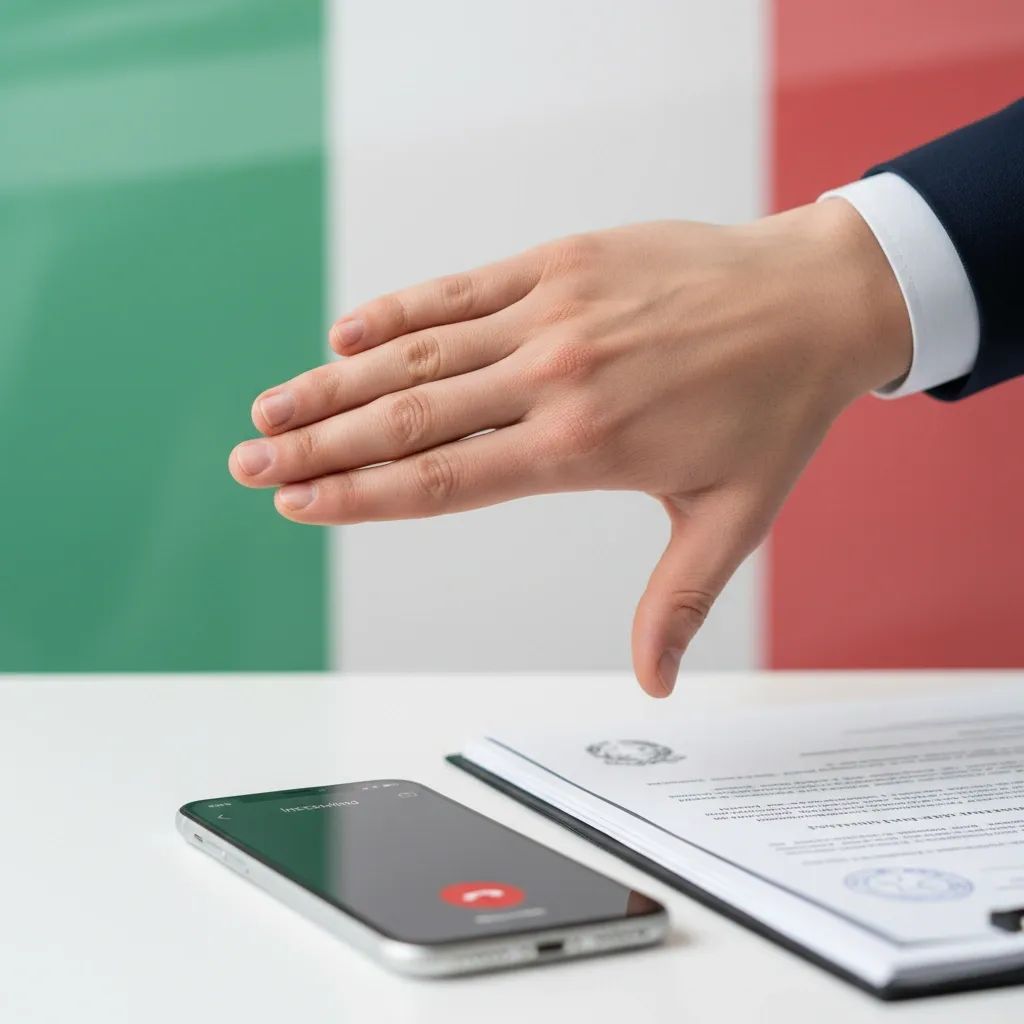
The Italy Senate Finance Committee has approved expanded telemarketing restrictions that now cover telecommunications companies in addition to energy providers, a decision that took effect despite the absence of government endorsement. Residents can expect fewer unsolicited sales calls starting in 60 days, with important consumer protections maintained in the final legislative text.
Why This Matters
• Wider coverage: The ban on cold-calling now applies to telecom services (mobile, internet, landline) as well as electricity and gas contracts.
• Legal weight: Contracts signed in violation of the new rules are automatically null and void, shifting proof of consent to the seller.
• Delayed rollout: Full enforcement begins 60 days after enactment, with energy-sector provisions already set to take effect on 19 June 2026.
• Protections preserved: The final text maintains the requirement for companies to use uniquely identifiable caller IDs and stricter consent provisions from the April framework.
How the Rules Actually Work
Under the approved amendment to the Decreto Accise Ter (Excise Duty Decree III), commercial solicitations by phone or text message aimed at proposing or concluding contracts will be prohibited unless the consumer has directly requested contact through the company's own digital platforms or has given explicit written consent to receive offers. The framework maintains the structure introduced in April's energy-focused "Decreto Bollette" (Utilities Bill Decree), but extends it to the telecommunications sector—a move that affects millions of households bombarded with sales pitches for mobile plans, fiber-optic internet, and bundled packages.
The Italy Senate committee vote proceeded without favorable opinion from the government, a rare procedural divergence that underscores parliamentary determination to address what many residents describe as an epidemic of intrusive sales calls. Senators declined to vote on a third draft circulated this morning that would have eliminated both the consent provisions and the caller-ID requirement entirely, opting instead for the second version that preserves the core consumer safeguards introduced in April.
What Was Preserved
The final approved text maintains critical consumer protections from the April energy decree. Crucially, salespeople are required to call from a number that uniquely identifies the company, with non-compliance rendering any resulting contract void. This provision serves as a key enforcement mechanism against number-spoofing and identity masking—protections that consumer advocates championed as essential deterrents to abusive sales practices.
Similarly, the final version preserves specifications that professionals may contact consumers "via the professional's own IT interfaces" and limits outreach based on "existing customer relationships and explicit consent to receive commercial proposals." These technical and procedural guardrails, first defined in the April decree, remain intact in the approved text and provide residents with meaningful protections and clear enforcement pathways.
Impact on Residents and Business
For Italian households, the practical effect is a two-tier system: energy and gas providers face the strictest rules (with the 19 June deadline fast approaching), while telecom companies will be subject to parallel restrictions once the 60-day grace period expires. Any contract signed after those dates without proper consent documentation can be challenged and voided, giving residents meaningful recourse against high-pressure sales tactics.
On the business side, telecom operators and energy retailers will need to overhaul compliance systems, invest in consent-management infrastructure, and retrain call-center staff. Industry associations have warned of higher operational costs and potential job losses in outbound sales teams, particularly for firms that rely heavily on cold-calling to acquire customers. The Italy Communications Authority (AGCOM) already mandates that call centers disclose whether operators are based in Italy, elsewhere in the EU, or outside the bloc—a transparency rule that layers onto the new telemarketing ban.
European Context and Enforcement
Italy's telemarketing crackdown aligns with a broader European trend. The General Data Protection Regulation (GDPR) requires explicit, informed, and freely given consent for marketing communications, while the e-Privacy Directive (2002/58/EC) addresses unsolicited electronic communications. Italy has gone further than many EU neighbors by establishing the Public Opposition Register (Registro Pubblico delle Opposizioni), which allows residents to block telemarketing calls to both landlines and mobile numbers. Enrollment in the register automatically revokes any prior consent for promotional purposes, and call centers must cross-reference their lists before launching campaigns.
The 2024 Legislative Decree 48 introduced tougher sanctions for violations in the communications sector, targeting practices like caller-ID spoofing and mandating transparency on the caller's physical location. The new telemarketing ban complements these measures, creating a multi-layered enforcement architecture that consumer protection groups describe as among the strictest in the EU. Non-compliance can trigger GDPR fines of up to €20M or 4% of global annual turnover, whichever is higher, alongside nullification of contracts and potential civil claims.
Political Friction and Next Steps
The absence of government backing for the amendment signals internal friction within Italy's ruling coalition. While the Ministry of Economy has publicly supported efforts to curb telemarketing abuses, technical ministries reportedly expressed concerns about the economic fallout for legitimate call-center operators and the administrative burden of enforcing nuanced consent rules across multiple sectors. Parliamentary sources indicate that the government preferred a more gradual rollout, piloting the stricter regime in the energy sector before expanding to telecoms.
The amendment now moves to the full Senate floor for debate, with the Decreto Accise Ter expected to pass into law by mid-month. Consumer advocacy organizations are pressing lawmakers to maintain the unique caller-ID requirement and consent provisions that were preserved in this approved version, arguing that these protections are essential to the decree's deterrent effect. Industry lobbyists, meanwhile, are seeking clarifications on how "direct request" will be defined and whether consent obtained before the decree's entry into force remains valid for cross-sector marketing.
What Residents Should Do
Even with the new rules, proactive steps remain essential. Enrolling in the Public Opposition Register is free and takes minutes via the official website or toll-free number. Registration blocks telemarketing from companies that do not have a pre-existing customer relationship, though it does not cover market-research calls or communications from political parties and charities.
When receiving a sales call, residents should ask the caller to confirm the legal basis for contact—whether it stems from a direct request, existing customer relationship, or explicit consent. Document the interaction, including date, time, caller ID, and company name. If a contract was signed under pressure or without proper consent, notify the seller in writing within 14 days and assert your right to contract nullity under the new decree. The Italy Antitrust Authority (AGCM) and Garante per la Protezione dei Dati Personali (Data Protection Authority) both accept complaints and can initiate enforcement proceedings.
For residents who rely on landlines or have elderly family members particularly vulnerable to high-pressure tactics, consider enabling anonymous-call rejection features offered by most telecom providers, which automatically block calls from numbers that hide their identity. With these protections now enshrined in law—including the unique caller-ID requirement—residents have stronger legal grounds to challenge violations. Personal vigilance remains the first line of defense until enforcement mechanisms fully mature and industry behavior adapts to the stricter legal environment.


