
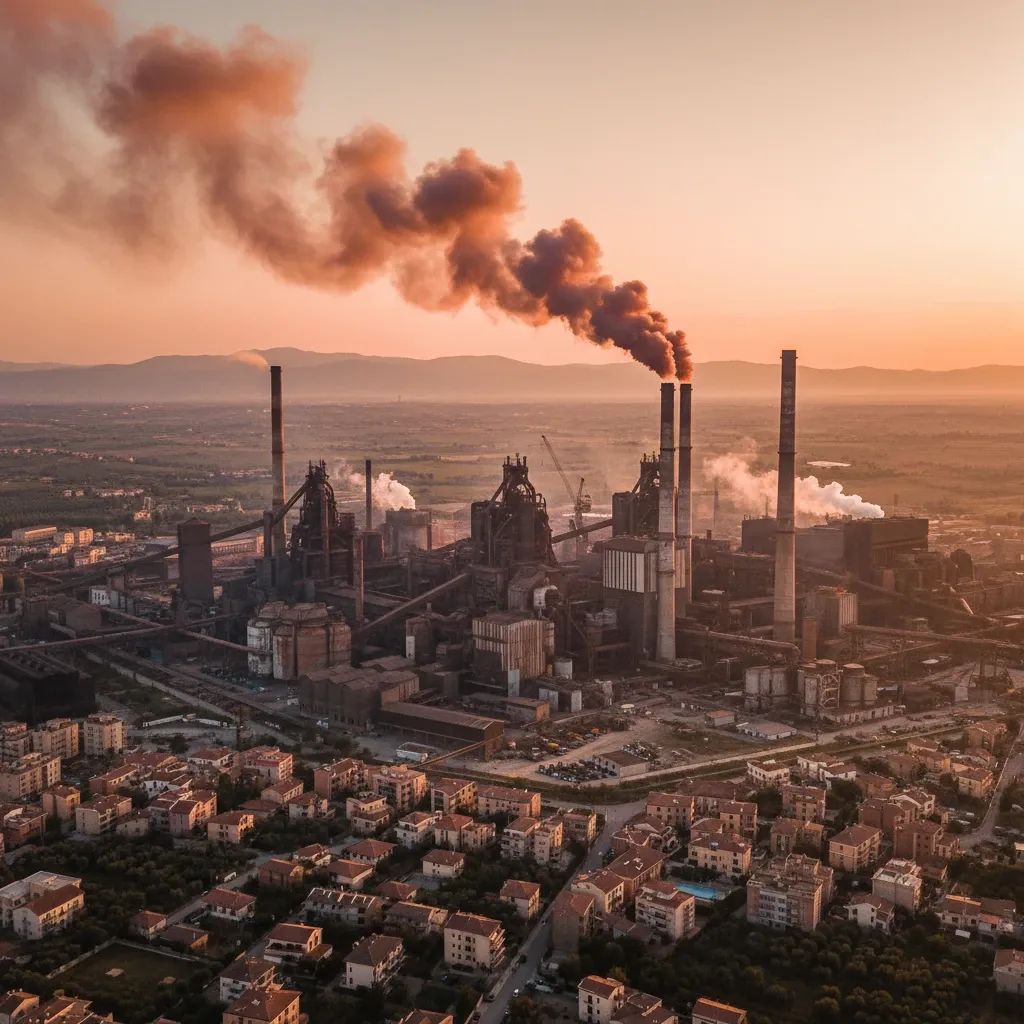
The Italian steel manufacturer Eusider has formally expressed its willingness to join an emerging domestic consortium aiming to acquire portions of the troubled ex-Ilva steelworks in Taranto, adding momentum to a bid that now encompasses 15 steel industry firms and presenting a credible alternative to foreign suitors circling Italy's most controversial industrial asset.
Why This Matters
• Job security for thousands: The outcome will determine employment for direct workers and tens of thousands in the supply chain across southern Italy.
• Strategic autonomy: A successful Italian bid would keep critical steel production capacity under domestic control rather than ceding it to Indian or American investors.
• Regulatory deadline looming: A Milan Court of Appeal ruling demands closure of the hot-rolling plant within 90 days unless environmental hazards are resolved, forcing rapid decisions.
• Government intervention expected: Prime Minister Giorgia Meloni has scheduled high-level negotiations for early September 2025 to evaluate competing bids.
Background: Why Ilva Matters to Italy
For those unfamiliar with the ex-Ilva's contentious history: The Taranto steelworks has been at the center of a decades-long legal and environmental crisis. The facility faces criticism over asbestos contamination, particulate emissions, and alleged health impacts on the local population—issues that have triggered multiple shutdowns, court orders, and billions in public investment attempts. This struggle represents a broader tension in Italy between industrial production, environmental protection, and worker livelihood.
Eusider Brings Steel Transformation Expertise
Maria Anghileri, head of the Young Entrepreneurs Association within Italy's main business lobby Confindustria and a member of the Eusider ownership family, confirmed the company's participation during an interview from the Rimini Meeting. Eusider operates as a steel transformer, processing over 1 million tons of coils and plate annually with consolidated revenues exceeding €1 billion.
"The Ilva is a strategic asset not only for companies operating in the steel sector but for the entire Italian manufacturing industry," Anghileri emphasized, pointing to the urgency of action given tightening timelines. The firm has formally notified both Confindustria President Emanuele Orsini and Federacciai President Antonio Gozzi of its readiness to contribute industrial know-how and capital to the rescue effort.
The addition of Eusider extends the consortium beyond primary steel producers into the downstream transformation segment, potentially strengthening the operational logic of any restructuring plan. The original 14 companies coordinated by Federacciai—Italy's steel industry federation—include heavyweights such as Acciaieria Arvedi, Feralpi Siderurgica, Marcegaglia Carbon Steel, O.R.I. Martin, and Duferco Travi e Profilati.
What This Means for Industrial Policy
The Italian consortium focuses primarily on the cold-rolling area and auxiliary sites while explicitly excluding Taranto's hot-rolling plant, which faces imminent judicial closure over particulate emissions and asbestos contamination. This strategic narrowing reflects the reality that environmental liabilities at the blast furnace complex remain unresolved despite years of legal wrangling and billions in public funds.
Estimated valuations for the cold-rolling portion range between €600 million and €1 billion, a figure dwarfed by the approximately €2 billion offer reportedly tabled by India's Jindal Group for the entire facility including the hot plant. Flacks Group LLC, an American fund, has also submitted an expression of interest.
The Italian bid hinges on substantial state participation through Invitalia, the government's investment vehicle, which consortium members consider indispensable for financial viability. Over the past three years, the Meloni government has already allocated €1.189 billion to maintain operations at Acciaierie d'Italia, the legal entity currently managing the ex-Ilva assets under extraordinary administration.
What This Means for Italy's Economy and Your Community
For residents across Italy, the Ilva outcome carries practical implications:
• Steel availability and pricing: Italy's construction, automotive, and appliance sectors depend on domestic primary steel. A successful Italian bid could help stabilize supply chains and pricing for renovation projects, car manufacturing, and industrial goods. Foreign ownership might disrupt these patterns or increase costs.
• Southern Italy's economic stability: Taranto's broader economy depends heavily on the steelworks. Beyond the direct 8,000+ workers, tens of thousands rely on related jobs. A failed rescue could accelerate regional brain drain and economic decline, while success provides foundation for diversified growth.
• Employment opportunities: Beyond crisis management, restructuring could create opportunities in environmental remediation, retraining programs, and green steel technologies as the facility modernizes toward electric arc furnace production.
Government Commits to September Negotiations
Speaking at the opening ceremony of the Mediterranean Games in Taranto, Prime Minister Giorgia Meloni acknowledged public frustration over the decades-long impasse while pledging maximum governmental effort. "I perfectly understand the reasons of those here in Taranto who express dissent, and I guarantee that on ex-Ilva the government is doing and will continue to do everything in its power," she stated, facing some public protests during the event.
Meloni announced that negotiating tables will reconvene in early September 2025 to review all formal bids. The Prime Minister framed the challenge as balancing economic development, environmental protection, and health safeguards while emphasizing that "Taranto is not only Ilva" but a city with extraordinary potential tied to history, culture, and strategic location.
President Sergio Mattarella has characterized the ex-Ilva situation as a "national commitment," signaling the highest levels of political attention. The sense of urgency is amplified by union warnings of an unprecedented "social bomb" if mass layoffs materialize without a credible industrial plan.
Environmental Transition and European Context
Italy's steel sector sits at a continental crossroads. As the second-largest steel producer in Europe, the country has developed sophisticated scrap-based circular economy capabilities, with mills like Arvedi already pioneering 100% electric arc furnace (EAF) production using recycled ferrous scrap—a pathway aligned with the EU's ambition to achieve carbon neutrality by 2050 and a 30% emissions reduction by 2030.
Across Europe, 33 decarbonization projects are underway or planned, with Germany leading with 12 initiatives followed by Sweden and France. The German Ruhr Valley offers a cautionary and instructive precedent: once Europe's steel heartland, it has undergone radical transformation, converting massive former facilities like the 200-hectare Landschaftspark Duisburg-Nord into green recreational spaces attracting over a million visitors yearly—though such transitions require sustained public investment and regional economic diversification.
Italy's challenge differs in scale and urgency. The ex-Ilva's hot plant represents one of Europe's largest integrated steelmaking sites, and its potential closure would eliminate a substantial share of national primary steel capacity, forcing greater reliance on imports or scrap-only production. The Integrated Environmental Authorization (AIA) approved in July 2025 provided a regulatory framework for sustainable operations, but judicial intervention has effectively superseded that timeline.
Impact on Workers and Regional Economy
Unions representing metalworkers (Fim, Fiom, Uilm, Usb) have appealed directly to President Mattarella, warning that failure to secure a viable buyer threatens not only the direct workforce but tens of thousands employed in logistics, maintenance, and supply chains throughout Puglia and southern Italy. They demand any agreement include binding commitments on employment levels, decarbonization pathways, and professional retraining programs.
The broader Taranto economy remains heavily dependent on steel despite diversification efforts. While the Mediterranean Games and increased tourism investment signal alternative growth trajectories, the industrial base still anchors a significant portion of regional GDP and household incomes.
For manufacturing firms across Italy that consume flat steel products—automotive suppliers, appliance makers, construction materials producers—the prospect of reduced domestic primary capacity raises concerns about supply chain resilience and input costs, particularly if geopolitical disruptions affect import channels.
What Happens Next: Timeline and Scenarios
The September 2025 government-convened tables will bring together national union leadership, Puglia regional authorities, local government, and prospective investors. Two parallel tracks are expected: one dedicated exclusively to the industrial future of the steelworks, the other focused on broader economic development initiatives for Taranto to reduce dependence on a single industrial monoculture.
Expected decision timeline: Government officials suggest final decisions on the winning bid should emerge by late September 2025, though judicial deadlines may compress this further.
Potential scenarios and what they mean:
• Italian consortium wins: Steel production continues under Italian control, employment levels stabilize, gradual environmental remediation begins, and supply chains remain domestically anchored.
• Foreign buyer acquires assets: Potentially higher capital investment but uncertain employment guarantees, potential supply chain reorientation, and loss of Italian industrial autonomy in a strategic sector.
• No buyer emerges: Liquidation becomes likely, triggering mass unemployment, regional economic crisis, and permanent loss of primary steel capacity.
Staying informed: Residents and workers can follow developments through Confindustria announcements, union communications, and regional government updates. Major Italian news outlets will cover each negotiation milestone.
The consortium's success depends on demonstrating operational credibility, securing state co-investment, and navigating the judicial order threatening immediate hot-plant closure. Whether the Italian bid can mobilize sufficient capital and political will to outmaneuver better-capitalized foreign competitors will determine not only the fate of thousands of workers but the future contours of Italy's industrial autonomy in a strategic sector.


