
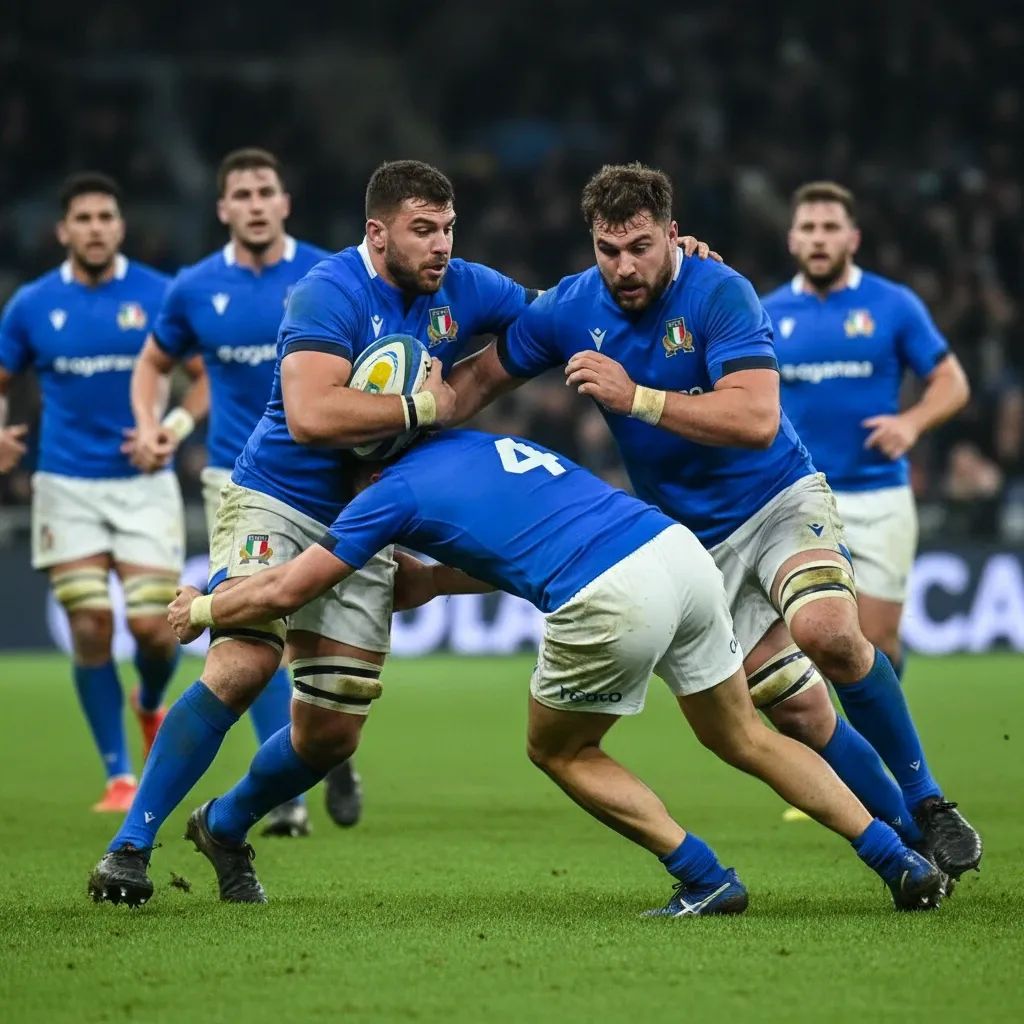
The Italian national rugby team has pulled off a landmark victory that decades of development and grassroots cultivation made possible, defeating England 23-18 on March 7 at Rome's Stadio Olimpico—their first-ever win over the English side in Six Nations history. The triumph reflects not just a tactical shift under head coach Gonzalo Quesada, but a structural evolution in how Italy builds and sustains elite rugby talent.
Why This Matters:
• Historic milestone: Italy's first Six Nations victory over England after more than two decades of facing them.
• Tactical breakthrough: A defensive system built on organization, passion, and consistency has become the team's identity under Quesada.
• Grassroots validation: Players from small provincial clubs, including the Bombo Rugby Firenze academy, are now anchoring the national squad.
• Momentum shift: The win positions Italy as a competitive force heading into the 2027 Rugby World Cup cycle.
The Anatomy of a Historic Win
Italy's victory was anything but straightforward. Trailing early in the match, the Azzurri mounted a second-half comeback culminated by a decisive try from Leonardo Marin in the 71st minute. The team's ability to weather early pressure and execute under duress exemplified the mental resilience that Quesada has instilled since taking over.
Tommaso Menoncello and Marin scored the tries, while fly-half Paolo Garbski contributed through conversions and penalty kicks, displaying the composed precision Italy has lacked in previous campaigns. England, despite tries from Freeman and Roebuck, could not match the home side's defensive intensity and attacking patience in the critical closing stages.
Massimo Giovanelli, a former captain of the Italian national side, highlighted the transformation on Rai Radio 1's Radio Anch'io Sport. "The new element of this Italy is continuity even in difficult moments, the capacity to function as a system, along with a very strong and organized defense," Giovanelli said. "Quesada has injected positivity, calm, and confidence, also through reviewing past performances and focusing on the certainty of the team's qualities and moral strength."
Quesada's Defensive Revolution
Since assuming the head coach role, Gonzalo Quesada has reengineered Italy's approach, particularly in defense. His philosophy centers on what he calls a "defensive edge"—a structured, passionate system that reflects a distinctly "Latino-Italian" identity. Under his guidance, the squad has prioritized organization and heart when possession is lost, creating a culture where defending is not a fallback but a defining trait.
The Argentine coach's emphasis on consistency has been transformative. Italy previously struggled to maintain performance levels across matches, often delivering inspired play one week only to falter the next. Quesada's regime demands incremental improvement, game by game, and a collective mentality capable of absorbing pressure and applying it in return.
This approach has already yielded results beyond the England victory. Italy secured back-to-back wins over Wales in 2024 and 2025, and posted a strong defensive showing against South Africa during the November 2025 Test window. The team's ability to "let the storm pass calmly," as insiders describe it, has become a hallmark of their play.
The Provincial Pipeline
Italy's success is rooted in a development model that draws heavily from small, provincial clubs—a network that has quietly nurtured three generations of competitive talent. Giovanelli stressed the importance of this pipeline: "Many of our players come from small clubs in provinces and villages that do essential grassroots work. The Cannone brothers come from a small Florence club, Bombo Rugby Firenze. Menoncello comes from a town in the province of Treviso. We must connect the territory to the national team, which has certainly made a leap in quality."
The Bombo academy, established in 1998, merged with Firenze Rugby Club in 2013 to form Florentia Rugby, and later combined with Firenze Rugby 1931 to create Unione Rugby Firenze in 2023. This consolidation has produced a robust youth system that now feeds directly into the national pipeline. Lorenzo Cannone, a flanker for Benetton and the Azzurri, began his journey at Bombo before progressing through Florentia and the National Academy.
In 2025, four players from Unione Rugby Firenze were called up to Italy's U18 and U19 squads. This steady flow of talent, combined with exposure to France's Top 14—the continent's most competitive league—has elevated the overall quality of the national team. Giovanelli noted that over the past 25 years, many Italians have played in France, "the most competitive league at the European level, and they have always done well."
A New Generation Comes of Age
Italy's current squad represents what Giovanelli calls a "third generation of quality." The roster includes the Garbski brothers—Paolo at fly-half and Alessandro Garbski at scrum-half—along with captain Michele Lamaro and the Cannone brothers (Lorenzo and Marco). These players combine technical skill with the mental fortitude and physicality honed in French and Italian club rugby.
Paolo Garbski, who plays for Toulon in the Top 14, has been instrumental in Italy's resurgence. He famously kicked the winning conversion against Wales in the 2022 Six Nations, ending a lengthy losing streak. By March 2026, he had earned 49 caps for Italy and was described by former Springbok coach Nick Mallett as part of Italy's "secret weapon" half-back pairing.
The blend of native and heritage players (oriundi) has deepened the squad's talent pool without diluting its identity. Quesada's selection philosophy emphasizes continuity with established players while integrating promising youth, ensuring coverage across all positions even when injuries occur.
What This Means for Italian Rugby
The England victory is not an isolated fluke—it is the product of systemic improvements in coaching, tactical planning, and player development. For Italy, the challenge now is to sustain this momentum and avoid the inconsistency that has plagued past campaigns.
Giovanelli emphasized the need to "give continuity to the production chain of quality players," ensuring that the current generation's success translates into long-term competitiveness. With the 2027 Rugby World Cup on the horizon, Italy is positioning itself as a team capable of advancing beyond the pool stages—a goal that once seemed distant.
For rugby enthusiasts and sports observers in Italy, this marks a cultural shift. The Azzurri are no longer perennial underdogs content with moral victories. They are a team with a clear identity, a coherent strategy, and the infrastructure to support sustained excellence. The connection between provincial clubs and the national team, long fragmented, is finally cohering into a competitive advantage.
For Italian rugby fans looking ahead: The next Six Nations matches will be broadcast on Rai Sport and available through streaming services for residents across Italy. Stay tuned for Italy's upcoming fixtures as they continue their campaign toward the 2027 Rugby World Cup.
As Italy prepares for the remainder of the Six Nations and the larger goal of 2027, the message from Rome is clear: this is not a moment of luck, but the result of decades of patient work now bearing fruit.


