
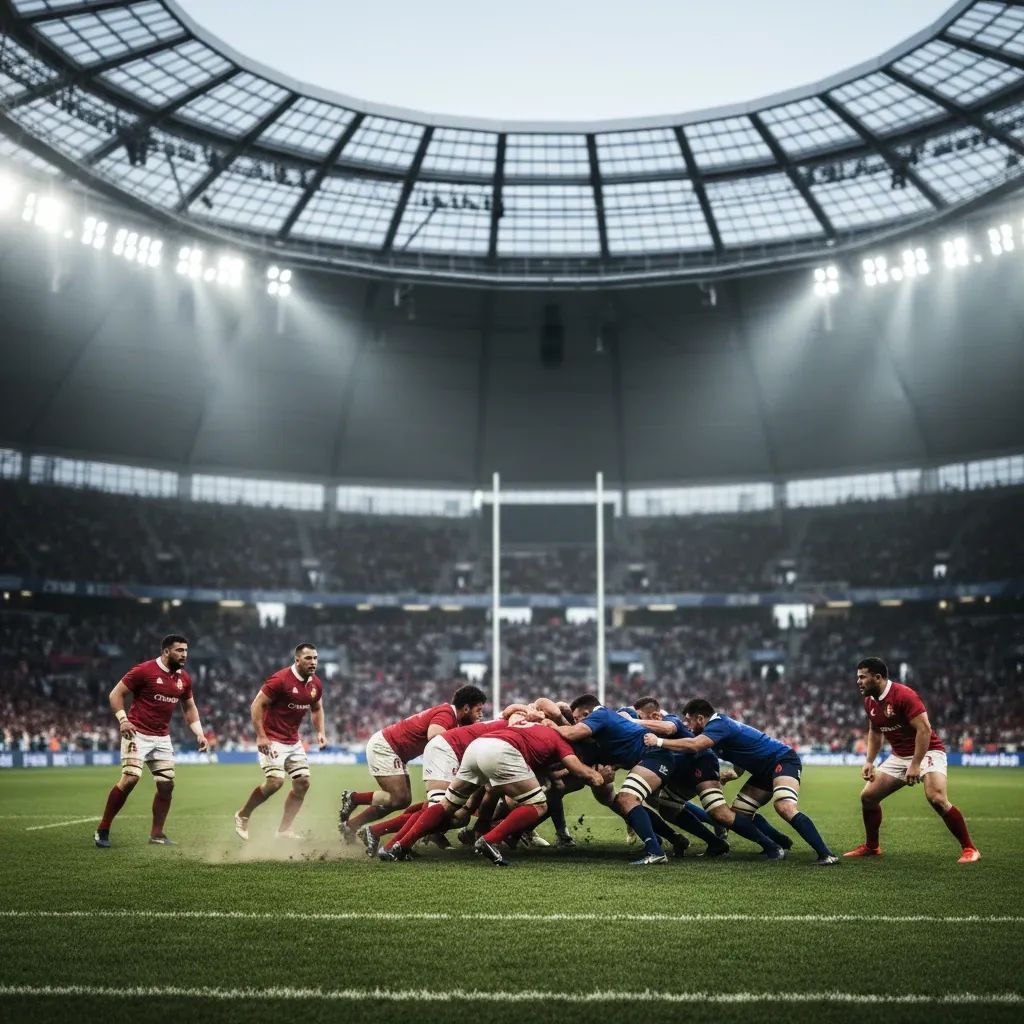
The Italian national rugby team faces what captain Michele Lamaro calls a "zero margin for error" test when they take on tournament leaders France on Sunday, February 22 at the Stade Pierre-Mauroy (Decathlon Arena) in Lille. The match, scheduled for 4:10 PM local time, represents Italy's toughest assignment yet in the 2025 Six Nations campaign—a contest where past demons and recent promise collide under a closed stadium roof.
Why This Matters
• Historic opportunity: Italy drew 13-13 at this same venue two years ago, nearly snatching victory before a last-second post denied Paolo Garbisi. The rematch offers a chance to prove that result was no fluke.
• Roster shift: Ange Capuozzo returns at fullback after recovering from injury, reuniting with his Toulouse clubmates—including world player of the year Antoine Dupont—this time as opponents.
• Campaign momentum: With a home win against Scotland (18-15) and a gutsy bonus-point loss in Dublin (20-13), Italy's trajectory under coach Gonzalo Quesada is upward. A strong showing against France could cement their status as legitimate Six Nations contenders.
France Arrives as Unstoppable Force
The French squad enters Lille having demolished Ireland and Wales in a display of power and precision that has left opponents scrambling. Coach Fabien Galthié has fielded his strongest possible lineup, anchored by Dupont, whose vision and explosiveness make him the most dangerous player in world rugby. France tops the Six Nations table with maximum points, their attacking game blending brute forward dominance with backline creativity that has overwhelmed every defense thrown at them.
Galthié's public praise for Italy—suggesting the Azzurri are on track to eventually win the Six Nations and compete consistently with the world's top 10—rings sincere but also carries strategic weight. The French coach knows his team crushed Italy 73-24 in Rome last year, the heaviest home defeat ever inflicted by France on the Italians. That humiliation remains fresh in Italian minds, a stark reminder of what happens when Les Bleus hit full stride.
Italy's Calculated Approach Under Quesada
Gonzalo Quesada, the Argentine tactician who took over the Italian program, dismisses talk of tournament standings or long-term projections. "We don't think about where we finish in the competition—that's for France, England, or Ireland to worry about," he explained this week. "Our focus is the performance, what needs improving, the words 'compete' and 'consistency.'"
That philosophy has yielded tangible results through the first two rounds. Against Scotland at Rome's Stadio Olimpico, Italy dominated the set piece and scored tries through Louis Lynagh and Tommaso Menoncello in the opening 15 minutes, weathering torrential rain to secure an 18-15 victory. A week later in Dublin, the Azzurri led Ireland 10-5 at halftime—the first time they'd held a lead at the break at Aviva Stadium—before falling 20-13 in a second-half surge by the hosts. Italy earned a defensive bonus point by keeping the margin within seven, and their scrum continued to prove a genuine weapon.
The pattern under Quesada is clear: Italy can compete physically with anyone, but maintaining precision and discipline for 80 minutes against elite opposition remains the challenge.
Capuozzo's Return and the Toulouse Connection
Ange Capuozzo's selection at fullback represents both a tactical upgrade and an emotional subplot. The 25-year-old Italian international has been electric for Toulouse this season, scoring a hat-trick against the Sharks in December's Champions Cup clash and forming a lethal partnership with Dupont. In one memorable sequence against Ulster, Dupont delivered a cross-field kick that Capuozzo collected at pace and finished with trademark acceleration.
Sunday, that club chemistry gets set aside. Capuozzo replaces Alessandro Pani, who performed admirably in Dublin, but the Italian coaching staff believes the former's counterattacking instinct and ability to exploit broken play could prove crucial against a French side that generates turnover ball with ruthless efficiency.
"We'll face quite a few of my Toulouse teammates," Capuozzo acknowledged, "and they'll do everything to give us disappointment by winning the Garibaldi Trophy again." That trophy, contested annually between Italy and France, has resided in French hands for most of its history—France holds a 46-3-1 record across 50 meetings, with Italy's only Six Nations victories coming in 2011 (22-21) and 2013 (23-18).
Lamaro: "We Cannot Afford Too Many Mistakes"
Captain Michele Lamaro, speaking at the pre-match press conference, echoed Quesada's emphasis on process over outcome. "Compared to that 13-13 draw, we've made progress, even if we've been inconsistent," he said. "The goal is clear: improve match by match. I think we're heading in that direction over these two years, with some down moments."
Lamaro identified France's counterattack and turnover game as the primary threats. "There's never a right or wrong moment to face teams like France, an incredibly strong team," he continued. "Sunday's focus will be on us, on what we can do, and trying to be as precise as possible. In this match, we cannot afford to make too many mistakes."
That assessment aligns with Quesada's game-plan preview. "If after 10 or 15 minutes they create the chances they usually create and manage to pull away, to score like in the first two tournament matches, it will be difficult to stop them," the coach warned. France scored early and often against both Ireland and Wales, building leads that allowed them to play with freedom and further pile on points.
What This Means for Italian Rugby's Trajectory
For Italian rugby supporters and the broader sporting community in Italy, Sunday's match represents more than a single result. It's a referendum on whether the Quesada project—now in its third championship cycle—can deliver the consistency needed to escape the Six Nations basement permanently.
The 2025 draw in Lille offered hope; the 2024 shellacking in Rome threatened to erase it. Italy's performances this tournament suggest the trajectory is genuinely upward, but only a strong showing against the tournament's dominant power can validate that claim.
Dupont himself offered a telling assessment: "It's a team that continues to improve, that continues to surprise. And I think we should stop using the word 'surprising,' because they've played excellent matches, not always winning, with great intensity and making matches difficult for every team they face."
Quesada wants his players to "bring what we are to the field but also go beyond what we showed against Scotland and Ireland." That, he says, is the definition of growth—not chasing a result, but executing at a level previously beyond reach.
The Tactical Chessboard
Italy will wear their distinctive "Garibaldi red" alternate kit, a symbolic choice for a match named after the Italian unification hero. The Stade Pierre-Mauroy's retractable roof will remain closed to shield players from forecast inclement weather, creating a cauldron atmosphere where France's home support can amplify pressure on the visitors.
The Italian set piece, particularly the scrum, has been a revelation this tournament. If the Azzurri can win clean ball and limit France's possession through disciplined phase play, they can keep the scoreboard respectable and create scoring opportunities off French errors. Garbisi's boot remains crucial—his 8 points against Scotland and 7 in Dublin show he can punish indiscipline.
But France's depth and skill across all positions mean Italy must perform near perfectly. The visitors' discipline record will face scrutiny; conceding penalties in their own half invites the kind of territorial suffocation that allowed Ireland to turn the tide last week.
Historical Echoes and Future Ambitions
The last five years of Italy-France encounters tell a story of overwhelming French dominance punctuated by rare moments of Italian resistance. From a 50-10 drubbing in 2021 to a 60-7 World Cup humiliation in 2023, the pattern has been predictable—except for that 13-13 draw and a competitive 24-29 loss in 2023.
Italy's challenge is transforming occasional competitive performances into consistent ones. Galthié's compliments about a future Six Nations title may sound patronizing, but they reflect a genuine assessment of Italian potential under Quesada's structured approach.
Sunday offers a measuring stick: Can Italy compete for 80 minutes against the world's second-ranked team? Can they avoid the early collapse that has plagued previous encounters? Can the forward pack that dominated Scotland and troubled Ireland impose itself against French power?
Quesada's message to his squad is simple but demanding: "We must bring what we are, but also exceed it." In a tournament where expectations for Italy have traditionally centered on avoiding wooden spoons rather than chasing titles, that ambition alone represents progress. Whether it translates to points on the scoreboard in Lille will answer whether Italian rugby's upward trajectory is sustainable or another false dawn.


