
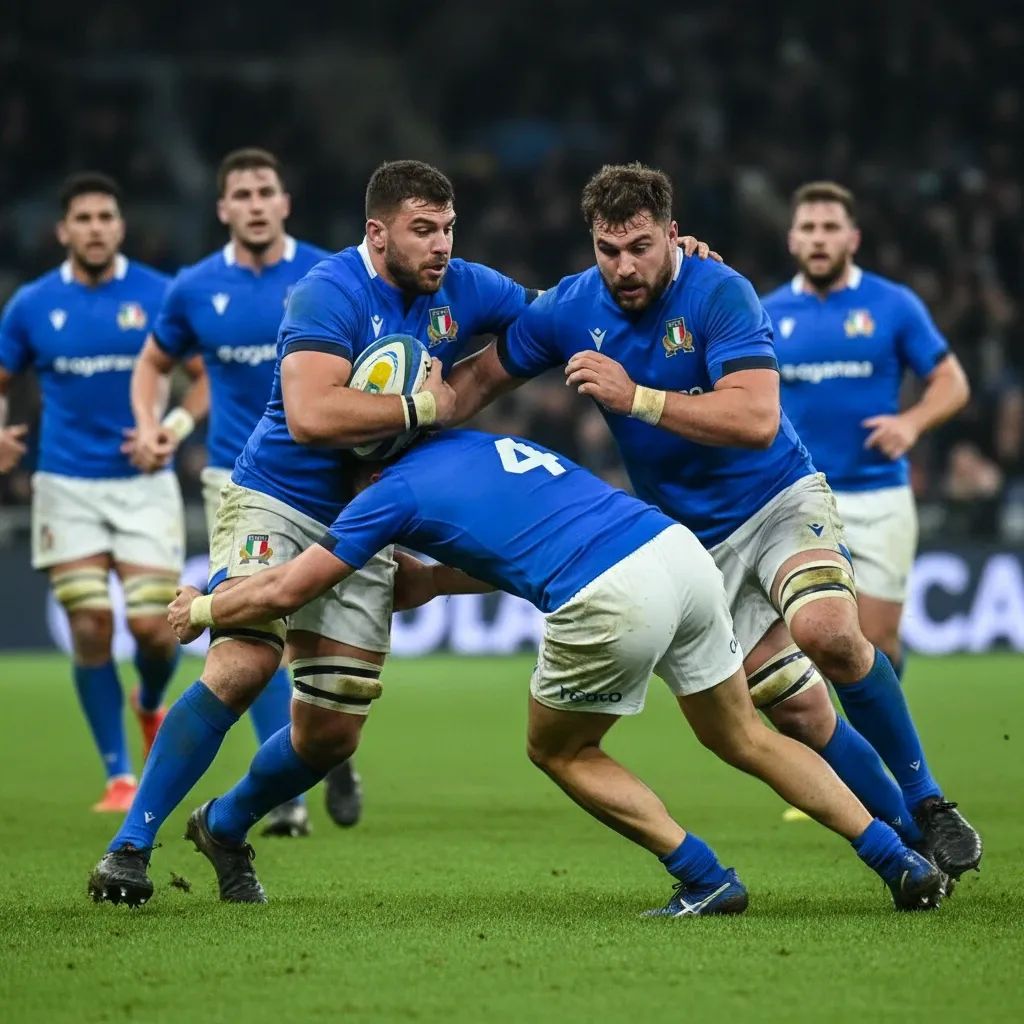
Italy's national rugby squad absorbed a heavy 33-8 defeat to France in Lille, a result that exposes the razor-thin margin between competing and converting when facing Europe's elite sides. The match remained competitive until the final 10 minutes, when France's depth and finishing power pulled away from a resilient Italian effort that had kept the score at 19-8 through 70 minutes.
Why This Matters:
• Tournament standing: Italy sits 4th in the 2026 Six Nations table with 4 points after three matches—one win against Scotland, two losses.
• Home fixture next: The Azzurri return to Rome's Stadio Olimpico on 7 March to face England at 17:40, a must-win opportunity to salvage tournament momentum.
• Finishing crisis: Italy created multiple scoring chances but converted none—a 20% success rate when 80% is needed against top-tier opposition, according to captain Michele Lamaro.
• France unbeaten: Les Bleus sit atop the standings with a perfect 15 points from three matches, powered by Antoine Dupont's orchestration and opportunistic scoring.
Competitiveness Without Reward
The Italy Rugby Federation's squad under head coach Gonzalo Quesada delivered 70 minutes of disciplined, organized rugby that belied the final scoreline. Playing in red jerseys at the Decathlon Arena, the Azzurri absorbed wave after wave of French pressure, bottled up star scrum-half Antoine Dupont repeatedly, and briefly threatened to turn the contest into a genuine upset.
Yet the numbers tell a harsher story. France scored four tries in the opening 29 minutes—exploiting a bouncing ball after a long lineout throw by Nicotera, capitalizing on turnovers, and punishing Italian handling errors—before Italy's Ange Capuozzo finally crossed for the visitors' lone try. Fly-half Paolo Garbisi added a penalty to bring the score to 19-8 at the interval, a deficit that held for much of the second half.
The collapse came late. Debutant Dréan powered over in the 75th minute following a driving maul, and Gailleton added a fifth try shortly after, inflating the margin to 25 points and securing France a bonus-point victory that restored them to the tournament lead.
What This Means for Italian Rugby
Italy's inability to capitalize on attacking possession remains the defining flaw. Quesada's postgame assessment was clinical: "We defended with discipline, had possession and territory, and created interesting opportunities. I never felt ultra-dominated. But we gave away situations—bounces, lost balls—and at this level, you pay."
Captain Michele Lamaro was more direct, emphasizing that creating three or four clear try-scoring chances against France means nothing without finishing at least 80% of them. Against Scotland on 7 February, Italy managed just that, grinding out an 18-15 home victory. Against Ireland on 14 February, they lost 21-54 but showed flashes of ambition. Against France, the pattern repeated: brave defense, creative attack, zero payoff.
The Italy Rugby squad's challenge is now mental as much as tactical. With England arriving in Rome in two weeks, the Azzurri face a side that has beaten Ireland 42-21 and put 48 points on Wales but also lost to Scotland 20-31. England are vulnerable—but only if Italy can convert pressure into points.
France's Formula: Dupont and Opportunism
France's national rugby team under Fabien Galthié continues to redefine pace and improvisation. Antoine Dupont, back after a brief Olympic sevens detour, remains the fulcrum: his box kicks pinned Capuozzo deep, his quick taps accelerated French rucks beyond 2 seconds, and his grubber kick set up Bielle-Biarrey's opening try after just 4 minutes.
France's tactical blueprint leans on three principles: submerger (flood the breakdown), étirer (stretch the defense), and surcharger (overload isolated zones). Dupont's vision and off-the-cuff passing make those concepts lethal. Italy's Lorenzo Cannone disrupted one French phase sequence in the 6th minute, and flanker Zuliani intercepted a Ramos pass in the 9th, but those moments of resistance were islands in a French tide.
Ramos scored the third try after a 50-meter counterattack by Gailleton, who scooped a loose ball and sprinted downfield. The fourth came from a pick-and-go sequence led by powerful lock Meafou. By halftime, France had 19 points from situations Italy will review with frustration—each try born from an Italian error rather than French dominance in set-piece or phase play.
Tournament Landscape and Road Ahead
The 2026 Six Nations standings after three rounds:
France: 15 points (3 wins)
Scotland: 11 points (2 wins, 1 loss + bonus points)
England: 10 points (2 wins, 1 loss + bonus points)
Italy: 4 points (1 win, 2 losses)
Wales: 1 point (3 losses + 1 bonus point)
Ireland: 0 points (2 losses)
Italy's position is fragile but not hopeless. A home win against England on 7 March would lift them to 8 or 9 points and keep alive hopes of a mid-table finish—a modest but meaningful target for a program still building consistency under Quesada's second season.
The final match comes on 14 March in Cardiff against Wales, who have lost all three fixtures so far. Italy will be favored there, but only if the finishing woes are addressed in training over the next fortnight.
Quesada's Balancing Act
The Italy national team coaching staff under Gonzalo Quesada has overseen tangible progress: the scrum won penalties against France, prop Fischetti anchored a dominant shove, and the lineout—though shaky—generated enough clean ball to threaten. Quesada's attacking system, which blends phase play with opportunistic kicking, has made Italy a "serious threat" according to independent analysis, with players like Menoncello and Capuozzo thriving in space.
But the system depends on execution. In the second half against France, Italy's lineout accuracy dropped below 70%, starving the backs of quality possession. Without clean ball, Garbisi and Lynagh had no platform to launch attacks, and France's defense—anchored by Dupont's reading of breakdowns—smothered anything ambitious.
Quesada must now decide: does he simplify the game plan to guarantee higher completion rates, or persist with the high-risk, high-reward style that nearly toppled Ireland and held France at bay for 70 minutes? The England match will reveal his choice.
Player Spotlight: Capuozzo and Garbisi
Ange Capuozzo, Italy's electric fullback, remains the brightest spark. His try—a hustling chase onto a loose ball after Menoncello's kick pressured the French backfield—showcased his instinct and speed. Earlier, his crossfield kick found Lynagh perfectly, setting up the attacking sequence that led to the try. Yet Capuozzo also bore the brunt of Dupont's aerial assault, fielding high balls under intense pressure from French chasers. He held firm, but the tactic exposed Italy's lack of depth in back-three cover.
Paolo Garbisi contributed a crucial penalty and a try-saving tackle on Ramos in the 20th minute, but his goal-kicking remains inconsistent—Italy needs him at 80% success to punish opposition errors. Against England, Garbisi will face a more physical defensive line; his distribution and territorial kicking must improve if Italy are to control field position.
Lessons from France, Hope for Rome
The Azzurri rugby squad will spend the next two weeks dissecting what went wrong in Lille. The defensive structure held for 70 minutes, a testament to assistant coach Mike Catt's systems. The scrum, once a liability, now wins penalties. The attacking ambition is genuine.
What's missing is ruthlessness. France punished every Italian mistake within 30 seconds. Italy created half a dozen promising positions and scored once. The gap between competitive and successful lies in that conversion rate, and no amount of tactical innovation compensates for dropped passes, inaccurate lineouts, or hesitant support runners.
England arrive in Rome with their own vulnerabilities—Scotland exploited their narrow defense, and Ireland ran through their midfield channels. If Italy can deliver clean set-piece ball and finish half their chances, the Olimpico crowd on 7 March will witness a contest. If not, the tournament risks unraveling into a battle with Wales to avoid the wooden spoon.
The pieces are in place. The coaching is sound. The talent exists. Now Italy must prove they can finish what they start.


