
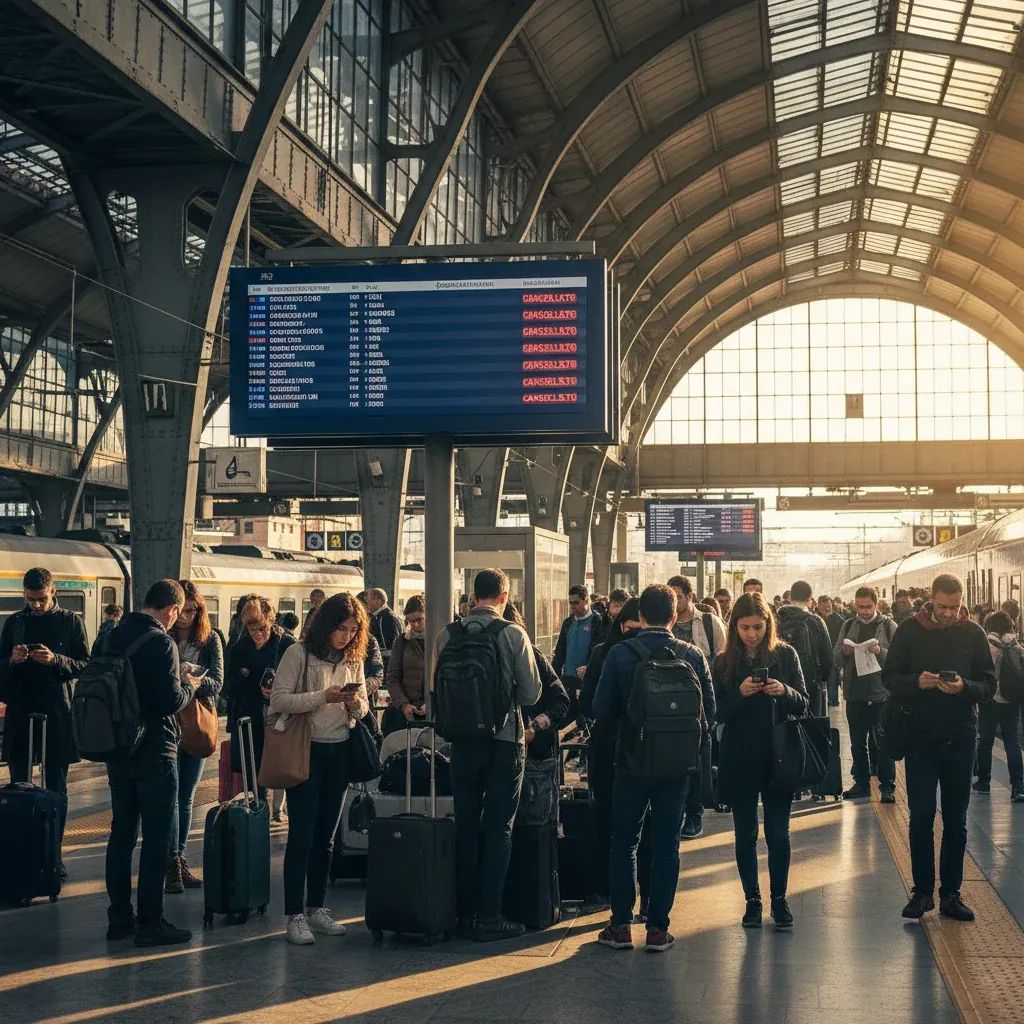
A nationwide rail stoppage that would have disrupted millions of journeys across Italy on Wednesday has been called off, but commuters still face a turbulent 24 hours as grassroots unions press ahead with their own strike action.
Why This Matters:
• Major national strike canceled after government negotiations on June 9
• Regional and base union strikes still active from 3:00 a.m. Wednesday to 2:00 a.m. Thursday
• High-speed, Intercity, and regional services may face cancellations outside guaranteed travel windows (6:00–9:00 a.m. and 6:00–9:00 p.m.)
• Travelers should check service status with Trenitalia, Italo, and Trenord before departure
Government Talks Avert Full Shutdown
The Italy Ministry of Infrastructure and Transport (MIT) convened emergency talks with the country's leading rail unions on Tuesday evening, presided over by Deputy Minister Edoardo Rixi. Six major labor organizations—Filt-Cgil, Fit-Cisl, Uiltrasporti, Ugl Ferrovieri, Fast Confsal, and Orsa Trasporti—emerged from the meeting with an agreement to suspend their planned 8-hour national walkout.
The original protest, scheduled for June 11, stemmed from disputes over the government's decision to split upcoming Intercity rail tenders into three separate regional lots rather than award a single national contract. Union leaders argue this fragmentation invites a race to the bottom on wages and service quality, opening the door to foreign operators who may undercut local labor standards.
Deputy Minister Rixi declared the suspension proof that "serious and concrete dialogue delivers results," and promised continued collaboration to safeguard both worker rights and commuter needs. The Ministry emphasized it had "listened and gathered the demands of rail workers, protecting a working day for millions of employees and commuters."
Grassroots Strikes Proceed Regardless
Despite the headline-grabbing cancellation, two base unions—Cub Trasporti and Sgb (Sindacato Generale di Base)—are maintaining their 23-hour strike, running from 3:00 a.m. on June 11 through 2:00 a.m. on June 12. Their platform focuses on demands for a collective bargaining agreement that adequately protects rights, safety, health, and wages for all rail workers, distinct from the Intercity tender dispute.
The stoppage affects staff employed by all rail companies and freight-on-rail operators, with particular impact expected on Trenitalia Tper services in Emilia-Romagna and neighboring regions. Network operator RFI has flagged potential disruptions to High-Speed (Frecciarossa, Frecciargento, Frecciabianca), long-distance Intercity, and regional routes during the strike window.
In addition, smaller sector-specific walkouts remain scheduled:
• National Assembly Pdm/Pdb (train drivers and onboard crew of the FS Group): 9:01 a.m. to 5:00 p.m., June 11
• FS Security personnel in Sicily: 10:01 a.m. to 6:00 p.m., June 11
• Mercitalia Shunting & Terminal workers: 6:00 a.m. to 2:00 p.m., June 11
What This Means for Residents
Passengers traveling Wednesday morning or evening should anticipate cancellations, delays, and last-minute changes. Regional trains typically observe protected service bands from 6:00 to 9:00 a.m. and from 6:00 to 9:00 p.m., when skeleton crews ensure minimal connectivity. Outside these windows, service levels depend on participation rates among rank-and-file staff.
High-Speed and Intercity routes enjoy less formal protection, meaning journeys scheduled between 9:00 a.m. and 6:00 p.m. face higher cancellation risk. Travelers holding tickets for this period are advised to check real-time updates on official carrier websites—Trenitalia, Italo, and Trenord—and to review refund or rescheduling policies before heading to the station.
For those whose trains are scrapped, the Italy Consumer Code (Article 30 of Legislative Decree 206/2005) entitles passengers to full refunds or alternative transport of comparable standard, though in practice securing a seat on a packed alternative service can prove challenging during strikes.
The Broader Battle Over Rail Liberalization
The June 11 dispute is the latest flashpoint in a multi-year struggle over Italy's railway future. By mid-2026, the sector has already logged 5 national strikes totaling 119 hours—a pace roughly in line with 2024 (11 strikes, 227 hours) and 2025 (12 strikes, 245 hours). Recurring themes include contract renewals, wage increases, job security in outsourced services, and opposition to competitive tendering that unions fear will erode standards.
At the heart of the current standoff lies the Ministry's plan to divide the Intercity network into three non-equivalent geographic lots. Unions contend this risks "contractual dumping," where operators compete by squeezing labor costs rather than improving service quality. They warn of reduced commercial offerings, network congestion, and deteriorating passenger experience, particularly as new international entrants eye Italy's liberalized High-Speed market.
The debate echoes broader European tensions over railway unbundling and open-access competition, pitting proponents of market efficiency against defenders of integrated national operators. Italy's experience with High-Speed competition between Trenitalia and Italo has delivered lower fares and higher ridership, but the extension of that model to the loss-making Intercity segment remains contentious.
Economic Toll on Commuters and Business
Rail strikes exact a steep price beyond platform inconvenience. Recent economic analyses estimate that transport stoppages in Italy generate annual productivity losses between €1.8 billion and €2.4 billion, factoring in missed work hours, supply-chain delays, and reduced consumer spending. The tourism sector alone absorbs roughly €450 million in annual strike-related damage, as visitors cancel bookings or curtail itineraries.
For individual commuters, even routine delays—unrelated to strikes—add up to 30–40 hours of wasted time per year for those experiencing just 15–20 minutes of daily lateness. During strikes, the burden multiplies: travelers pay for taxis, car-share rides, and parking, or burn through leave days waiting for service to resume. The psychological cost—elevated stress, eroded work-life balance—compounds the financial hit.
Businesses face disrupted logistics, missed meetings, and idled staff. A single national strike can subtract several hundred million euros to roughly €1 billion from GDP in one day, according to industry estimates. Indirect costs ripple through manufacturing, logistics, and services, where just-in-time delivery models leave little margin for transport interruptions.
State coffers also take a hit: reduced economic activity translates to €580–€810 million in foregone tax revenue annually, encompassing VAT, income tax, and social contributions. That shortfall tightens fiscal room at a time when public investment in rail infrastructure—another union demand—remains a political flashpoint.
Navigating Wednesday's Uncertainty
Passengers holding tickets for June 11 should adopt a defensive posture:
Check service status early Wednesday morning via carrier apps or websites; many cancellations are posted by midnight.
Arrive at stations with buffer time; crowds swell as travelers scramble for guaranteed services.
Activate ticket-change or refund requests online to avoid ticket-office queues.
Monitor social media accounts of Trenitalia, Italo, and Trenord for real-time alerts.
Consider alternative transport—FlixBus, BlaBlaCar, or regional bus networks—though these fill quickly once strike news breaks.
For employers, Wednesday offers a reminder to revisit remote-work contingency plans. Companies that rely on rail freight should liaise with Mercitalia and private operators to assess whether the morning shutdown affects cargo movements, particularly perishable or just-in-time shipments.
What Happens Next
The suspension of the main strike buys both sides time to negotiate, but the underlying disputes remain unresolved. Unions have not withdrawn their opposition to the three-lot Intercity model, and the Ministry has yet to offer binding social clauses in tender documents—a demand that would guarantee job protections and wage floors for staff transferred to new operators.
Further talks are expected in the coming weeks, with unions retaining the option to call fresh strikes if they judge progress insufficient. The Italy Guarantor Authority for Strikes in Transport Services—the regulatory body that enforces minimum service levels—continues to monitor compliance, though its powers to block or delay walkouts are limited by collective-bargaining protections enshrined in Italian labor law.
In the meantime, Wednesday's partial shutdown serves as both a warning and a dress rehearsal. Travelers accustomed to Europe's most punctual rail systems may find Italy's stop-start summer a jarring reminder that the country's transport backbone remains a contested political and economic arena. For those relying on the 6:15 a.m. regional to Milan or the evening Frecciarossa to Rome, the advice is simple: check, recheck, and have a Plan B.


