
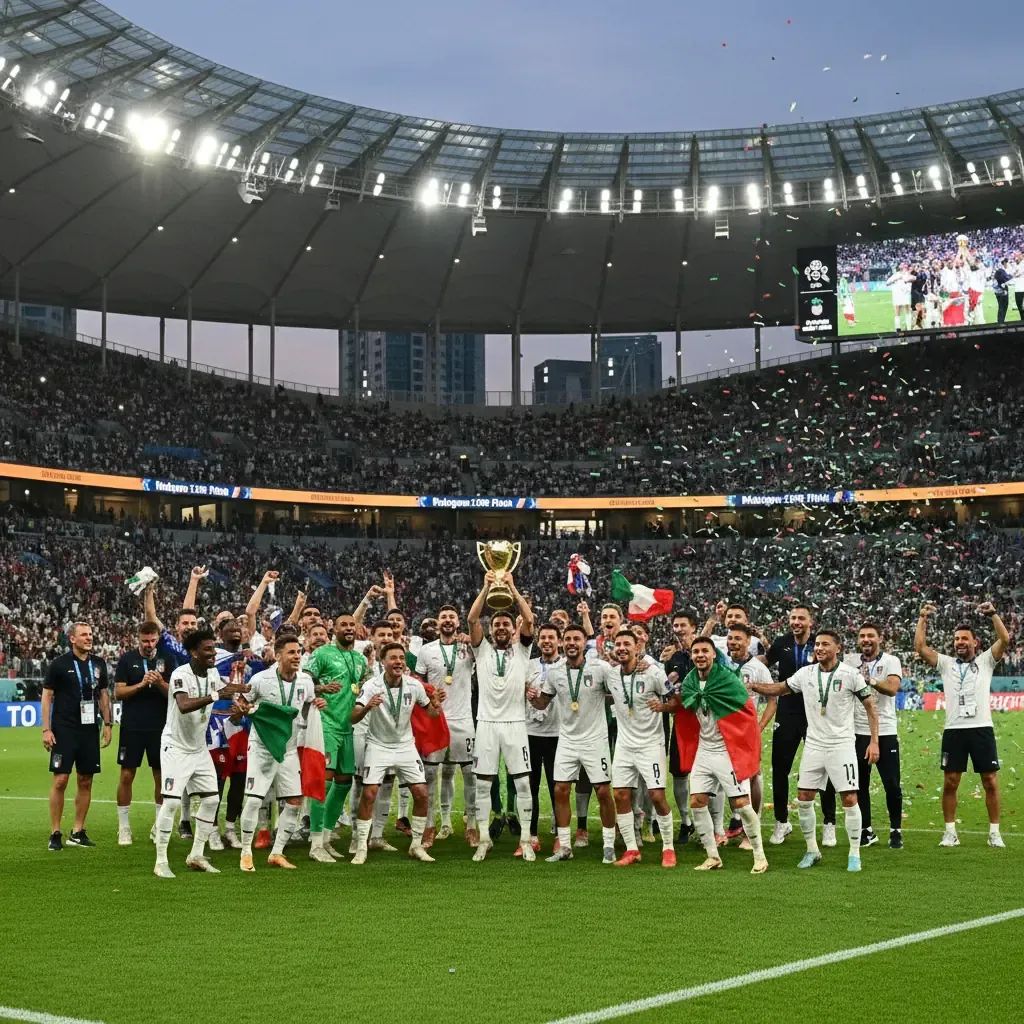
The Italian Football Federation (FIGC) is entering a critical phase of its search for a new national team manager, with an announcement expected within days that will shape the trajectory of Italian football through the 2030 World Cup cycle. The decision comes 111 days after Gennaro Gattuso resigned following Italy's failure to qualify for the 2026 World Cup—compounding previous absences from 2018 and 2022, an unprecedented crisis for a four-time champion.
Why This Matters
• Three-man shortlist: The FIGC is evaluating Pep Guardiola, Roberto Mancini, and Andrea Pirlo, with federation insiders suggesting a "surprise" candidate may still emerge.
• Regional pride at stake: Neighboring France and Germany are finalizing appointments of Zinedine Zidane and Jürgen Klopp respectively, raising pressure on Italy to make a statement hire.
• Timeline under scrutiny: The vacancy has now extended far longer than ideal, with the 2026 World Cup qualification cycle already underway while Italy's coaching search continues.
• Presidential promise: New FIGC president Giovanni Malagò has pledged a resolution "within very few days," though not necessarily at Thursday's Serie A assembly where he and technical director Paolo Maldini are scheduled to appear.
What This Means for Italian Football
The coaching selection will define Italy's footballing identity for the next World Cup cycle. A Guardiola appointment would signal a return to elite European status, attracting international attention and potentially luring talented young players with dual nationality options. A Mancini return offers continuity and experienced crisis management but risks appearing backward-looking. Pirlo represents a philosophical commitment to long-term development, accepting short-term uncertainty for potential future payoff.
For Italian residents and football supporters, the decision carries practical and emotional weight. Three World Cup absences have created a crisis of confidence that extends beyond the national team. National team performance influences commercial revenues, sponsorship deals, and grassroots participation rates. Minister Abodi recently announced that 0.5% of sports audiovisual rights allocated to the FIGC will be redirected to Lega Pro to incentivize youth talent development. This structural reform acknowledges that the coaching appointment is part of a broader rebuilding effort—the new manager will inherit not just a squad but responsibility for restoring the entire footballing ecosystem that supports elite performance. Young players at local clubs watch the Azzurri; how the national team performs directly influences whether they pursue professional football careers and whether communities invest in youth academies.
The Guardiola Gambit: Ambition Meets Reality
The FIGC leadership triumvirate—president Malagò, technical director Maldini, and his advisor Leonardo—traveled to Barcelona around July 20, 2026 to meet with Guardiola, presenting him with a four-year project culminating in the 2030 World Cup. The pitch represents Italy's most ambitious coaching recruitment effort in modern history, targeting the Catalan tactician who recently concluded a decade-long tenure at Manchester City.
Yet the obstacles are formidable. Guardiola has publicly stated his intention to take a sabbatical, telling reporters he wants to "discover life" outside football after years of relentless club management. According to sources close to the negotiations, his initial response to the Italian delegation was polite but brief—a conversation lasting only minutes in which he reiterated his desire not to consider offers at this time. Some insiders suggest he might delay any decision until early 2027, a timeline incompatible with Italy's immediate needs.
The financial dimension adds another layer of complexity. Guardiola's salary expectations, shaped by his Manchester City contract, far exceed typical national team compensation structures. While the FIGC hasn't disclosed budget parameters, Malagò has emphasized the need for "compatibility with federal finances," a coded acknowledgment that landing Guardiola would require extraordinary financial creativity.
Despite these challenges, the pursuit itself signals intent. As sports minister Andrea Abodi noted at a recent memorial event, "The national team shirt is loved, and this is not the time to question it." His comments, while diplomatically neutral, underscore the political dimension of the appointment—a coaching choice that will be interpreted as either a statement of renewed ambition or acceptance of diminished status.
Mancini's Redemption Arc
Roberto Mancini presents a markedly different profile. The 57-year-old is the last manager to lift a trophy with Italy, having guided the Azzurri to Euro 2020 glory before his controversial departure for a club position in the Gulf in 2023. That exit, which came with a substantial financial package, damaged his reputation among Italian supporters who viewed it as abandonment during a critical qualification period.
Now, following his contract termination, Mancini is widely reported to be "ready to relaunch himself on the national bench." According to football market specialist Ciro Venerato, speaking on July 17, Mancini has signaled clear availability. In a June 2025 interview—months before the current vacancy—he had already hinted at regret, stating: "For a manager, there is nothing more beautiful than guiding the national team" and admitting his previous departure was "a mistake."
President Malagò is understood to favor Mancini's candidacy, valuing both his proven international credentials and his familiarity with Italian football infrastructure. The arrangement would likely involve significantly lower salary demands than the Guardiola option, easing budgetary pressures while providing immediate credibility. An "agreement in principle" has been discussed in multiple reports, suggesting advanced negotiations.
Yet Mancini's return would be complicated by the circumstances of his departure. Italian football media and fan bases remain divided on whether his Gulf sojourn constitutes a disqualifying breach of loyalty or simply a pragmatic career choice. The question of trust—whether he would remain committed through the 2030 cycle—will inevitably dominate public discourse if his appointment is confirmed.
Pirlo's Unproven Vision
Andrea Pirlo, the third candidate, represents the highest-risk, highest-potential option. At 47, the former midfield maestro brings tactical sophistication and deep understanding of Italian football culture, having earned widespread respect during his playing career. Paolo Maldini, in particular, champions Pirlo's candidacy, viewing him as possessing a modern, progressive football philosophy aligned with the technical regeneration Italy requires.
Pirlo's coaching résumé, however, remains thin. His managerial experience spans just six years:
• Juventus Under-23 (2020): Appointed but quickly promoted
• Juventus first team (2020-2021): Won Coppa Italia and Supercoppa Italiana; finished 4th in Serie A
• Fatih Karagümrük (Turkey, 2022-2023): Mid-table finish
• Sampdoria (Serie B, 2023-2024): Playoff qualification, first-round elimination
• United FC (Dubai, 2025-present): Current position
His tactical thesis, written for his coaching license, outlines a "proactive, possession-based, attacking" system with all 11 players active in both phases, manipulating space and time through patient buildup from the back. He favors flexible formations—primarily 4-3-3, 4-1-4-1, and 3-5-2—adapting to match situations rather than adhering to rigid structures.
What Pirlo lacks in experience, he compensates with three assets: affordable salary requirements, intimate knowledge of Italian football ecosystems, and "bomb-proof attachment to the Azzurri shirt," as one federation source described it. Whether these intangibles can substitute for proven success at the highest levels remains the central question.
The Mystery Candidate
Malagò's cryptic comment—"there are not only Pirlo and Mancini on the list, there could be a surprise"—has fueled speculation about a fourth option. Names floated include Antonio Conte, currently unattached after leaving Napoli, and Raffaele Palladino, though both are considered less likely than the primary trio. The possibility remains that Malagò is simply managing expectations or maintaining negotiating leverage.
Thursday's Serie A assembly may clarify the timeline, though Malagò has already suggested the announcement might "slip by a few more days" beyond that gathering. What is certain is that Italy's footballing community, after nearly four months of speculation, awaits a resolution that will either restore confidence or deepen skepticism about the federation's ability to navigate its most challenging era in decades.


