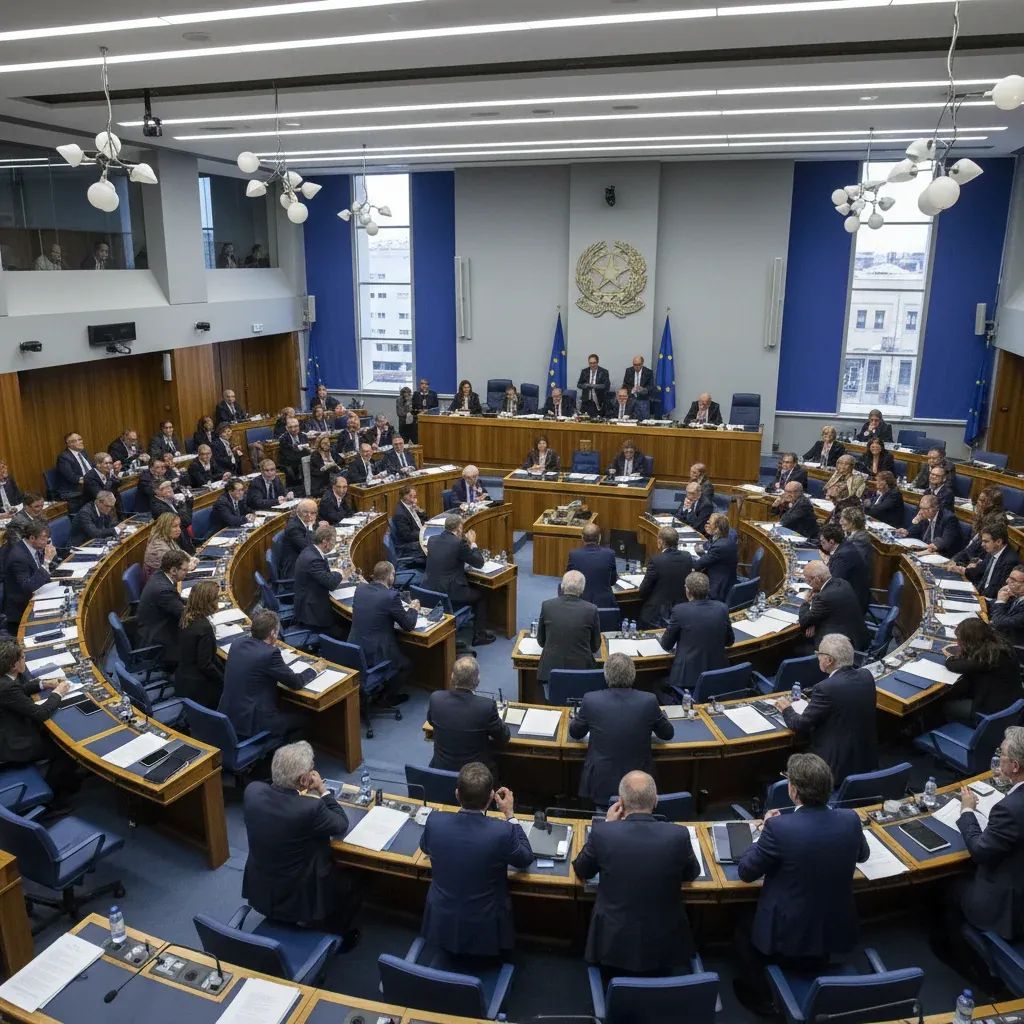
The Italian Cabinet approved a controversial draft law on July 23, 2026 that would reverse the burden of proof in criminal cases involving defendants aged 14 to 18, triggering alarm from legal experts, child welfare organizations, and frontline workers who warn the measure could undermine decades of educational justice principles.
Why This Matters
• Legal presumption shift: Minors between 14 and 18 will now be presumed criminally responsible unless their defense can prove they lacked the capacity to understand their actions at the time of the offense.
• Constitutional concerns: Italy's criminal lawyers' union warns the bill may violate constitutional protections for minors.
• Parliament approval required: The draft must still pass through both chambers of Parliament before becoming law.
• Part of broader crackdown: This follows the Caivano Decree enacted three years earlier in 2023, which expanded arrest powers and lowered thresholds for pretrial detention of juveniles.
The Current System Under Pressure
Italy's juvenile justice framework currently treats adolescent defendants between 14 and 18 differently from adults. Under Article 98 of the Penal Code, judges must determine on a case-by-case basis whether a minor possessed the mental and emotional maturity to grasp the consequences of their actions. If they lacked that capacity, they cannot be prosecuted.
The new bill, championed by Prime Minister Giorgia Meloni and Justice Minister Carlo Nordio, flips that logic. Going forward, the government proposes that criminal capacity be assumed unless the defense can demonstrate otherwise. The minimum age of criminal responsibility remains at 14, and no harsher sentences are introduced, but the procedural change is substantive: it shifts investigative and evidentiary burdens onto the defendant.
Officials frame the reform as a practical response to rising juvenile crime and as a logical follow-up to the Caivano Decree, a September 2023 law that broadened police powers, extended urban exclusion orders to 14-year-olds, introduced a new offense called "stesa" (firing weapons or detonating explosives to spread terror), and lowered the maximum sentence threshold required to impose pretrial detention on minors from 9 years to 6 years.
What Legal Experts Are Saying
The Union of Criminal Defense Chambers issued a sharp rebuke, describing the draft as a "radical attack on the very foundation of juvenile justice." In a statement released by the national executive, the organization warned that the bill "adds another brick to the repressive strategy adopted against minors, which began with the Caivano Decree and continued most recently with the proposed extension of preventive detention to adolescents."
The lawyers' union raised doubts about constitutional compatibility, arguing that the measure represents a "worrying cultural regression." Italy's Constitution enshrines the principle that punishment must aim at rehabilitation, particularly for minors, and critics contend that presuming guilt contradicts that ethos.
Ciro Cascone, a former juvenile prosecutor in Milan who spent 20 years in the specialized courts and now serves as Advocate General at the Bologna Court of Appeal, dismissed the reform as both contradictory and ineffective. "Magistrates will continue to conduct the assessments they have always done regarding capacity," he told journalists. "What worries me is the message. I fear this is a pretext to say 'we tried, and now let's lower the age below 14'—and that is absolutely something to avoid."
Cascone's concern points to a potential slippery slope: if presumption of capacity becomes the norm for 14-to-18-year-olds, advocacy for further lowering the minimum age of criminal responsibility could gain political traction.
Impact on Frontline Social Work and Faith-Based Outreach
Don Claudio Burgio, chaplain at Milan's Cesare Beccaria Juvenile Detention Institute, called the bill "a step backward" in an interview with Radio Vatican. He emphasized the developmental reality that shapes daily life inside the facility. "At 14, 15, 16—sometimes even older—these kids are profoundly unconscious, still immature. Sometimes they cannot perceive the seriousness of their crimes," he said. "Many of these young people have not been raised with an ethical code or a system of values."
For Burgio, the reform chooses "a form of justice that does not respect the age of these boys or their conscience." He criticized the political rhetoric around so-called "baby gangs" and the term "maranza," street slang for delinquent youth. "Using labels and slogans," he argued, "means wanting to simplify a youth distress phenomenon that is very deep. These shortcuts prevent us from looking in depth and making decisions that are forward-thinking."
His critique reflects a broader anxiety among educators and social workers: that policy driven by headline-grabbing incidents may overlook the root causes of juvenile delinquency, such as school dropout rates, family instability, and inadequate mental health support.
UNICEF's Call for Education Over Punishment
UNICEF Italy expressed "grave concern" over the draft law, urging Italian lawmakers to prioritize training and social investment in a country still marked by significant educational poverty and undetected youth distress. The organization invoked the UN Convention on the Rights of the Child, which Italy ratified in 1991, noting that it "requires every measure concerning minors to be guided by their best interest and an educational, not punitive, approach."
The 2019 General Comment No. 24 from the UN Committee on the Rights of the Child specifically recommends that criminal capacity be assessed individually, based on psychological and emotional maturity, rather than presumed. UNICEF warned that reversing the burden of proof risks exposing vulnerable adolescents to legal treatment that does not account for their developmental stage.
Criticism from Civil Society and Anti-Mafia Groups
Libera and Gruppo Abele, two prominent Italian civil society organizations focused on social justice and anti-mafia work, issued a joint statement condemning the move as politically motivated. "We continue in the wrong direction," they wrote, "aiming more for electoral consensus than for real solutions to problems."
The organizations have long argued that effective crime prevention among youth requires investment in community centers, mentorship programs, school retention initiatives, and family support services—none of which feature prominently in the government's recent legislative agenda.
What This Means for Residents
For Italians concerned about both public safety and juvenile welfare, the bill poses a dilemma. On one hand, some communities have experienced high-profile incidents involving young offenders, fueling demand for accountability. On the other, legal and social service professionals warn that a presumption-based system may accelerate incarceration without addressing the underlying conditions that produce delinquency.
If enacted, the law would likely increase the number of minors facing trial and pretrial detention, as judges would no longer be required to affirmatively establish criminal capacity before proceeding. Defense attorneys would need to commission psychological evaluations and expert testimony to rebut the presumption—a burden that could disadvantage minors from low-income families who lack access to specialized legal representation.
The bill must now pass through the Italian Parliament, where opposition parties and advocacy groups are expected to mount a vigorous challenge. Amendments are possible, but the government holds a working majority, making significant alterations uncertain.
Comparative Context: How Other European Countries Handle Juvenile Responsibility
Italy's current system is considered one of Europe's more progressive models, emphasizing individualized assessment and rehabilitation. By contrast, Spain and Portugal set the minimum age of criminal responsibility at 16, treating offenses by 12-to-16-year-olds with exclusively educational measures. Ireland raised its minimum age from 7 to 12 in 2006, retaining detention as a last resort and focusing on educational programming within secure facilities.
The Council of Europe's 2010 Guidelines on Child-Friendly Justice call for specialized training, multidisciplinary approaches, and detention only as a measure of last resort—principles that critics argue the Italian government is now diluting.
The Broader Legislative Context: From Caivano to Present
The Caivano Decree (Law 159/2023) marked a turning point in Italy's juvenile justice policy. Named after a town near Naples plagued by organized crime and youth violence, the law expanded the Questore's power to issue warnings to minors as young as 12, lowered the sentence threshold for pretrial detention, and criminalized possession of drugs for distribution near schools.
Early data suggest the decree has led to more minors entering detention facilities, though overall juvenile crime rates have not spiked dramatically—a pattern critics interpret as evidence of increased criminalization rather than increased offending.
The new draft law on criminal capacity represents the next phase in this policy trajectory, one that places procedural efficiency and prosecutorial leverage above the traditional Italian emphasis on case-by-case developmental evaluation.
Whether this approach will survive parliamentary scrutiny, withstand constitutional challenge, or achieve its stated goals remains an open question—but the stakes for Italy's youngest defendants, and the future direction of its justice system, are undeniably high.