
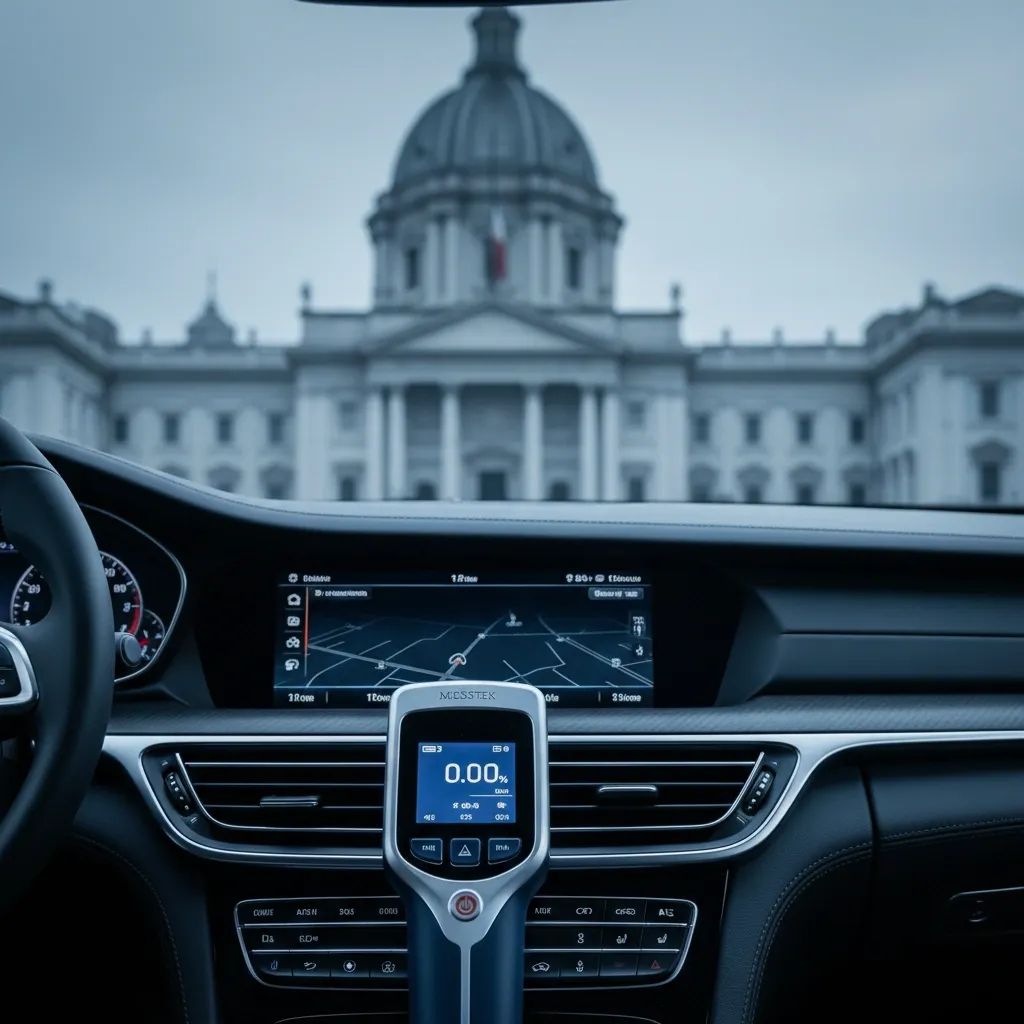
The Italy Ministry of Infrastructure and Transport has officially activated a new alcohol interlock mandate, imposing a €2,000 financial burden on thousands of drivers and raising urgent questions about technical feasibility across the nation's aging vehicle fleet.
Starting February 24, 2026, convicted drunk drivers in Italy must retrofit their vehicles with alcolock devices—breathalyzer-linked ignition systems that prevent engine start-up if alcohol is detected—before regaining full driving privileges. The rollout exposes a collision between policy ambition and practical reality, particularly for owners of older cars and families sharing a single vehicle.
Why This Matters
• Cost shock: Installation alone runs approximately €2,000 per vehicle, plus recurring expenses for periodic calibration, maintenance, and disposable mouthpieces.
• Old cars locked out: Italy's fleet averages 13 years of age—many models lack the electronic architecture necessary for alcolock integration, making compliance physically impossible.
• Restricted installer network: Only Ministry-approved workshops can perform installations, artificially limiting competition and driving up wait times and prices.
• Household collateral damage: Families with one shared car face zero-tolerance alcohol rules for all drivers, even those with clean records.
Who Must Install and How Long
The alcolock obligation applies to any driver holding an Italy-issued license who has received a final conviction for driving under the influence with a blood alcohol concentration (BAC) exceeding 0.8 g/L. Two special codes now appear on affected licenses: Code 68 (absolute alcohol prohibition) and Code 69 (vehicle must be equipped with a certified alcolock).
Duration varies by offense severity: two years for BAC between 0.8 and 1.5 g/L, and three years for readings above 1.5 g/L, both starting after the license suspension period ends. The mandate extends beyond passenger cars to commercial vans, buses, and trucks, amplifying the economic impact on professional drivers and small haulage operators.
As of February 23, the Portale dell'Automobilista published the official registry of approved devices—currently the Breatech Alcolock B1000 and Zaldy Alcolock (Zaldy V3 LE)—alongside a limited roster of authorized installation centers.
The €2,000 Question: What You're Really Paying For
Federcarrozzieri, the national association representing Italy body shops, emphasizes that the headline €2,000 figure covers only the initial purchase and installation. Drivers must also budget for:
• Periodic recalibration mandated by Ministry decree to ensure accuracy
• Routine maintenance checks to keep the device compliant
• Disposable mouthpieces for hygiene, required for each breath test
No official subsidy or payment plan program exists, leaving the entire financial burden on the individual—even if that person's conviction dates back years and they have since demonstrated sobriety.
For context, €2,000 represents roughly one month's gross salary for many Italy workers, or the equivalent of a substantial vehicle repair. When compounded with the cost of license reinstatement fees and increased insurance premiums post-conviction, the total expense can approach €3,000 or more over the obligation period.
Compatibility Crisis: When Your Car is Too Old
Italy's automotive landscape presents a unique challenge. With an average vehicle age of 13 years, a significant portion of the national fleet predates the standardized electronic control units (ECUs) that alcolock systems rely on for seamless integration.
Technical barriers include:
• Mechanical ignition systems in pre-2000s models that lack the digital interface points required for interlock connection
• Non-standard electrical architectures in vehicles manufactured before widespread adoption of 12-volt systems (the industry norm since 1955, but inconsistently applied in certain markets)
• Weak or aging batteries unable to sustain the alcolock's minimal power draw without frequent discharge
• Deteriorated wiring harnesses that make secure, safe connections difficult or dangerous
While most post-1990 vehicles from major manufacturers—BMW, Ford, Iveco, Citroen, DAF—appear on the compatibility lists, drivers of niche brands, vintage models, or heavily modified vehicles may find themselves in a bureaucratic dead end: unable to install the device, yet unable to drive legally without it.
Hybrid and electric vehicles add another layer of complexity. Certain models, including some Tesla variants, employ 16-volt electrical systems incompatible with standard alcolock units, though workarounds exist at additional cost.
Market Distortion and the Installer Bottleneck
Federcarrozzieri President Davide Galli highlights a structural flaw in the rollout: only workshops explicitly designated by device manufacturers and listed on the Ministry registry can perform installations. This closed-loop system excludes hundreds of otherwise qualified body shops and repair centers, violating Italy's competition statutes and creating artificial scarcity.
The consequences are predictable:
• Longer wait times for installation appointments, delaying license reinstatement
• Higher labor costs due to reduced competition among authorized centers
• Geographic disparities, with rural and southern regions particularly underserved
This bottleneck also raises liability concerns. If an obligated driver cannot secure an installation appointment due to capacity constraints, they face continued license suspension—and potential criminal penalties if caught driving—through no fault of their own.
The Single-Car Family Paradox
A particularly harsh unintended consequence affects households with one shared vehicle. Once the alcolock is installed, every family member must pass a zero-BAC breath test to start the engine—regardless of whether they have any alcohol-related driving history.
This means:
• A spouse with a spotless record cannot drive after a single glass of wine with dinner
• Adult children living at home face the same restrictions
• Even passengers cannot assist in an emergency if the primary driver becomes incapacitated
The Ministry has not issued guidance on exemptions or alternative arrangements for multi-driver households, leaving families to navigate the policy gap on their own. Some legal experts suggest registering a second vehicle in another family member's name, but that option is financially out of reach for many.
Enforcement and Penalties: What Happens If You Don't Comply
Italy authorities are taking a hard line on non-compliance. Drivers subject to the alcolock mandate who fail to install the device face:
• Fines ranging from €158 to €638
• License suspension extended by one to six months
Tampering with or disabling an installed alcolock triggers doubled penalties, and driving under the influence without the required device results in sentences increased by one-third.
These enforcement measures apply nationwide, with Polizia Stradale and Carabinieri conducting roadside checks. In the first three months following the December 2024 Code update, authorities tested over 203,000 drivers, sanctioning 1.7% for alcohol violations—a rate suggesting roughly 3,500 potential alcolock candidates annually if conviction trends hold.
Impact on Residents and Professional Drivers
For Italy residents, particularly those in sectors requiring regular vehicle use—sales representatives, tradespeople, delivery drivers—the alcolock mandate represents a career-altering event. Professional drivers convicted of DUI face not only the personal expense but potential job loss if employers deem the device a liability or insurance risk.
Foreign residents and expats holding Italy licenses are equally subject to the rule, with no provision for international license swaps or exemptions. If you rent or lease a vehicle, you must arrange for alcolock installation on that vehicle or forego driving entirely during the obligation period.
For investors and fleet operators, the policy introduces new compliance costs. Companies employing drivers with alcolock obligations must decide whether to accommodate the devices on corporate vehicles or reassign those employees to non-driving roles—a decision with labor law implications.
What Other European Countries Are Doing
Italy joins a growing list of EU member states—Austria, Belgium, France, Denmark, Sweden, Finland, Poland, and Lithuania—that have adopted alcolock programs. Most of these countries apply the technology to commercial vehicles, heavy transport, and public transit as a condition of license reinstatement after serious alcohol offenses.
France takes a rehabilitation-focused approach: drivers face medical and psychological evaluations before license reinstatement, with alcolock installation sometimes offered as an alternative to extended suspension. The French system prohibits permanent revocation, instead imposing six-month to one-year waiting periods depending on recidivism.
Germany and Switzerland combine administrative and judicial authority to revoke licenses, often conditioning reinstatement on proof of sobriety through medical testing rather than mandating device installation.
Studies from Scandinavian programs show alcolock use reduces recidivism by up to 75% during the installation period, though long-term behavioral change depends heavily on accompanying counseling and support services—elements largely absent from Italy's current framework.
The Road Ahead: What You Should Do Now
If you are subject to the alcolock mandate or know someone who is, here are immediate steps:
Check vehicle compatibility by consulting the Portale dell'Automobilista registry and contacting authorized installers early—appointment backlogs are already forming.
Budget comprehensively: Factor in not just the €2,000 installation but ongoing calibration, maintenance, and mouthpiece costs over the two- or three-year obligation.
Explore alternative transport: For older vehicles deemed incompatible, consider whether selling and purchasing a compatible model is more cost-effective than extended license suspension.
Review household vehicle arrangements: If you share a car, discuss whether a second vehicle or car-sharing arrangement is necessary to preserve mobility for non-obligated drivers.
Document everything: Keep records of installation appointments, calibration dates, and maintenance logs—these will be critical if disputes arise over compliance.
The alcolock rollout marks a significant shift in Italy road safety enforcement, one that prioritizes technological intervention over traditional penalties. Whether it proves effective in reducing alcohol-related crashes—or merely imposes unsustainable costs on already-penalized drivers—will depend largely on how quickly the Ministry addresses the compatibility, cost, and access issues now surfacing across the country.


