
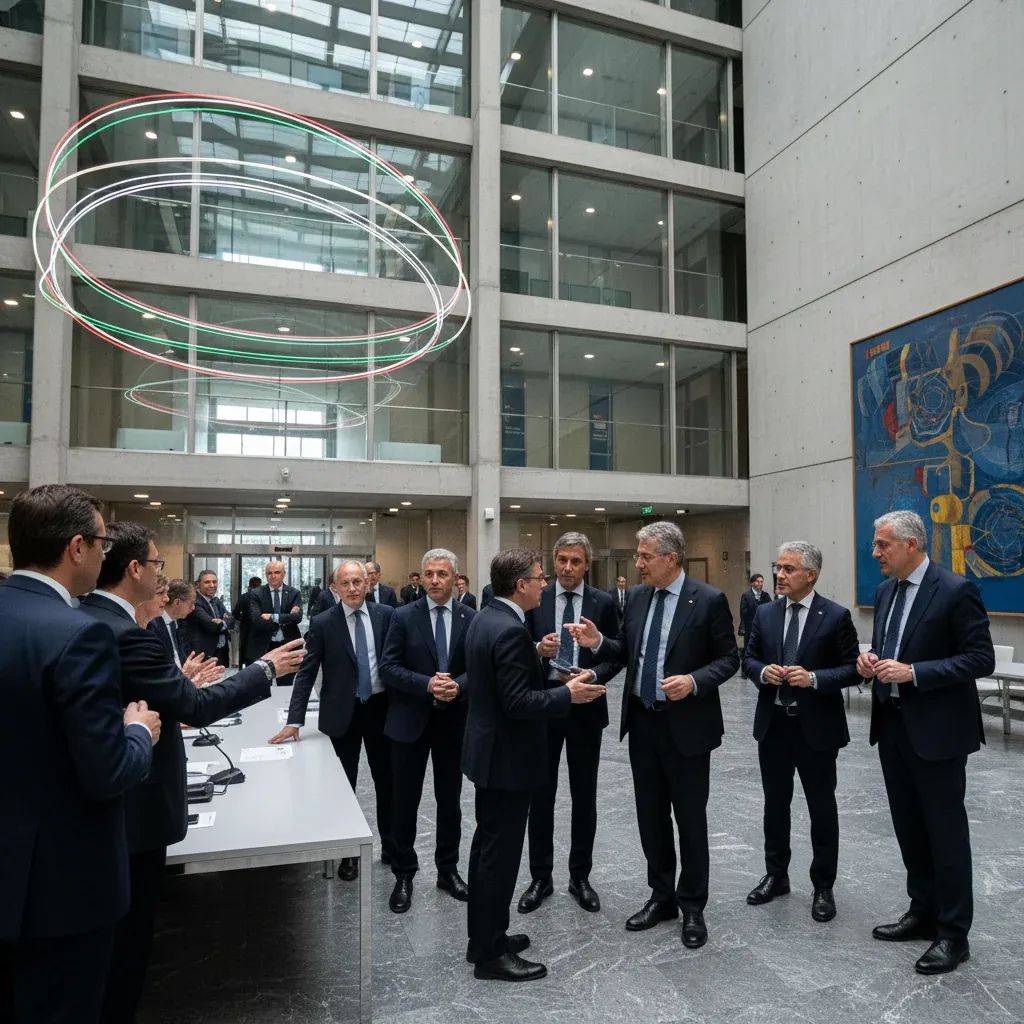
The Federazione Italiana Giuoco Calcio (FIGC) has installed its new leadership structure this week, with newly appointed President Giovanni Malagò naming Ezio Maria Simonelli as Deputy Vice President and Umberto Calcagno as Vice President—a power-sharing arrangement that signals both reconciliation with Serie A clubs and a nod to player representation during a turbulent period for Italian football.
Why This Matters:
• Serie A gains direct influence: Simonelli's appointment as vicario gives the league presidency a formal voice in federal decision-making after years of friction with the federation.
• Player welfare elevated: Calcagno's role marks the first time the Associazione Italiana Calciatori (AIC) holds a vice presidency, potentially reshaping contract, injury, and welfare policies.
• National team rebuild begins: Both appointments are Malagò's opening moves to stabilize the federation following Italy's failure to qualify for recent World Cups.
Malagò's First Strategic Moves
The appointments were finalized during the Federal Council sessions held July 1–2, 2026, marking the official start of Malagò's tenure. Both Simonelli and Calcagno were elected unanimously on the president's recommendation, a show of consensus-building that contrasts with the factional disputes that plagued former President Gabriele Gravina's final months in office.
Malagò, who led the Comitato Olimpico Nazionale Italiano (CONI) from 2013 until 2025 and oversaw the organization of the Milano Cortina 2026 Winter Olympics, brings a reputation for administrative discipline and coalition management. The CONI (Italian National Olympic Committee) is the governing body for all Olympic sports in Italy and coordinates between sports federations and international sports bodies, making Malagò's experience invaluable for managing complex stakeholder relationships. His election on June 22, 2026 came as the federation faced mounting criticism over the national team's collapse—Italy missed the 2022 and 2024 World Cups, a historic drought that triggered Gravina's resignation. His experience organizing the Olympics demonstrates his ability to manage large-scale institutional reform and coordinate competing interests, capabilities directly applicable to football federation governance.
In his first public remarks as FIGC president, Malagò emphasized collective effort: "Da solo non posso fare nulla, ma con voi posso fare tutto" ("Alone I can do nothing, but with you I can do everything"). The choice of Simonelli and Calcagno underscores that philosophy—both represent powerful constituencies within Italian football.
What the Vice Presidencies Mean
Under FIGC statutes, vice presidents hold specific delegated authority from the president and represent the federation legally when the president is unavailable. The vicario role—assigned to Simonelli—is hierarchically second-in-command and assumes full presidential authority in the event of vacancy or incapacity.
Vice presidents also participate in the preparation of extraordinary administrative acts, review annual budgets and financial statements for Federal Council approval, and oversee economic measures for athlete injury protection, particularly for players called up to national duty. They may also serve on the Board of Club Italia, the technical advisory body that shapes youth development programs and national team strategy.
Simonelli's Appointment: Serie A's Return to Power
Simonelli's elevation is widely interpreted as a reward for Serie A's support during Malagò's election campaign. As president of Lega Calcio Serie A, Simonelli represents the commercial and competitive interests of Italy's top-flight clubs, whose votes were decisive in the federal assembly.
The appointment also aims to repair the fractured relationship between the federation and the league. Recent tensions included Serie A's refusal to grant national team coach Gennaro Gattuso a mid-season training camp with league players, a dispute that highlighted the federation's weakening authority over domestic football operations.
By placing Simonelli in the vicario position, Malagò ensures that league scheduling, player availability, and commercial calendar conflicts are negotiated at the highest federal level rather than through adversarial public disputes. Simonelli's dual role—league president and federal deputy—positions him as a bridge figure tasked with aligning club interests with national team priorities.
Calcagno and the Players' Voice
Calcagno's appointment is a structural first. While the AIC has long held a seat on the Federal Council, this is the first time the players' union president has been elevated to a federal vice presidency, giving labor concerns a direct line to executive decision-making.
Calcagno's portfolio is expected to focus on contract standards, injury compensation, and welfare protections, particularly for players in lower divisions where financial instability is chronic. His presence may also influence debates over calendar congestion, rest periods, and mental health resources—issues the AIC has increasingly prioritized.
For Malagò, the move is both symbolic and strategic: it signals a commitment to player-centered reform while neutralizing a potential source of opposition during the federation's restructuring phase.
What This Means for Residents
If you follow Italian football—or work in its adjacent industries—the new FIGC leadership structure has practical implications:
For fans and season ticket holders: The Simonelli-Malagò partnership may lead to more cooperative scheduling between Serie A and international fixtures. Recent conflicts over national team preparation windows—such as the disputes during the UEFA Nations League campaigns—could be resolved through more formal coordination. Expect fewer last-minute squad withdrawals and more transparent communication about player availability, particularly ahead of the next World Cup qualifying campaign beginning in late 2026.
For youth coaches and academy staff: Malagò has indicated that the Director of Technical Development role will be announced before the new national team coach, and that the position may be merged with the presidency of Club Italia. This suggests a top-down overhaul of youth pathways, potentially affecting academy funding, scouting protocols, and talent identification criteria across Serie B and Lega Pro academies.
For lower-division clubs and employees: Calcagno's influence could translate into stronger enforcement of payment guarantees and contract protections in Serie B and below, where delayed wages and administrative insolvency remain endemic problems. Recent cases involving clubs like Salerno and other Serie B sides have highlighted the need for improved financial oversight, an area where the AIC has long advocated for stricter standards.
For media and sponsors: The leadership reshuffle is designed to stabilize the federation's commercial appeal ahead of the next World Cup qualifying cycle. Malagò's Olympic organizing experience suggests a focus on professionalization, which may attract new sponsorship categories and broadcast partnerships.
Rebuilding the National Team
Beyond internal governance, Malagò's immediate challenge is restoring credibility to the Azzurri. Italy's absence from two consecutive World Cups (2022 and 2024) represents a major performance crisis in the federation's 118-year history. Public confidence in the national team has eroded, and sponsors have begun redirecting investment toward club football.
Malagò has signaled that the appointment of a Technical Director will precede the hiring of a new head coach, a reversal of traditional practice. The Technical Director would oversee long-term strategy, player development pipelines, and coaching philosophy, while the head coach would execute the competitive program.
This structural change reflects Malagò's belief that Italy's failure is systemic rather than tactical—a diagnosis that requires institutional reform rather than another coaching change.
The Road Ahead
Malagò's first Federal Council has set the tone: collaboration over confrontation, institutional reform over symbolic gestures, and long-term planning over reactive decision-making. The unanimous backing for Simonelli and Calcagno suggests that, at least for now, the major stakeholders are willing to suspend hostilities and give the new leadership room to operate.
Whether this consensus survives contact with the realities of Italian football—its financial disparities, its political infighting, its unforgiving media environment—remains to be seen. But for the first time in years, the FIGC has a leadership team with the structural authority and stakeholder buy-in to attempt meaningful change.
The next test will be the appointment of the Technical Director and head coach, decisions that will define Malagò's presidency and determine whether Italy can restore its standing in international football. For now, the federation has traded crisis management for cautious optimism.


