
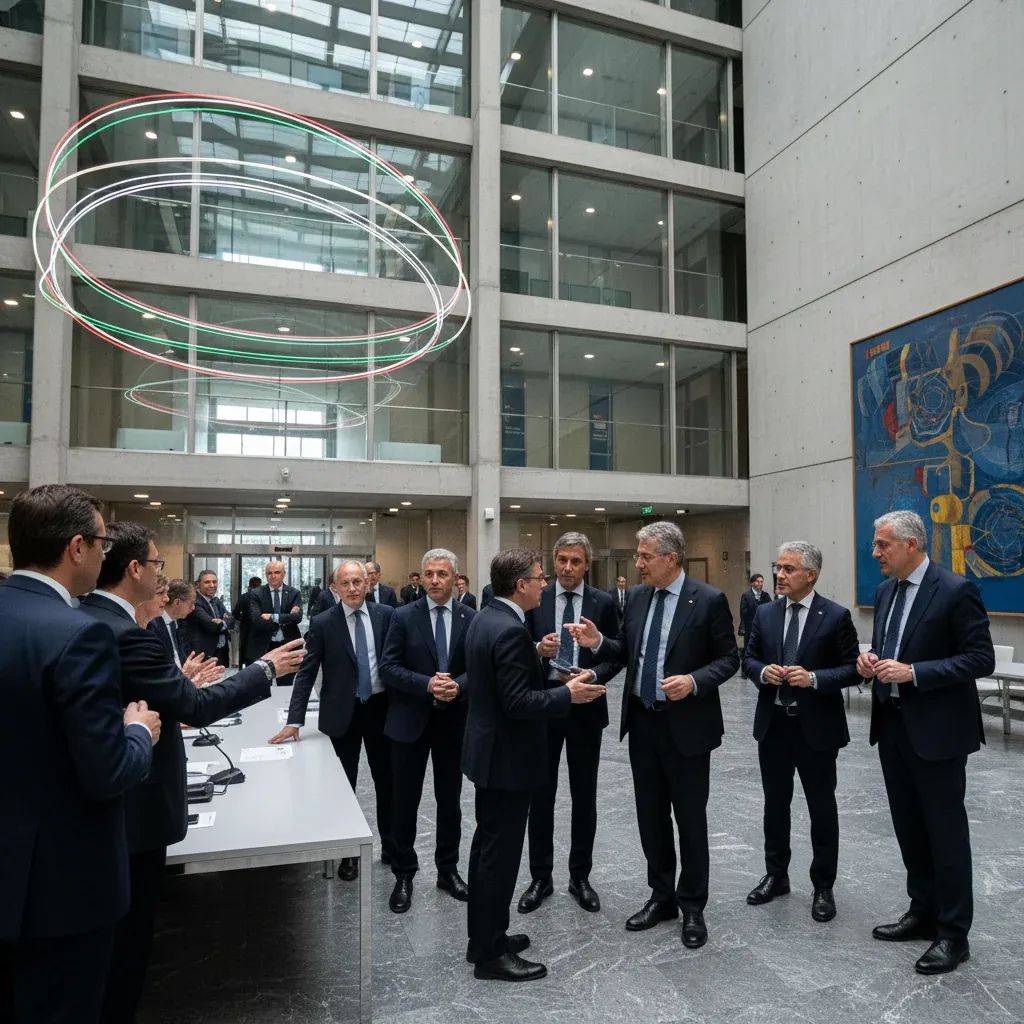
The Italian Football Federation (FIGC) presidency race is heating up as outgoing president Gabriele Gravina refuses to endorse any successor, leaving the June 22 election wide open. The succession battle unfolds against two concurrent crises: Italy's failure to qualify for the 2026 World Cup and an expanding prosecutor investigation into alleged referee manipulation.
Why This Matters:
• Election timeline: Candidates must declare by May 13, with Serie B clubs interviewing contenders on May 6 to extract specific commitments on financial sustainability.
• Voting power: Serie A clubs back ex-CONI president Giovanni Malagò, but control only 18% of votes—meaning lower leagues and amateur football will decide the outcome.
• Governance at stake: Calls for federal commissariamento (external administration by government-appointed commissioner) threaten Italy's autonomy under FIFA/UEFA rules. If imposed, this could jeopardize the Euro 2032 hosting rights or freeze club participation in UEFA competitions, though legal experts believe oversight would more likely target the referee association (AIA) rather than the entire federation.
• Referee probe fallout: Prosecutors in Milan are investigating alleged VAR manipulation involving ex-referee designator Gianluca Rocchi, adding pressure for structural reform but occurring separately from Gravina's resignation decision.
Why Gravina Stepped Down
Gabriele Gravina resigned on April 2, 2025, triggering the immediate dissolution of the entire Federal Council under FIGC statutes. The primary cause: Italy's third consecutive failure to qualify for the World Cup, after a playoff defeat to Bosnia sealed the national team's absence from the 2026 tournament in North America. Although re-elected for a term running until 2028, Gravina accepted responsibility for this outcome.
"I made a commitment to take Italy to the World Cup, and I failed to honor that pledge," Gravina told Italian broadcaster La7 on the program Otto e Mezzo. "It was an act of responsibility toward the federation."
Yet the outgoing president insists his broader record merits recognition. "I do not consider myself to have failed," he stressed. "If judged by isolated episodes, sure, I failed. But if we look at the full scope of activity and the projects delivered, our federation is among the most respected in Europe."
Beyond the World Cup failure, Gravina faced mounting political pressure from Italy's Minister of Sport Andrea Abodi and parliamentary critics, as well as legal scrutiny over a 2018 television-rights deal for the third-tier Lega Pro. A separate Council of State ruling fined the federation €4.2M for obstructing youth football activities, compounding the broader sense of governance crisis.
The Succession Race
With nominations closing May 13, two establishment figures dominate the field:
Giovanni Malagò, the former CONI (Italian Olympic Committee) president who now chairs the organizing committee for the Milano-Cortina 2026 Winter Olympics, has secured backing from most Serie A clubs. Yet his support base represents less than one-fifth of the assembly's voting weight, leaving him dependent on broader coalitions. Malagò is expected to clarify his intentions before the Coppa Italia final on May 13, the same day candidacies must be submitted.
Giancarlo Abete, FIGC president from 2007 to 2014 and current head of the Lega Nazionale Dilettanti (amateur league), offers continuity and reportedly enjoys warmer relations with government circles. His grassroots power base gives him structural leverage that top-flight clubs cannot match.
Matteo Marani, president of the professional third-tier Lega Pro, and Demetrio Albertini, the former Milan midfielder backed by the players' union, round out the list of plausible contenders, though both face steeper odds.
Gravina has pointedly declined to play kingmaker. "Malagò and Abete are both excellent executives, but I made a solemn commitment not to throw my weight behind anyone," he declared.
Serie B Demands a Seat at the Table
On May 6, Lega Serie B president Paolo Bedin will convene all second-tier clubs at FIGC headquarters in Rome to question presidential candidates face-to-face. The session—scheduled one week before the candidacy deadline—follows an April 14 assembly that produced a unified policy platform finalized by the league's board.
"This initiative represents the culmination of a structured, shared process," the league said in a statement. "Through this work, Serie B positions itself as a central and proactive interlocutor, bringing to the attention of candidates a series of strategic priorities for the development of the football system and for strengthening the category."
The move underscores frustration among mid-tier professional clubs over governance models that concentrate influence in Serie A while leaving second- and third-division sides to manage chronic deficits. Serie B's leadership wants explicit commitments on revenue distribution, cost controls, and youth development before casting votes that could tip the balance in a fragmented electoral college.
The Referee Scandal: A Separate Crisis
Beginning in May 2025, prosecutors in Milan opened an investigation into alleged manipulation of referee assignments and VAR interventions—a crisis unrelated to but concurrent with Gravina's resignation. Former Serie A/B referee designator Gianluca Rocchi and VAR supervisor Andrea Gervasoni are under investigation for alleged sporting fraud tied to matches in the 2023–24 and 2024–25 seasons.
Prosecutors allege Rocchi pressured match officials and skewed assignments to favor specific clubs—including Inter Milan in high-stakes fixtures such as a Bologna clash and a Coppa Italia semifinal derby. A separate accusation claims Rocchi directly influenced VAR operators during an Udinese-Parma match in March 2025, prompting a penalty call revision. Inter has denied any involvement; both Rocchi and Gervasoni have self-suspended from their roles.
Gravina addressed the probe while defending due process: "We should be guarantors of due process. We're throwing mud without knowing anything." Gervasoni was scheduled for questioning on April 30; Rocchi's lawyer declined interrogation on the same date, citing insufficient access to case files.
The inquiry originated from a complaint filed by former assistant referee Domenico Rocca, who accused Rocchi of improper interference in VAR communications. Although the FIGC's internal sports-justice body initially dismissed the allegations, prosecutors reopened the case after interviewing Rocca in July 2025. Interim designator Dino Tommasi has taken over match-official assignments.
What is Commissariamento and Why It Matters to Fans
Minister Abodi and Lazio president Claudio Lotito—a longtime Federal Council member until his 2024 electoral defeat—have floated the idea of imposing a government-appointed commissioner to bypass the June vote and implement root-and-branch reform.
What it means in practical terms: A commissioner would temporarily replace the elected FIGC president and Federal Council, allowing direct government intervention in federation decisions. While competitive matches would continue under FIFA/UEFA supervision, such intervention breaches autonomy principles that protect sports organizations from political interference.
The consequences for Italian football could be severe: Euro 2032 hosting rights could be jeopardized, and Italian clubs might face suspension from UEFA competitions. However, legal experts believe any oversight would more likely target the referee association (AIA) rather than the entire federation, limiting but not eliminating these risks.
For ticket holders and stadium-goers, commissariamento could create administrative uncertainty around season operations and broadcasting arrangements during the transition period. CONI president Luciano Buonfiglio told reporters his office sees no clear legal grounds for takeover but is consulting jurists.
Lotito's public critique of "disaster" under Gravina's watch drew a sharp rebuke from the outgoing president: "It's normal that someone who served on the Federal Council for twenty years, left only two years ago because he lost an election, now participates in a parliamentary culture commission and talks about disaster? We demand respect for football."
Gravina dismissed commissariamento as "absolutely contrary to the autonomy of sport, to statutes, to UEFA and FIFA. If you try to invade someone else's field, you trigger the principle of institutional rupture."
What This Election Means for Italian Football Residents
For football fans and the broader sports economy in Italy, the stakes extend beyond administrative reshuffles. A protracted leadership vacuum or external intervention risks delaying competitive reforms, stalling broadcasting-revenue negotiations, and eroding the credibility of domestic competitions already struggling with declining match attendance and Serie A clubs' chronic losses.
The June 22 assembly will not merely pick a figurehead; the new president will inherit a mandate to overhaul governance structures that Gravina himself described as hampered by "confusion of roles" among the federation, leagues, and individual competitions. Whether Malagò's Olympic pedigree, Abete's institutional memory, or a dark-horse candidacy prevails, the winner must navigate a fractious coalition of top-flight owners, cash-strapped lower divisions, and a sprawling amateur network—all while the referee scandal unfolds in parallel.
Investors, sponsors, and municipal authorities tied to stadium projects will watch closely. Any signal that Italy's football governance remains mired in scandal or political interference could chill the flow of capital into infrastructure and player development at a moment when European rivals are pulling ahead. For residents, this translates to potential delays in stadium improvements, uncertainty around ticket pricing and availability, and reduced investment in youth development—the pipeline for future talent.


