
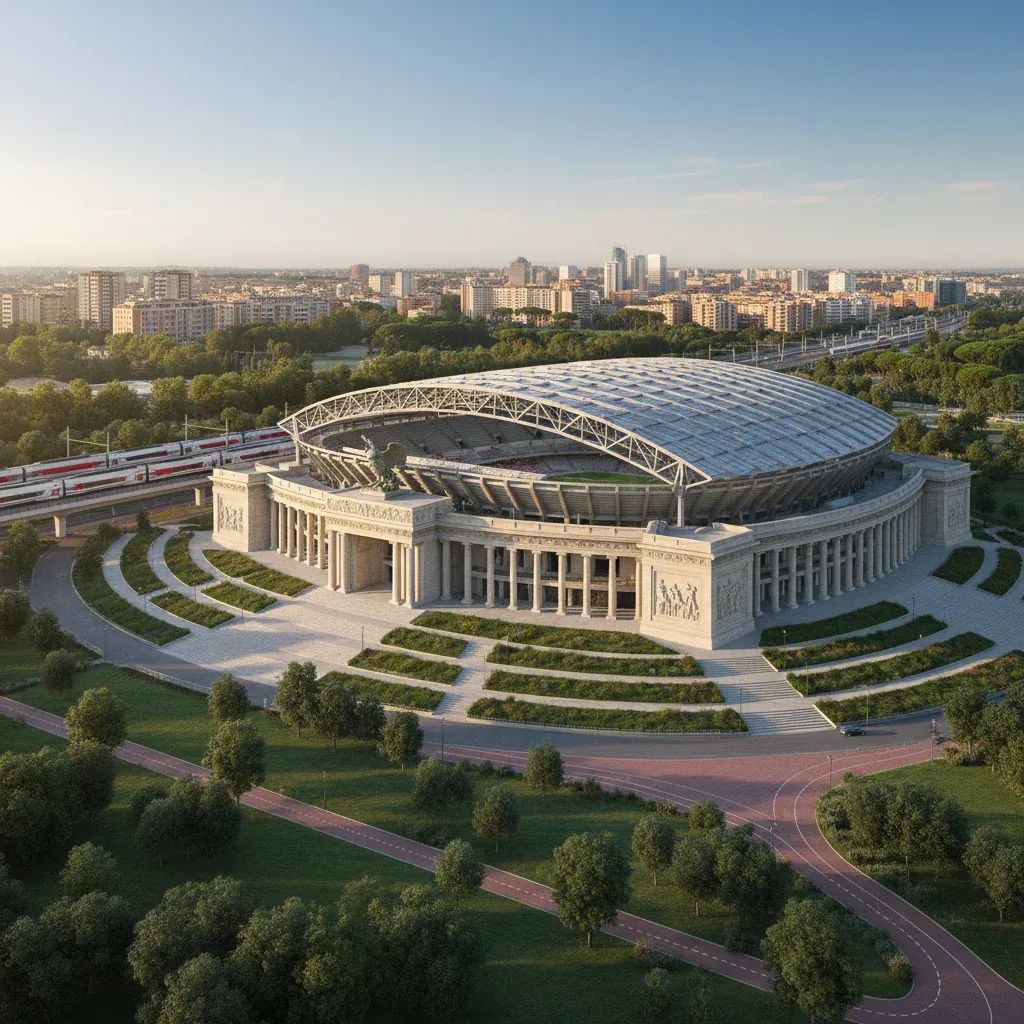
Italy faces a €4.5 billion race against time to bring thirteen of its aging football stadiums up to UEFA standards—but only five will make the final cut for Euro 2032. The country's opportunity to co-host the tournament with Turkey has become both a deadline and a reckoning for Italian football infrastructure, forcing cities, clubs, and regional governments into a scramble to secure funding, navigate bureaucracy, and modernize facilities that UEFA's leadership has bluntly called "among the worst in Europe."
As of the July 31 deadline, thirteen Italian cities submitted bids to the Italian Football Federation (FIGC) covering sixteen stadium projects. The lineup includes Bari, Bologna, Cagliari, Florence, Genoa, Lecce, Milan, Naples, Palermo, Rome, Salerno, Turin, and Verona. Over the next two months, the FIGC will evaluate technical compliance with UEFA's Category 4 criteria—the only designation acceptable for continental tournaments—before submitting a shortlist to UEFA by October 1. The final decision on all ten host stadiums (five Italian, five Turkish) is expected by October 2026, with all venues required to be match-ready by June 2031.
Why This Matters
• Economic scale: €4.5B in combined public and private investment is flowing into Italian stadium infrastructure—one of the largest capital injections into the sector in decades.
• Real estate and urban renewal: Cities like Rome, Milan, and Bologna are fast-tracking mixed-use developments anchored by new stadiums, potentially reshaping entire neighborhoods.
• Tourism dividend: Host cities can expect a surge in visitors during the tournament, with lasting infrastructure benefits for hospitality and transport sectors.
• Regulatory pressure: Lagging cities risk being sidelined—not just for Euro 2032, but for future UEFA competitions and club licensing.
Turkey's Ready Arsenal vs. Italy's Construction Site
The contrast between the two co-hosts is stark. Turkey submitted ten modern, UEFA-compliant stadiums from which to select five—most constructed or heavily renovated within the past decade. Istanbul alone offers three world-class venues: the Atatürk Olympic Stadium (74,753 capacity), Rams Park (53,611), and Ülker Stadium (47,834). Other candidates in Ankara, Bursa, Konya, Trabzon, and Antalya are already operational and meet or exceed UEFA benchmarks.
Italy, by contrast, counts just one fully compliant stadium today: Allianz Stadium in Turin, home to Juventus. Iconic grounds like Rome's Olimpico, Milan's San Siro, and Naples' Diego Armando Maradona are, in UEFA's assessment, functionally obsolete. That reality has triggered a wave of proposals—some realistic, others aspirational—spanning renovations, relocations, and greenfield builds.
Milan has floated projects for new stadiums for both Inter and AC Milan, with combined outlays potentially reaching €1.5B. Rome presented three separate bids: the existing Olimpico (earmarked for a €130M facelift), a new AS Roma venue at Pietralata (estimated at €1.2B), and a Lazio-backed refurbishment of the derelict Flaminio (€450M). Naples put forward dual proposals—renovating the Maradona (€250M in public funds) or constructing a private facility backed by club president Aurelio De Laurentiis.
Elsewhere, Bologna abandoned plans to modernize the Dall'Ara and is now pursuing a new 30,000-seat multipurpose arena with BolognaFiere. Cagliari's municipal council narrowly approved public interest and surface rights for a new Stadio Gigi Riva (€215M+), sending documentation to the FIGC just hours before the deadline. Florence's Franchi is undergoing a phased overhaul scheduled for completion by 2029, with club owner Rocco Commisso pledging an additional €100M on top of the public €150M allocation.
Southern cities face steeper hurdles. Bari's mayor requested "substantial financial support" for refurbishing the San Nicola, signaling budget constraints. Salerno proposed the Arechi, which requires significant work. Palermo's Barbera arrived late to the table, and Lecce submitted a bid despite limited recent investment.
What This Means for Residents
For Italians living in or near candidate cities, Euro 2032 is more than a football tournament—it's a catalyst for infrastructure overhaul with tangible local effects:
Urban regeneration: Stadium projects typically include adjacent commercial, residential, and green spaces. Rome's Pietralata proposal, for example, envisions a mixed-use district integrating retail and housing. Bologna's new stadium concept is explicitly designed as a "multifunctional" hub, aiming to activate the area year-round.
Public vs. private financing: While the Ministry for Sport and Youth, led by Andrea Abodi, emphasizes that €4.5B comes largely from private investors, substantial public money is on the line. Naples' Maradona renovation draws €200M from the Campania Region and €50M from municipal coffers. Cagliari's bid leans on a €50M regional contribution. Taxpayers in these jurisdictions should monitor contract terms, especially around long-term concessions and revenue-sharing.
Construction timelines and disruption: Major renovations and new builds will bring years of construction noise, traffic rerouting, and dust. Florence's Franchi work is already underway; expect similar disruptions in Milan, Rome, and Naples once projects commence. For residents near proposed sites, understanding the phasing and mitigation plans is critical.
Property values: Proximity to modern stadiums can lift residential real estate prices, but also intensify matchday congestion and parking shortages. Historical precedent from Turin (post-Allianz Stadium) suggests mixed outcomes depending on neighborhood context.
The Bureaucratic Bottleneck
Italy's delay-prone approval process remains the chief obstacle. Even cities with strong technical bids face municipal council votes, environmental impact assessments, heritage consultations, and procurement tenders—each capable of derailing timelines. Cagliari's last-minute council approval underscores the knife-edge politics involved. Rome's triple bid reflects uncertainty about which project can clear regulatory and financial hurdles fastest.
Abodi has touted a new "commissarial platform" and legislative reforms designed to streamline stadium approvals, but skepticism persists. UEFA President Aleksander Čeferin set a hard March 2027 deadline for infrastructure readiness, warning that Italy's co-hosting role is conditional on visible progress. If Italian cities falter, Turkey's surplus of ready venues could absorb additional matches—or worse, the FIGC could face exclusion from certain hosting duties.
Financial Reality Check
The €4.5B figure represents aggregate investment across all sixteen proposals, but not all will proceed. Only five stadiums will receive UEFA designation, and several projects may collapse under financial or political pressure. Cagliari's tender, due to open by August 20 with bids evaluated in autumn, includes a 50-year concession for the winning consortium—a model increasingly common but controversial for locking in private control of public assets.
Bologna's stadium push depends on co-financing from BolognaFiere and the club, with a formal request submitted to Abodi for inclusion in the Euro 2032 pipeline. Naples risks a bidding war between public renovation and private construction, with De Laurentiis's proposal contingent on land acquisition and regulatory green lights.
For cities outside the final five, the tournament still offers a galvanizing narrative. Parma and Venice, neither among the thirteen candidates, are citing Euro 2032 as justification for their own stadium projects, hoping to ride the momentum even without direct involvement.
The October Countdown
Between now and October 1, the FIGC will conduct technical audits of all sixteen proposals, assessing capacity (UEFA requires a mix of 60,000-, 50,000-, 40,000-, and 30,000-seat venues), accessibility, media facilities, security infrastructure, and sustainability credentials. Ten stadiums currently meet or are close to UEFA standards, according to the federation, but "close" leaves room for disqualification.
Cities that advance will need to demonstrate not just architectural compliance but bankable financing, shovel-ready permits, and credible delivery schedules. The FIGC's submission to UEFA will include reserve candidates in case primary choices falter—a tacit acknowledgment of Italy's track record for project slippage.
A National Reckoning
Italy's struggle to field five world-class stadiums by 2031 lays bare decades of underinvestment in sports infrastructure. The country's most storied clubs play in venues built for the 1990 World Cup—or earlier. Generational inertia, fragmented ownership (many stadiums are municipally owned but club-operated), and preservation battles over historic structures have left Italian football lagging behind Germany, England, and even Turkey in facility standards.
Euro 2032 offers a forcing function. As Abodi put it, "Italian football will change its face." Whether that transformation materializes depends on the willingness of governments, clubs, and private investors to align interests, cut through red tape, and deliver on schedule. For the thirteen candidate cities, the next eight weeks represent a high-stakes audition—one that could redefine not just their sporting infrastructure, but their economic and cultural trajectory for decades to come.


