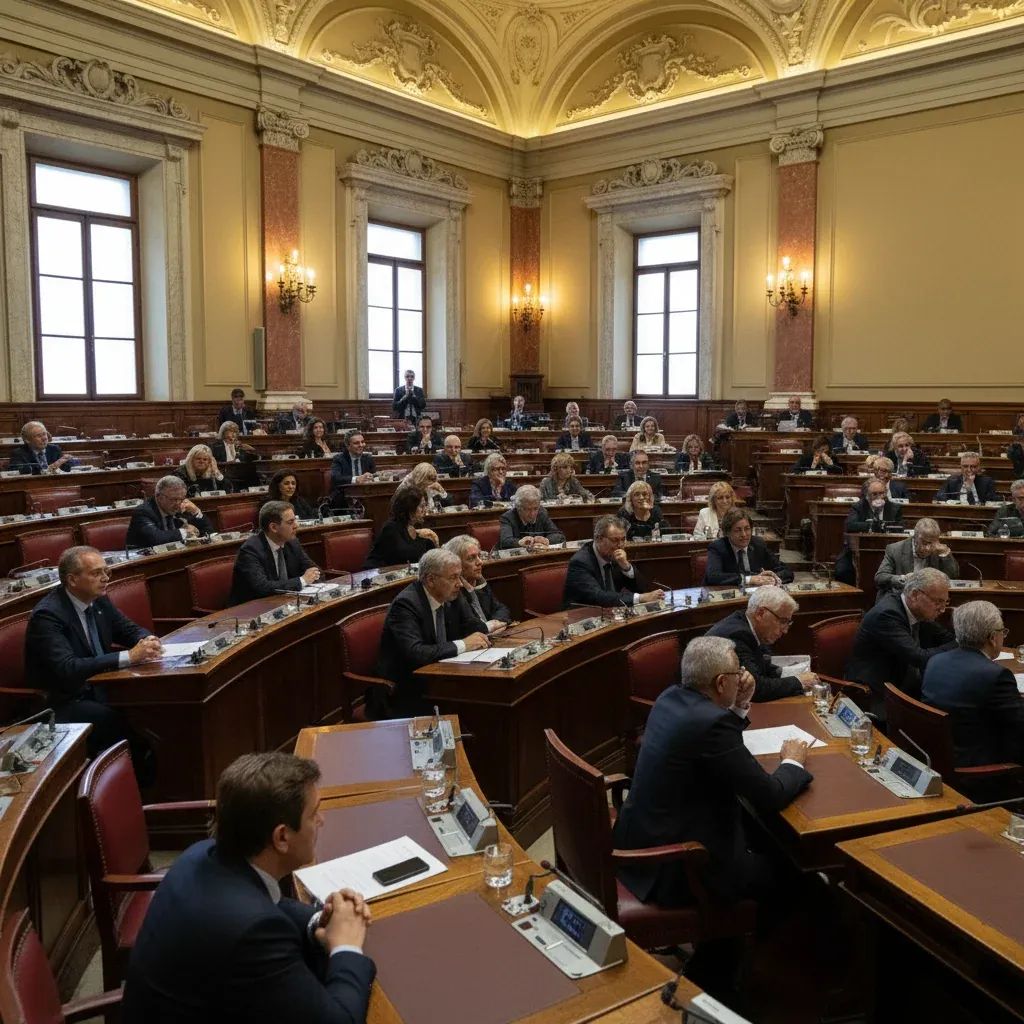
The Italian Chamber of Deputies has delivered a bruising setback to Prime Minister Giorgia Meloni's coalition, rejecting by a single vote an amendment that would have restored voter preferences in the country's electoral system. The outcome—188 against, 187 in favor—has ignited a political firestorm over internal betrayal and exposed deep fractures within the ruling center-right alliance.
Why This Matters
• Electoral lists remain blocked: Italians will not regain the ability to choose individual candidates if the current reform passes unchanged.
• Up to 50 suspected defectors: Internal estimates suggest between 30 and 50 center-right deputies may have voted against their own government's position during the secret ballot.
• Constitutional risk looms: Legal experts warn the absence of voter preferences could trigger a Constitutional Court challenge, echoing the 2014 ruling that struck down similar provisions.
What the Vote Was About
The amendment, initially tabled by Fratelli d'Italia, Noi Moderati, and the Udc, aimed to introduce up to three written preferences for candidates of different genders within multi-member constituencies, while keeping party leaders locked at the top of each list. Both the Lega and Forza Italia publicly backed the proposal, yet the secret ballot—a procedural norm in the Italian Parliament for electoral reforms—revealed a different reality.
The proposal was part of broader legislation known informally as the "Stabilicum," which institutes a proportional system with a majority bonus of 70 seats in the Chamber and 35 in the Senate for any coalition or party exceeding 42% of the vote. If no force reaches that threshold, pure proportional representation applies. The reform also mandates that coalitions declare their candidate for prime minister when registering.
The Hunt for "Franchi Tiratori"
Within hours, corridors at Montecitorio buzzed with accusations and spreadsheet tallies. Luca Ciriani, the Minister for Parliamentary Relations, publicly estimated 20 to 25 defectors, though internal calculations now put the figure closer to 40 or even 50, factoring in the seven votes cast by Italia Viva in favor of the amendment.
Suspicion quickly centered on Forza Italia deputies perceived as close to Marina Berlusconi, who has openly criticized authoritarian tendencies within the coalition. One Forza Italia parliamentarian, speaking anonymously, countered: "We were present at 98%—Fratelli d'Italia should look at its own ranks first." Meanwhile, records show that 7.14% of Lega deputies and 3.7% of Forza Italia members did not participate in the vote at all, including four Lega lawmakers and two from Forza Italia who were neither on official leave nor recorded as absent on prior votes.
The Chamber's Board of Quaestors issued a formal censure letter to deputies affiliated with Roberto Vannacci's Futuro Nazionale faction for filming the secret ballot—a breach of parliamentary protocol. The video, shared widely on social media, was intended to prove the group's loyalty but instead drew institutional rebuke.
Political Fallout and Finger-Pointing
Prime Minister Giorgia Meloni framed the loss as evidence that "the swamp has won again," while her brother-in-law and Fratelli d'Italia political chief Arianna Meloni posted a photo of celebrating opposition deputies with the caption: "Never forget this image. The left celebrating as if they'd won the World Cup after blocking Giorgia Meloni's proposal to give Italians back their right to choose who goes to Parliament. Shameful."
Minister Ciriani struck a defiant tone: "It may look like a defeat, but it's a victory for coherence. The Prime Minister took on enormous risk—she fights to the end. Others should be ashamed."
Opposition leaders met in the so-called "Corridoio della Corea" in the Chamber to coordinate strategy. Giuseppe Conte of the Movimento 5 Stelle mocked Meloni's attendance at an Italian culinary awards ceremony the following day, suggesting she should instead have been at the Quirinale Palace to tender her resignation. Matteo Renzi of Italia Viva observed: "Meloni has now lost the majority of the country in the referendum and the majority of her government in Parliament."
Roberto Vannacci, the former general leading Futuro Nazionale, accused "Badoglian" traitors within the coalition—a reference to the 1943 Italian armistice—and challenged Meloni to "show some guts and push through our amendment" in the Senate. Carlo Calenda of Azione responded by calling Vannacci "a true fascist subservient to Putin" and "a traitor to the fatherland who has dishonored the uniform," demanding democratic forces isolate him.
What Happens Next in the Legislative Marathon
Despite the embarrassment, the Chamber approved Article 1 of the reform—the structural core establishing the proportional system with majority bonus—by 208 votes to 143 in a separate secret ballot. The house also unanimously passed an amendment allowing citizens temporarily domiciled away from their registered residence for work, study, or medical treatment to vote where they currently reside, provided they register in a special roll. That provision received 349 votes with cross-party support.
The bill now moves to the Italian Senate, where voting is public and the dynamic shifts. Senate President Ignazio La Russa has hinted at the possibility of a "surgical modification" to reintroduce preferences in Palazzo Madama, though that would necessitate a third reading back in the Chamber—again under secret ballot rules. The government has not ruled out attaching a confidence vote to force passage, a mechanism employed by past administrations but traditionally considered a last resort.
Constitutional and Timing Landmines
Legal scholars have warned that maintaining blocked lists without voter preferences risks a Constitutional Court intervention. Italy's highest court struck down similar provisions in the so-called "Porcellum" law in 2014, ruling that voters must have a say in selecting their representatives. Several civic committees have already announced plans to challenge the reform if it passes in its current form, though the timeline for a ruling remains unclear.
Another constraint looms: the European Court of Human Rights recommends that member states refrain from altering electoral systems within 12 months of a scheduled vote. While not legally binding, failing to observe that guideline could invite international scrutiny and domestic criticism, especially if the reform drags into autumn and the current legislature is set to expire within a year.
Impact on Residents and Democratic Process
For Italian voters, the practical consequence is stark: if the Stabilicum becomes law without preferences, citizens will once again surrender the power to influence which individual candidates represent them in Parliament. Party leaders would retain full control over list composition and candidate placement, a system critics argue fosters patronage and weakens accountability.
The introduction of remote voting for students, workers, and patients marks a modest democratic expansion, potentially enfranchising tens of thousands who previously faced logistical barriers. Yet that gain may be overshadowed by the broader rollback of electoral choice.
The episode has also underscored the fragility of the Meloni coalition, which commands a comfortable majority on paper but showed itself vulnerable to internal revolt when shielded by anonymity. Whether that fissure reflects policy disagreement, personal rivalries, or strategic positioning ahead of future elections remains a subject of intense speculation in Rome.
As the Senate prepares to take up the legislation in the coming months, the underlying question is whether Italy's political class will deliver a system that genuinely empowers voters—or one that entrenches party control under the guise of stability.