
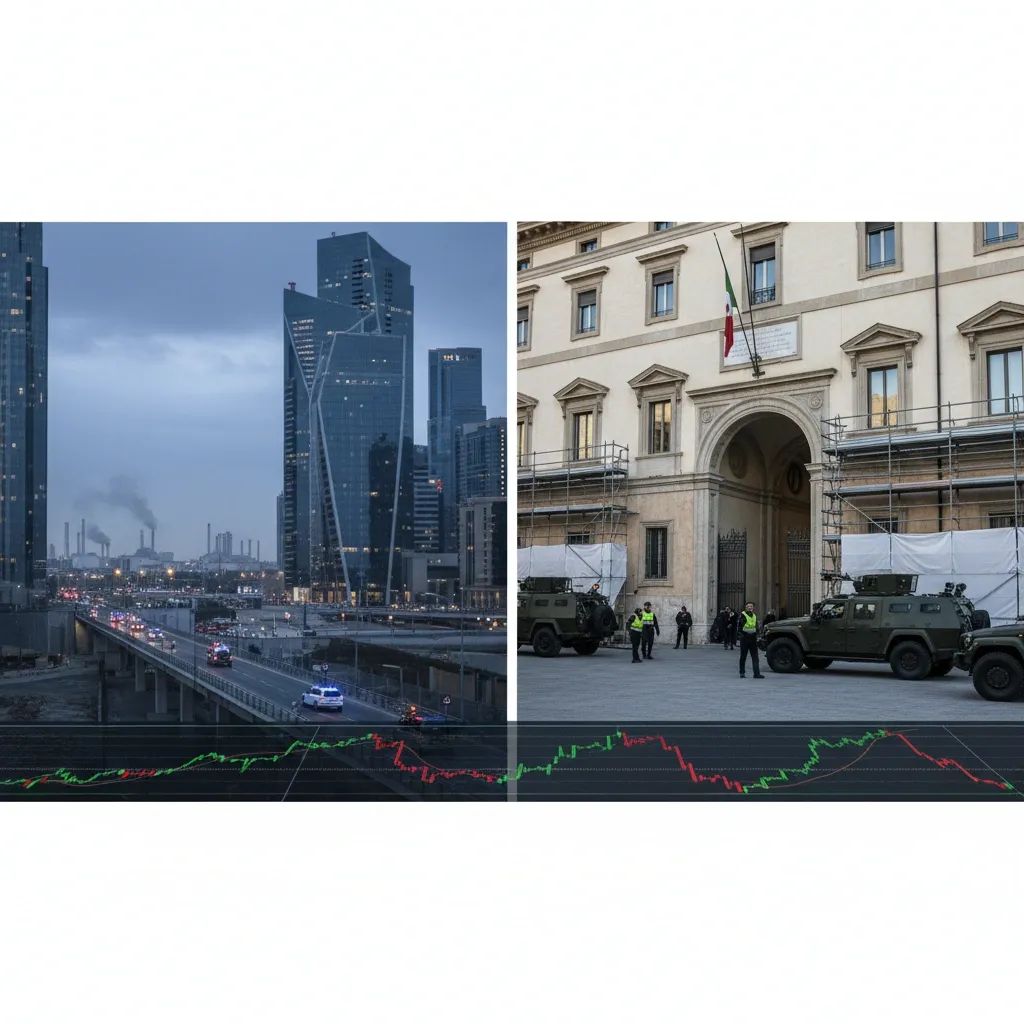
Bank of Italy Governor Fabio Panetta warned in his May 29, 2026 annual address that Italy faces a self-reinforcing cycle of decline. Unless the country rapidly addresses its chronic underinvestment in human capital and innovation, Italy risks entering a downward spiral that will continue driving young talent abroad and stalling economic growth for years to come.
Panetta used his address to outline what he termed a "vicious circle" undermining the nation's future. When a country fails to invest adequately in education and innovation, its productive system remains technologically backward. That lack of sophistication reduces demand for skilled labor, which in turn discourages young people from pursuing higher education or staying in Italy once they graduate. The result: a talent exodus that further weakens the country's capacity to adopt new technologies or compete globally.
The scale of the exodus is significant. Between 2020 and 2024, according to Panetta's address, roughly 100,000 young Italians chose to leave, many of them university graduates seeking better salaries, career prospects, and recognition of merit abroad. Over the broader 2012–2022 period, more than 1.3 million Italian citizens relocated, with over 60% under the age of 35. This hemorrhage of human capital compounds Italy's demographic crisis, as the birthrate falls and the working-age population shrinks.
The economic toll is substantial. Italy spends 4% of GDP on education—a full percentage point below the EU average of 4.8%—making it one of the lowest investors in human capital among major European economies. In absolute terms, Italy allocated 8% of public spending to education in 2024, versus a European average of 9.6%. This positions Italy near the bottom among major EU member states—France spends 5%, Germany 4.5%, and Spain 4.1% of GDP on education. While per-student spending has risen by 37% over the past decade—from €6,100 to €8,400 in 2024—the overall shortfall persists.
Framing the challenge in stark terms, Panetta stated: "The ultimate measure of Italy's success will be its ability to offer opportunities and a future to the young." He warned that failing to reverse course risks entrenching a cycle where low innovation begets low skills, which in turn prevents the adoption of advanced technologies. The governor emphasized this is not just an economic issue but a matter of civic responsibility.
Technology and Innovation: The Decisive Arena
Panetta identified technology—especially artificial intelligence, robotics, and automation—as the decisive arena for Italy's economic future. While the share of Italian firms using AI has grown, intensive adoption remains limited compared to European peers. The governor cautioned that technological transformation will not automatically generate shared prosperity; it must be actively governed.
"The development of artificial intelligence must serve people and society, not the concentration of technological power," he stated, emphasizing that innovation policy must ensure workers are reskilled and that productivity gains translate into broader welfare rather than a narrow concentration of wealth.
The challenge is twofold. First, Italy's industrial base remains insufficiently innovative, which reduces the demand for advanced skills and limits the incentive to adopt new technologies. Second, without a robust education system to produce and continuously train workers, even firms that wish to innovate struggle to find the talent they need. Technology alone is not enough—it requires human capital, institutional support, and a culture that rewards merit over nepotism and personal connections.
Banking Consolidation: Building Stronger Institutions
Panetta also signaled cautious support for banking mergers and acquisitions that create stronger, more efficient national champions. He argued that well-designed consolidations can bring Italy's banking structure closer to that of France and Spain, where the top five banks control a larger market share. Currently, Italy's top five lenders hold a smaller slice of the market, a fragmentation that limits their ability to compete internationally and diversify revenue.
Panetta stressed that any consolidation must deliver tangible benefits: creating more robust intermediaries capable of supporting the real economy and offering better services at lower costs to customers. He did not comment on specific merger cases currently under discussion but laid out a clear framework for evaluating them.
At the same time, he urged prudence in lending given the uncertain geopolitical and economic environment. Banks must avoid an indiscriminate credit crunch but also guard against excessive risk-taking. Public guarantees on loans—introduced during the COVID-19 pandemic—should return to their "proper function," he said, reserved for creditworthy firms that genuinely struggle to access financing, and ensuring the subsidy actually benefits borrowers rather than intermediaries.
Geopolitical Risks and Energy Uncertainty
The broader economic outlook is clouded by geopolitical turbulence. The conflict in the Persian Gulf has triggered a fresh energy shock, with oil prices spiking above $120 per barrel. The European Central Bank's latest staff projections warn that in the most adverse scenario—if the conflict drags on and damages critical energy infrastructure—eurozone inflation could peak above 6% and remain above target for an extended period, while growth could be shaved by a full percentage point over 2026–27.
For Italy, which depends heavily on imported energy, such a shock would be particularly damaging. Historical episodes—such as the 1973 oil crisis—demonstrate that energy price surges can double inflation rates, shrink GDP, and raise unemployment. Sectors with high energy intensity face especially steep declines in output and investment.
The ECB faces a delicate balancing act: raising interest rates would curb inflation but risk choking off growth; cutting rates would support the economy but undermine the 2% inflation target. Panetta noted that a "recalibration" of monetary policy may be necessary but stressed that the ECB must remain flexible as economic data evolves, rather than locking itself into a predetermined path.
Implications for Residents
For people living in Italy, Panetta's warnings translate into tangible concerns across multiple dimensions of daily life. Job prospects and wages will remain constrained unless productivity rises, which depends fundamentally on investment in education and innovation. Youth emigration is likely to continue unless the country creates attractive career paths, competitive salaries, and a genuinely meritocratic environment that rewards talent and performance.
On the economic front, inflation pressures from energy shocks could erode purchasing power over time, especially if geopolitical tensions persist and disrupt global energy markets. The proposed banking sector changes may eventually bring more competitive loan rates and expanded digital services, but such benefits will materialize only if consolidations are executed responsibly and with consumer interests in mind.
At the macroeconomic level, fiscal constraints will limit public spending on welfare and development unless Italy addresses its high public debt burden sustainably—a structural challenge that touches nearly every Italian household's economic security.
Europe's Role and the Path Forward
Panetta also addressed the European dimension, noting that the EU has "finally begun to react" to profound global transformations and instability. However, he urged the bloc to demonstrate speed of action, translating objectives and priorities into decisions, investments, and results.
"Europe must find in greater unity the condition of its own strength," he said, highlighting the continent's assets: abundant savings, productive capacity, scientific expertise, strong institutions, and values that remain a global reference point. For Italy, deeper European integration—particularly in capital markets, defense, and innovation—could provide crucial support in addressing domestic weaknesses and competing globally.
The governor called on Italy to orient its potential toward growth, incomes, and prosperity in the years ahead, treating the challenge as not just economic policy but a civic duty. Breaking the vicious cycle will require decisive action on education spending, accelerated innovation adoption, and policies that create genuine opportunity for young Italians. Whether the country can meet this challenge will shape its competitiveness and social cohesion for decades to come.


