
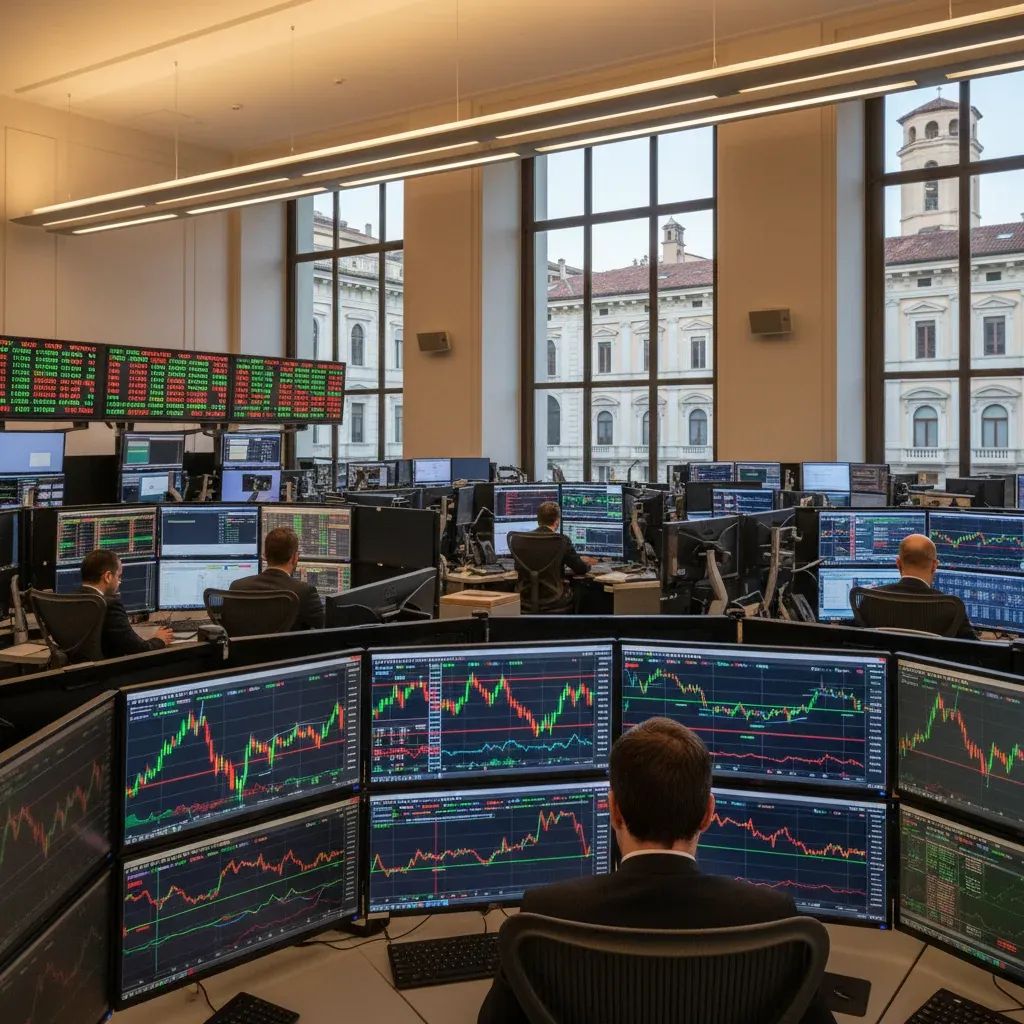
The Italy stock exchange closed with mixed signals as aerospace and telecom infrastructure stocks surged while technology and energy names retreated, reflecting broader investor uncertainty tied to diplomatic negotiations between Washington and Tehran.
Why This Matters
• Avio shares jumped 5.5% after successfully launching the Smile satellite using its Vega C rocket, marking a key milestone for Italy's space industry.
• Oil-linked stocks fell as Brent crude dropped 1.7% to $110 per barrel amid optimism over U.S.-Iran peace talks, dragging down Saipem, Tenaris, and Eni.
• Technology names took profit with Prysmian down 3.1% and STMicroelectronics off 1%, despite both companies posting strong year-to-date gains exceeding 68% and 130% respectively.
• The FTSE MIB added just 0.1%, lagging Frankfurt (+1.1%), Paris (+0.7%), and London (+0.6%) as Italy investors remained cautious.
Aerospace and Defense Lead Milan Rally
Piazza Affari saw its strongest performances concentrated in the defense and aerospace sectors. Avio led the charge, climbing more than 5% following confirmation that its Vega C launcher successfully deployed the Smile satellite into orbit. The mission represents a critical validation of the Italian-built rocket system, which has been positioning itself as a competitive alternative in the European space launch market.
Defense contractor Leonardo advanced 3.2%, while shipbuilder Fincantieri gained 4.1%, both benefiting from renewed investor interest in Italy's industrial defense capabilities. The sector has outperformed broader indices this year as European governments accelerate procurement and modernization programs.
Ferrari motored ahead by 3%, extending its premium valuation amid robust demand for luxury vehicles, while Stellantis added 0.5% following news that the automaker will produce an electric vehicle at its Pomigliano plant. The announcement comes two days ahead of the company's updated industrial roadmap, which investors hope will clarify the group's electrification timeline and cost structure.
Telecom Infrastructure Gains on 5G Expansion
Inwit, the tower infrastructure operator spun out from Telecom Italia, climbed 4.2% as the market priced in accelerating demand for cellular infrastructure tied to 5G network buildouts across Italy. The company has secured long-term hosting contracts with major mobile operators, and its business model—leasing space on thousands of tower sites—generates predictable revenue streams that appeal to yield-focused investors.
The stock has become a favorite among those seeking exposure to Italy's digital transformation without the operational complexity of telecom service providers. With regulatory tailwinds supporting faster deployment and the Italian government pushing connectivity in underserved regions, Inwit's infrastructure is increasingly seen as essential national utility.
Technology and Energy Names Retreat on Profit-Taking
Despite stellar year-to-date returns, Prysmian dropped 3.1% and STMicroelectronics fell 1%, with both stocks suffering from profit-taking after extended rallies. Prysmian, the Milan-based cable manufacturer, is up 68.5% since January following announcements of multibillion-euro acquisitions and long-term supply agreements with hyperscale data center operators. Earlier this month, the company hit an all-time high after revealing plans to expand optical cable capacity by 40-50% over the next two years.
STMicroelectronics, the Geneva-headquartered chipmaker with significant operations in Italy, has surged 130% year-to-date, driven by booming demand for semiconductors in artificial intelligence servers and electric vehicle applications.
Today's declines reflect natural consolidation after rapid gains rather than deteriorating fundamentals. Both companies remain positioned in high-growth segments—data infrastructure and AI chips—that analysts expect to sustain demand well into 2027.
Energy stocks also retreated. Saipem slid 1%, Tenaris dropped 1.7%, and Eni lost 0.7% as oil prices pulled back. Brent crude fell 1.7% to $110 per barrel. The decline followed comments from U.S. President Donald Trump, who said "serious negotiations" with Iran had resumed and that he canceled a planned military strike after receiving a new peace proposal from Tehran.
Geopolitical Uncertainty Weighs on Market Sentiment
European markets have been affected by developments in the Middle East, where geopolitical tensions have influenced energy prices and investor sentiment. Investor confidence has been tested by diplomatic developments and energy market volatility.
The Italy 10-year bond yield edged up to 3.9%, while the spread over German Bunds held steady at 74 basis points, reflecting stable confidence in Italian sovereign debt despite broader market jitters. The euro traded at $1.163, consolidating near recent levels.
What This Means for Investors
For those with portfolios weighted toward Italy equities, today's session underscores the market's bifurcated character. Defense, aerospace, and infrastructure names are capturing inflows as investors bet on long-term structural trends—European rearmament, space commercialization, and digital connectivity. These sectors offer relative insulation from oil price volatility and geopolitical uncertainty.
Conversely, technology and energy stocks remain vulnerable to momentum shifts and external shocks, even when underlying business fundamentals stay strong. Investors holding Prysmian or STMicroelectronics should view today's declines as technical corrections within a broader bull trend, provided global demand for cables and chips remains robust.
The energy complex faces uncertainty tied to geopolitical developments. Changes in diplomatic negotiations could influence oil prices and energy sector valuations, affecting companies like Eni and Saipem.
Broader Market Context and Outlook
Milan's FTSE MIB continues to navigate shifting investor sentiment amid geopolitical and macroeconomic considerations. The index has shown volatility in recent trading sessions as investors assess energy prices and corporate earnings.
Trading volumes remain subdued, with subdued liquidity and investor caution ahead of key corporate earnings. Nvidia reports results, and those figures will likely set the tone for global tech sentiment and indirectly influence Italy's semiconductor and AI-linked plays.
Outside the main index, Somec surged 8.8% after announcing a €56M contract win, while Unicredit slipped 0.9% amid ongoing strategic considerations.
Wall Street futures pointed lower, with the Nasdaq down 0.8% and the S&P 500 off 0.5%, suggesting caution in broader market sentiment. European markets have outperformed U.S. indices recently, but the gap remains fragile and contingent on energy prices stabilizing and geopolitical risks fading.
Impact on Italy Residents and Economy
For those living in Italy, the stock market's health matters beyond portfolio returns. A sustained rally in the FTSE MIB signals confidence in Italian corporate earnings, industrial competitiveness, and fiscal stability—all of which support employment and wage growth. Energy price volatility could affect purchasing power and consumer confidence.
The strength in defense and infrastructure stocks reflects tangible investment flowing into Italian manufacturing and engineering, particularly in regions like Campania and Lombardy. These sectors employ thousands directly and support extensive supply chains, making their performance a real-world economic indicator.
For those holding Italian equities or pension funds with domestic exposure, diversification across sectors remains essential. Today's session showed that while aerospace and telecom infrastructure can thrive amid geopolitical turbulence, energy and technology names remain sensitive to global macro factors that no single investor can predict or control.


