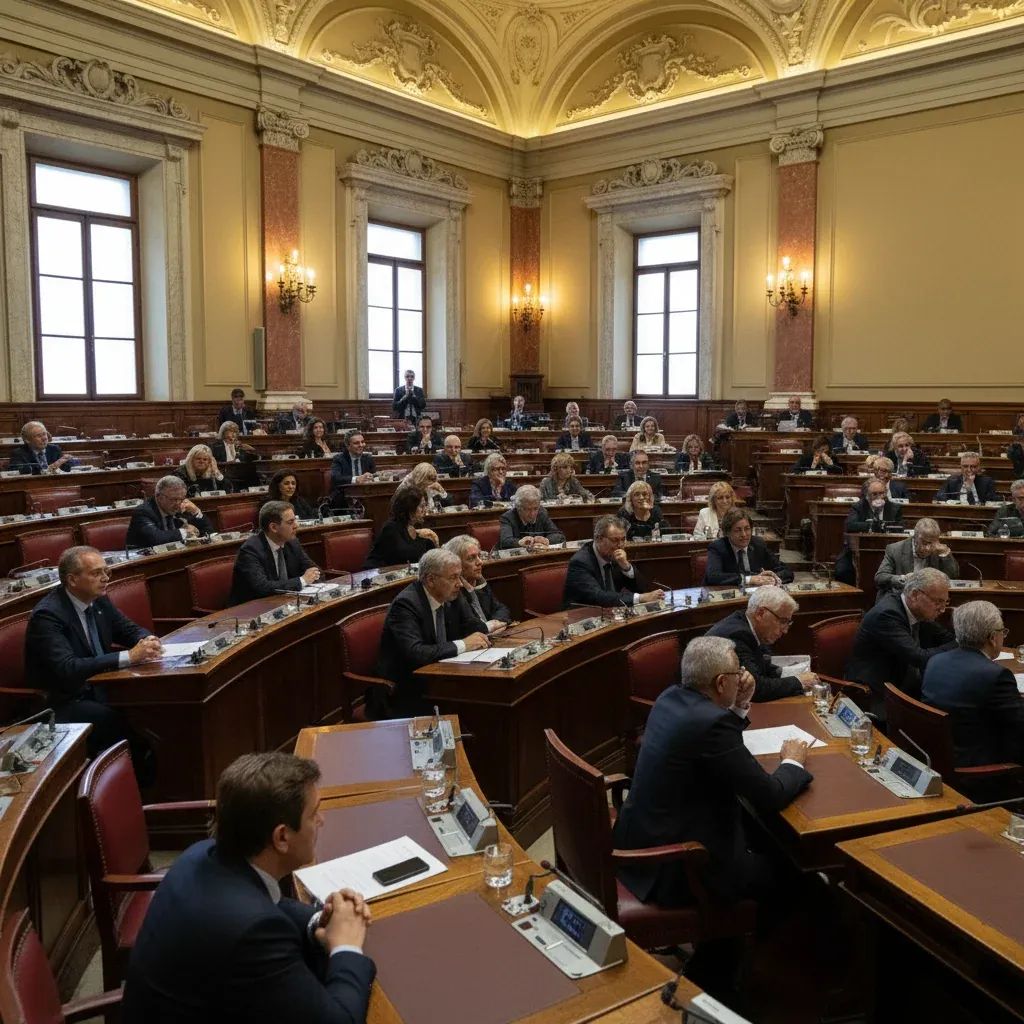
Italy's ruling coalition has moved closer to finalizing a controversial electoral reform that would fundamentally reshape how parliamentary majorities are formed, introducing a 42% threshold bonus system designed to guarantee stable governments. Opposition parties have escalated their resistance by formally requesting secret ballots on all amendments and the final vote, a procedural tactic that could expose internal fractures within the governing majority.
Why This Matters
• Governing power amplification: Any coalition crossing 42% of the vote would receive 70 extra seats in the Chamber of Deputies and 35 in the Senate, potentially controlling parliament with less than half the popular vote.
• Voter choice restrictions: Despite last-minute amendments introducing limited preference voting, party-selected blocked list leaders would still dominate candidate selection.
• Constitutional concerns: Legal scholars warn the reform may violate proportionality principles established by Italy's Constitutional Court, which has previously reviewed electoral bonus mechanisms with scrutiny.
• Timeline pressure: The reform is being rushed through the Chamber ahead of upcoming elections, with critics alleging the majority is tailoring rules to maximize their advantage.
Opposition Forces Secret Ballot Request
The presidents of the Democratic Party (PD), Five Star Movement (M5S), and Greens and Left Alliance (AVS) parliamentary groups—Chiara Braga, Riccardo Ricciardi, and Luana Zanella—have jointly petitioned Chamber President Lorenzo Fontana to conduct the entire legislative process under secret ballot procedures. Their formal letter invokes Articles 51, paragraph 3, and 49, paragraph 1 of the Chamber's regulations, which permit secret voting on matters touching individual conscience and fundamental democratic rights.
The strategic gambit aims to enable dissenting lawmakers within the governing coalition to vote against their party leadership without public exposure or subsequent disciplinary action. Secret ballots in Italy's Parliament have historically been invoked to protect individual conscience on sensitive legislation.
PD Secretary Elly Schlein characterized the electoral law as "unacceptable in both method and substance," accusing the right-wing coalition of "custom-tailoring" legislation out of fear of electoral defeat. Speaking to a joint assembly of PD parliamentary groups, Schlein declared: "This is their only priority in a country with zero growth, wages among the lowest in Europe, and the highest energy bills on the continent."
The opposition has pledged total obstruction, committing to vote against all government amendments while supporting any deletion provisions and shared amendments with coalition partners. They will also back allied amendments that introduce single-member districts or genuine preference systems that bypass blocked lists.
The "Stabilicum" System Explained
The proposed electoral system—colloquially dubbed "Stabilicum" or referred to after Prime Minister Giorgia Meloni—would replace Italy's current mixed system (the so-called Rosatellum) with a proportional framework heavily tilted toward governability.
Under the new architecture, any coalition reaching 42% of the national vote would automatically receive bonus seats sufficient to guarantee a working parliamentary majority: 70 additional Chamber seats and 35 Senate seats. The winning coalition's total representation would be capped at approximately 230 of 400 deputies (57.5%) and 115 of 200 senators (57.5%).
If no coalition crosses the 42% threshold, or if Chamber and Senate results produce different outcomes, the system reverts to pure proportional representation without bonuses—potentially recreating the parliamentary fragmentation and government instability that have historically plagued Italian politics.
The legislation maintains existing electoral barriers: 10% for coalitions and 3% for individual parties, with regional exceptions for Senate representation. Single-member districts, which under the current system account for 37% of seats, would be entirely eliminated in favor of multi-member proportional constituencies.
Last-Minute Preference Compromise
After internal coalition tensions, Brothers of Italy (FdI), along with minor centrist partners Noi Moderati and UDC, introduced an amendment permitting voters to express up to three candidate preferences from lists in proportional districts. However, the list leader position remains blocked—guaranteed election if the list crosses local thresholds—preserving significant party control over candidate selection.
The amendment requires alternating gender for multiple preferences; failure to comply results in annulment of the second and third choices. Critics from the opposition and women's rights organizations have attacked this provision for failing to guarantee gender balance among blocked list leaders, potentially reducing female parliamentary representation compared to current levels.
Both Deputy Prime Minister Matteo Salvini's League and Deputy Prime Minister Antonio Tajani's Forza Italia initially expressed reservations about preferences but announced support after internal caucus meetings. In a formal statement, the League indicated it had "verified that the mixed system guarantees governability and the possibility of giving voice to territories in choosing their representatives."
M5S leader Giuseppe Conte dismissed the preference mechanism as "fake," noting that with list leaders pre-selected and blocked, voters' actual influence remains minimal, especially for smaller parties where secretary-chosen candidates would dominate the elected delegation.
What This Means for Residents
For Italian voters, the reform represents a fundamental trade-off: enhanced government stability in exchange for reduced electoral proportionality and diminished direct influence over who represents them. The system strongly incentivizes pre-electoral coalition formation, as no single party has realistically approached 42% support in recent polling.
The elimination of single-member districts severs the direct territorial link between individual lawmakers and specific communities—a connection that previously gave voters a clear local representative to hold accountable. While candidates must run in at least one district within their constituency, the practical impact on territorial representation remains uncertain.
For Italian citizens living abroad, the reform maintains the current allocation of 8 Chamber seats and 4 Senate seats but reorganizes geographic distribution into broader zones. Seats for Valle d'Aosta, Trentino-Alto Adige, and overseas constituencies receive special treatment under the calculation methodology.
The reform's constitutionality faces potential challenges. Italy's Constitutional Court has previously reviewed electoral bonus mechanisms with scrutiny regarding proportionality standards.
Political Calculus and Economic Context
Opposition parties frame the reform as a cynical insurance policy by a government watching its polling advantage narrow. After the coalition's defeat in a 2025 referendum on direct prime ministerial election (the so-called premierato), critics argue the electoral law represents an attempt to achieve similar concentration of power through legislative rather than constitutional means.
Schlein's reference to "zero growth" reflects Italy's economic fragility, with GDP expansion stalled and household purchasing power eroded by persistent inflation. The contrast she draws—between urgent economic needs and prioritization of electoral engineering—resonates with voters frustrated by legislative attention to power mechanics rather than material conditions.
The secret ballot request injects significant uncertainty into the reform's trajectory. While the governing coalition commands a clear nominal majority, individual lawmakers facing reelection in competitive constituencies may calculate that distancing themselves from an unpopular reform outweighs party loyalty.
If Chamber President Fontana grants the secret ballot request—a decision carrying substantial discretion under parliamentary rules—the vote count becomes less predictable.
Timeline and Next Steps
The Chamber is expected to vote on amendments and the final text in coming sessions, with the legislation then moving to the Senate for parallel consideration. Given Italy's bicameral perfect symmetry—both chambers must approve identical text—the reform faces months of additional parliamentary procedure even if it passes the Chamber with the government's preferred language intact.
Legal challenges to the reform may emerge after passage, with scholars identifying multiple potential grounds for review, including the bonus mechanism's interaction with proportionality guarantees and gender representation provisions.
For voters, the immediate practical implication is heightened uncertainty about the rules that will govern the next general election. The secret ballot dynamic introduces the ironic possibility that a law designed to guarantee future government stability could precipitate a crisis in the current majority.