
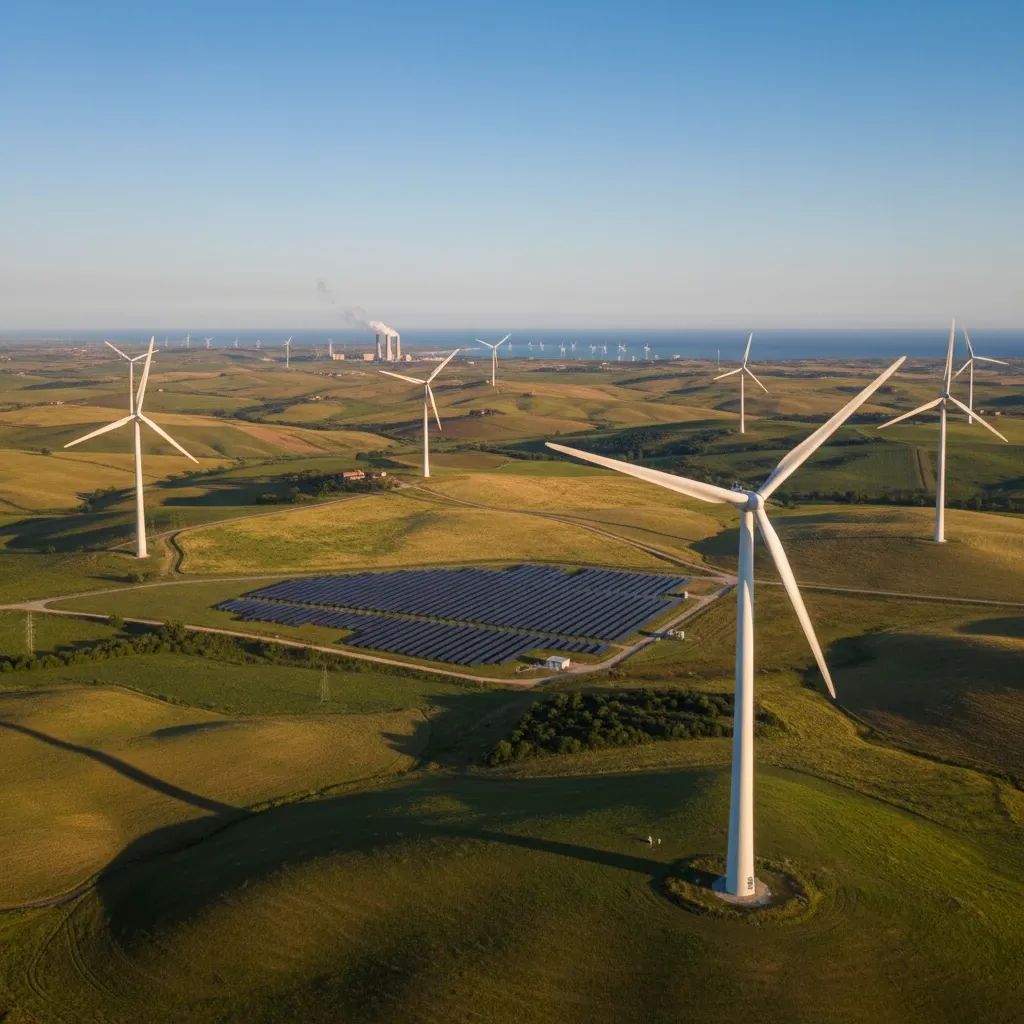
The Italy-based Toto Group's renewable energy arm, Renexia, has signed a framework agreement with Canadian fusion pioneer General Fusion Inc. to bring cutting-edge Magnetized Target Fusion (MTF) technology to Italian soil—a move that could position Italy as a European hub for next-generation clean energy by the mid-2030s.
Why This Matters
• Dual energy strategy: Italy is betting on offshore wind for immediate decarbonization while building infrastructure for fusion plants that could deliver 300 MW of baseload power per installation within a decade.
• Energy independence: Fusion technology aims to reduce Italy's reliance on imported fossil fuels, which remain vulnerable to geopolitical price swings and supply disruptions.
• Industrial revival: The partnership targets the reconstruction of Italy's vanished nuclear supply chain, potentially creating thousands of specialized manufacturing jobs across the Abruzzo region and beyond.
• Timeline acceleration: Site feasibility studies begin immediately, with first-phase development work slated for late 2026 pending final commercial terms.
Bridging the Energy Gap: Wind Today, Fusion Tomorrow
Renexia CEO Riccardo Toto framed the collaboration as a two-pronged approach to Italy's energy transition. "Offshore wind is fundamental today. Fusion is for tomorrow," he stated in a company release issued June 24, 2026. "We intend to contribute actively to the industrial development of these solutions, putting competencies, project capabilities, and dialogue with territories and institutions into a unified system."
The agreement spans the entire project lifecycle—from site evaluation and selection through commercial offtake agreements, permitting, construction, and commissioning. Renexia will leverage its experience navigating Italy's notoriously complex authorization processes, a skillset honed during years of offshore wind development in the Adriatic and Tyrrhenian Seas.
Fusion energy, long dismissed as perpetually "30 years away," has seen dramatic progress in recent years. General Fusion's Lawson Machine 26 (LM26) began integrated operations in early 2025 and has demonstrated significant progress toward fusion milestones. The company aims to reach "scientific breakeven" (100% of the Lawson criterion) by the end of 2026, a milestone that would validate MTF's commercial viability.
Unlike competing approaches that rely on superconducting magnets or high-powered lasers, MTF compresses molten lithium walls around a magnetized plasma target, generating fusion reactions without exotic materials or extreme electrical demands. A commercial-scale MTF plant would pair two 150 MW reactors operating in tandem to deliver 300 MWe of dispatchable, carbon-free electricity—roughly enough to power a mid-sized Italian city.
What This Means for Italian Industry and Energy Security
Italy's energy landscape remains heavily dependent on natural gas imports and intermittent renewables. According to industry reports, wind and solar have become increasingly important components of Italy's electricity mix, but grid stability continues to require fossil backup during periods of low wind and cloud cover. Fusion offers a potential solution: baseload power with zero carbon emissions, no long-lived radioactive waste, and no meltdown risk.
Italy's offshore wind development has faced bureaucratic hurdles. Despite numerous proposed projects totaling significant capacity, permitting delays have left many proposals stranded in environmental review processes. Renexia's pivot toward fusion reflects both frustration with regulatory delays and a belief that Italy must diversify its clean energy portfolio. "We don't want to deal only with renewables," the company emphasized in its statement. "This partnership aims to contribute to energy production through a balanced mix—from offshore wind, essential for large-scale clean production, to frontier technologies like nuclear fusion, a strategic objective we cannot afford to miss."
The Abruzzo-based Toto Group brings industrial heft: its portfolio spans construction, healthcare, and infrastructure, with deep ties to regional manufacturing clusters that once supported Italy's nuclear program before the 1987 referendum shuttered all reactors. Reviving this supply chain is a stated goal. "We're working to rebuild an industrial fabric that has almost vanished," Renexia noted, signaling ambitions to produce components domestically rather than import turnkey systems.
The European Fusion Race and Italy's Positioning
Italy is not alone in courting fusion developers. The European Commission's Euratom Work Programme 2026-2027 allocates €222 M specifically for fusion R&D, including a new public-private partnership to accelerate commercialization. Several European companies are pursuing fusion technology development, with timelines extending into the 2030s and beyond.
General Fusion's MTF technology offers a promising pathway to commercialization. The company has characterized the Renexia agreement as a significant step in developing fusion energy technology for global markets. General Fusion aims to deliver grid-connected power in the early to mid-2030s, positioning itself competitively among fusion developers.
Renexia already sits on General Fusion's Market Development Advisory Committee, a strategic body shaping commercial plant design. This insider access gives Italy early visibility into site requirements (access to water for cooling, grid interconnection capacity, seismic stability) and regulatory frameworks—critical advantages in a sector where first-mover nations may capture decades of technology exports and operational know-how.
Practical Hurdles: Permits, Public Opinion, and Grid Integration
Despite the momentum, fusion deployment in Italy faces non-trivial obstacles. Italy's 1987 nuclear referendum banned fission reactors following Chernobyl, and while fusion produces no long-lived waste and carries minimal accident risk, public skepticism toward anything labeled "nuclear" persists. Regional opposition has historically challenged nuclear energy proposals; Renexia will need a sustained public education campaign emphasizing fusion's safety profile.
Permitting timelines could stretch to 5-7 years if fusion plants are subjected to the same environmental review standards as other major energy infrastructure. The agreement's phased structure—evaluation, development, permitting, construction—suggests awareness of this risk. Early engagement with municipalities and environmental ministries will be essential.
Grid integration presents another challenge. Italy's transmission network, managed by Terna S.p.A., was designed for centralized fossil generation, not distributed renewables plus occasional fusion baseload. Pairing a 300 MW fusion plant with existing offshore wind farms could stabilize output, but synchronizing intermittent wind with constant fusion discharge requires sophisticated forecasting and storage buffers—technologies still maturing.
Cost competitiveness remains uncertain. General Fusion has not publicly disclosed detailed levelized cost of energy (LCOE) projections, but fusion's capital intensity—exotic materials, precision engineering, regulatory compliance—must compete with plummeting solar and onshore wind prices. Italian policymakers have signaled openness to exploring advanced nuclear technologies as part of the nation's long-term energy strategy.
The Bottom Line for Residents and Investors
For Italian households and businesses, the Renexia-General Fusion partnership is a bet on energy stability beyond 2035. If MTF plants deliver as promised, electricity prices could decouple from volatile gas markets, insulating consumers from geopolitical shocks like those that spiked bills during recent energy crises. Fusion would also create high-skill jobs in reactor maintenance, supply chain logistics, and component manufacturing—sectors where Italy retains engineering talent but lacks domestic demand.
For investors, the timeline is speculative but potentially lucrative. Fusion startups have attracted significant capital globally, with returns hinging on demonstration milestones (General Fusion's 2026 breakeven target) and regulatory approvals. The Toto Group's diversified portfolio cushions downside risk, but stakeholders in Renexia or General Fusion face outcomes contingent on technical success and political will.
The broader message is clear: Italy is hedging its energy future with a mix of mature renewables and frontier technology. Whether fusion delivers by 2035 or advances more gradually will depend as much on bureaucratic will as scientific progress—a dynamic Italian residents know all too well.


