
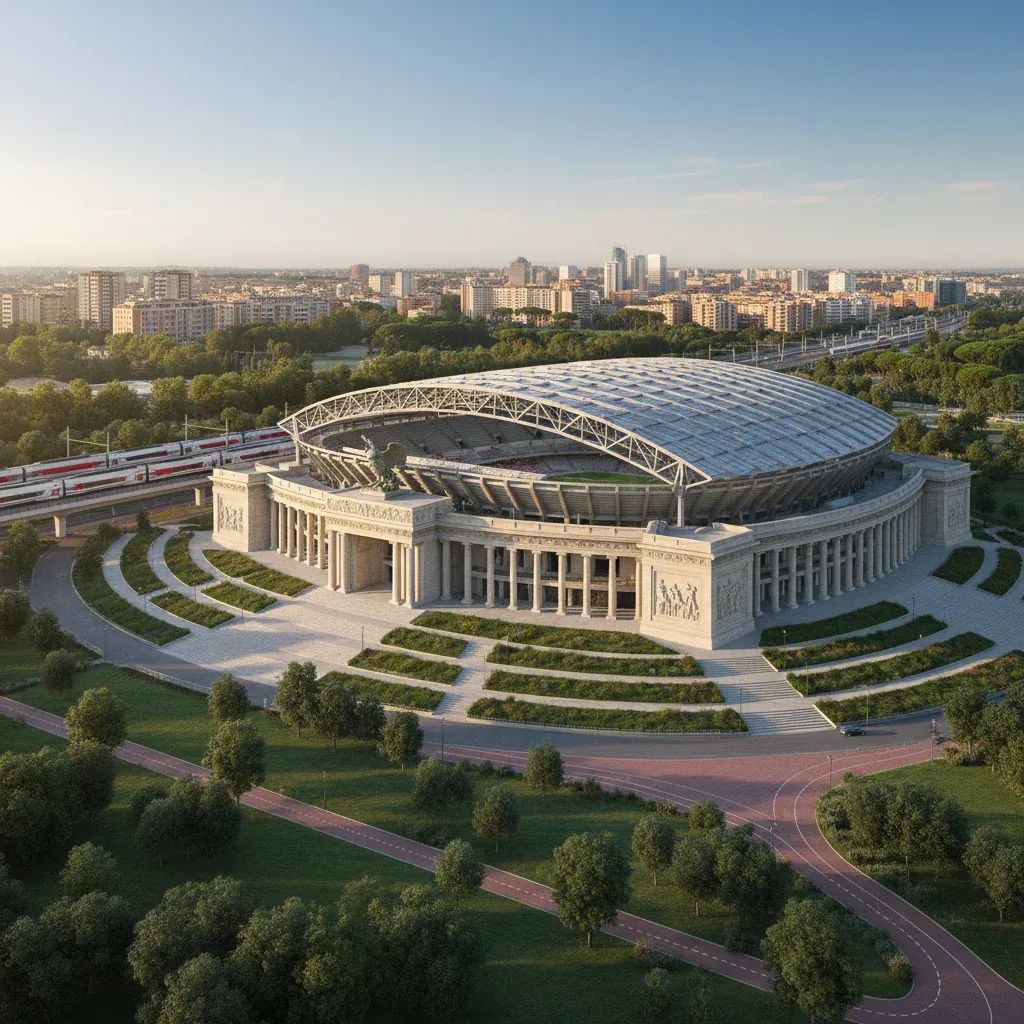
Italy's Sports Ministry has unveiled a sweeping agenda to overhaul Italian football governance, infrastructure, and revenue distribution, with Minister Andrea Abodi telling senators that the sector must now take responsibility for its own modernization or face escalating government pressure. Speaking before the Senate's 7th Commission on April 21, Abodi laid out concrete timelines for stadium projects, broadcast rights reform, and governance changes—all converging as the country prepares to co-host Euro 2032 with Turkey.
Why This Matters
• €3.5B in private stadium investment is moving through bureaucratic channels, with 5 to 6 construction sites expected to break ground by year-end 2026 or early 2027.
• A draft reform of the Melandri Law—governing how TV revenue is split among clubs—has been ready for months and targets implementation for seasons starting after July 1, 2026.
• The Minister rejected political commissariamento (extraordinary administration) of the Italian Football Federation (FIGC), warning it sets a dangerous precedent, yet acknowledged the federation's internal deadlock may force intervention if June's presidential elections fail.
Stadium Push: €3.5B Without Public Subsidy
Abodi emphasized that Italy's ambitious stadium modernization relies almost exclusively on private capital, a sharp departure from traditional public works models. The €3.5B pipeline includes projects in Milan, Rome, Genoa, Florence, and potentially Naples and Salerno, with the government's role limited to administrative facilitation rather than direct funding.
Currently, only Juventus' Allianz Stadium in Turin meets UEFA's standards for Euro 2032. Other venues lag behind, trapped in bureaucratic inertia and local opposition. Abodi announced that from October onward, his office will issue weekly progress updates on stadium projects, with a newly appointed commissioner tasked with cutting through red tape at municipal and regional levels.
Key projects include:
• Milan (San Siro): Inter and Milan's long-stalled plans for a new stadium remain a "cornerstone" for Euro 2032, despite ongoing investigations and local resistance.
• Rome (Pietralata and Olimpico): AS Roma has submitted technical and economic feasibility studies for a 60,605-capacity stadium at Pietralata, with total investment exceeding €1B—nearly €700M for the stadium itself, the rest for urban infrastructure. The Stadio Olimpico is also earmarked for the tournament. Meanwhile, Lazio has proposed redeveloping the historic Stadio Flaminio, with construction slated for the first half of 2027.
• Florence (Artemio Franchi): Renovation began in 2023 with public funds, an exception where municipal government drives the project.
• Genoa (Luigi Ferraris): Sampdoria and Genoa plan a joint €100M renovation.
• Salerno (Arechi): Over €100M in upgrades are underway, including full roof coverage.
Abodi stressed that public equity support—not grants—will be made available for projects whose economic frameworks have shifted over the years, potentially totaling €150M initially and €300M at maturity. A permanent working group involving Cassa Depositi e Prestiti, Invimit, SACE, and the Institute for Sports Credit is coordinating this effort.
Melandri Law Reform: More Equal Revenue, End of Single-Buyer Ban
The Minister confirmed that his office has held a draft revision of the Melandri Law since September 2025, following consultations with the Ministry of Economy and Finance and the Ministry of Made in Italy. The reform targets the 2026/27 season and beyond, aiming to rebalance broadcast revenue distribution and modernize how rights are sold.
Proposed Changes
The most disruptive element: abolishing the "no single buyer" rule. Under current law, broadcasters must be multiple; the draft would permit a single platform to acquire all rights for up to three years—potentially longer for Serie A—subject to review by Italy's communications authority, AGCOM.
Revenue distribution would shift toward merit and youth development rather than historic fan base or stadium attendance. The draft proposes:
• Over 50% split equally among all participating clubs.
• The remainder allocated based on sporting merit dating back to the 1999/2000 season and youth academy output.
• Women's football included at 1% of total revenue, cementing its place in the professional ecosystem.
Abodi framed the reform as essential for making Italian football "more commercially manageable," but cautioned it is not sufficient alone. He called on clubs and leagues to move beyond presenting the government with a "list of problems to solve" and instead demonstrate an "assumption of responsibility" for systemic change.
Mutuality and Infrastructure
The reform mandates that mutuality payments to lower leagues be earmarked for infrastructure upgrades and youth development, addressing what Abodi described as Italy's lowest mutuality rates in Europe. The draft also sets criteria for 5G connectivity and virtual/augmented reality ecosystems in stadiums, aiming to enhance fan experience and unlock new revenue streams.
Commissariamento: The Nuclear Option Abodi Won't Touch
When pressed on whether extraordinary administration—essentially a government-appointed overseer—could modernize the FIGC, Abodi offered a qualified yes but stressed he has "very strong reservations" about legislating such a mechanism for federations accountable to CONI (Italian National Olympic Committee).
"I don't want to force the issue," he said, "because I have a responsibility to hand over to whoever comes after me a situation that is not ambiguous. I have no doubts about our correctness, but I don't have certainty about those who come after us. I will not deliver such a delicate tool without certainty of its proper use."
The Minister's caution reflects the international stakes: FIFA and UEFA fiercely protect federations' autonomy from political interference. Past examples—most recently FIGH (Italian Handball Federation) in 2023—show that CONI-led commissariamento can occur, but government-imposed takeovers risk triggering international suspensions that would bar Italian clubs and national teams from competition.
Historical Context
The FIGC has been placed under extraordinary administration multiple times, notably after the 2006 Calciopoli scandal and again in 2018 when the assembly failed to elect a president. The current risk is elevated: if the June 22 electoral assembly cannot achieve the required supermajorities—three-quarters on the first ballot, two-thirds on the second, simple majority on the third—paralysis could force CONI's hand.
Political figures have openly called for commissariamento to bypass what they see as entrenched interests blocking reform. Abodi, however, prefers internal change, warning that "we need a system change, not just a change of presidents."
Betting Revenue and Youth Development
Abodi also addressed sports betting reform, suggesting that a share of proceeds should flow to event organizers—the clubs and leagues that generate the data underpinning betting markets. He noted that in other countries, betting revenue promotes competition and that clubs, as primary investors and data certifiers, should not be excluded from the value chain.
He called for stronger measures against illegal betting and gambling addiction (ludopathy), proposing a more precise monitoring observatory and improved traceability of bettors and betting limits.
On youth development, the Minister underscored the importance of identifying and training Italian talent to ensure the national team's long-term competitiveness. He also advocated for autonomy, transparency, and independence in the refereeing system, a perennial source of controversy in Italian football.
What This Means for Residents
For those living in Italy, these reforms carry tangible implications:
• Stadium accessibility and experience: New and modernized venues promise better facilities, connectivity, and safety. However, the reliance on private capital means ticket prices could rise as investors seek returns.
• Broadcast availability: The potential end of the single-buyer ban could consolidate Serie A rights under one platform—possibly lowering subscription complexity, but also risking monopolistic pricing if AGCOM oversight falters.
• Local economies: Major construction projects in Milan, Rome, and other cities will generate jobs and urban development, though they may also bring displacement and gentrification pressures.
• Youth football investment: Redirecting mutuality funds toward academies should improve grassroots pathways, benefiting families and communities invested in youth sport.
• National team prospects: Structural reforms aim to reverse Italy's recent World Cup failures, restoring pride and tourism revenue linked to international success.
Timeline and Next Steps
Minister Abodi committed to weekly updates on stadium projects starting October 2026, with the appointed commissioner empowered to resolve bureaucratic delays. The Melandri Law reform will proceed through parliamentary debate, with the government seeking broad consensus to ensure durability beyond the current administration.
The FIGC's June 22 electoral assembly looms as a pivotal moment. Figures including Giovanni Malagò, Giancarlo Abete, and Matteo Marani are engaged in consultations, but whether the federation can elect a president without descending into crisis remains uncertain.
Italy must submit its final list of five host stadiums for Euro 2032 by October 2026. With only Turin's Allianz Stadium currently compliant, the clock is ticking—and the government's willingness to gamble on private capital rather than public subsidy means the margin for delay is razor-thin.


