
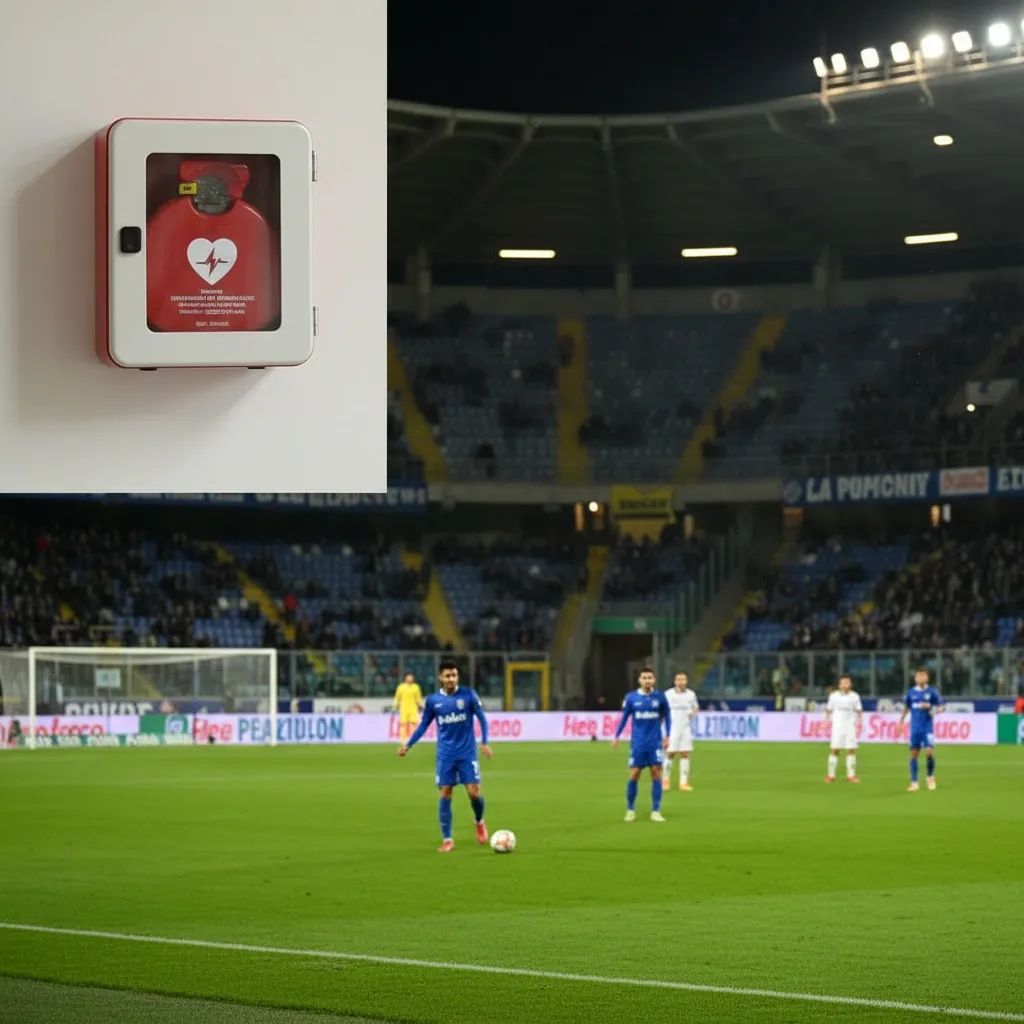
Matchday 34 honors Morosini With A Fundraising Campaign for Life-Saving Defibrillators
The Italian Serie B League will launch a significant commemorative campaign during matchday 34 in April 2026, transforming the memory of footballer Piermario Morosini into concrete action for cardiac safety across Italian sports. All 20 Serie B clubs will auction match-worn jerseys and captain's armbands to fund defibrillator distribution and renovations at the Piermario Morosini pitch in Bergamo. The initiative, executed in partnership with the non-profit organization Live Charity and the Morosini family, represents a decade-long effort to close the gap between Italy's advanced cardiac screening protocols and the critical need for rapid emergency response.
How to Participate: The 2026 Jersey Auction and Campaign Details
During the 34th round of Serie BKT, scheduled around mid-April 2026, captains of all 20 clubs will wear armbands printed with Morosini's portrait. Television broadcasters will overlay dedicated graphics onto live feeds, ensuring visibility for audiences nationwide. Each participating club will donate a match-worn jersey to Live Charity, which will host an online auction alongside the captain's armbands.
Funds raised will directly support two initiatives:
• Live Charity's "Italia Cardioprotetta" project, which installs defibrillator (DAE) units in public spaces and sports venues across the country
• Structural improvements at the Piermario Morosini pitch in the Monterosso neighborhood of Bergamo, where the footballer grew up
League president Paolo Bedin framed the initiative in practical terms: "Remembering Piermario means turning memory into concrete actions aimed at protecting athletes' health."
In parallel, the Morosini Association has organized the "Gran Galà della Solidarietà 2026," a fundraising gala that complements the Serie B league's efforts. The family's sustained engagement ensures that Morosini's legacy remains anchored in action rather than sentiment.
The Tragedy That Changed Italian Sports
On April 14, 2012, Piermario Morosini collapsed during a Serie B fixture between Pescara and Livorno while playing for Livorno, suffering fatal cardiac arrest caused by inherited arrhythmogenic cardiomyopathy. The midfielder, born in 1986, had built his career predominantly in Italy's second tier, wearing the shirts of Bologna, Vicenza, Reggina, Padova, and Livorno. His sudden death at age 26 exposed critical flaws in emergency response procedures: a defibrillator was present at the stadium but went unused, and a police vehicle blocked the ambulance exit for nearly a minute.
Within months, legislators enacted the so-called Decreto Balduzzi (Law 158/2012, converted to Law 189/2012), mandating semi-automatic external defibrillators (DAE) and trained personnel at all sporting facilities used by professional and amateur clubs. The regulation took full effect for amateur organizations on July 1, 2017, after a phased rollout that began in 2013. Subsequent amendments in Law 116 of August 4, 2021 extended the requirement to cover training sessions in addition to competitions, and obliged clubs to register their devices with regional 118 emergency dispatch centers.
Three physicians were convicted of manslaughter in 2016 for failing to deploy the defibrillator and follow protocol, though Italy's Supreme Court overturned the sentences in 2019. The legal saga underscored a systemic disconnect: advanced cardiac screening, in place since 1982, had positioned Italy as a global leader in primary prevention, yet the lack of a robust secondary response—immediate defibrillation—rendered those safeguards incomplete.
Why This Matters: The Regulatory Landscape for Residents and Clubs
For anyone attending or organizing matches in Italy, the regulatory landscape is now unambiguous. Clubs without a functioning DAE and certified personnel face sanctions, and competitions cannot commence if equipment or trained staff are absent. Yet a 2025 study revealed that more than 70% of Italy's DAE inventory sits inside public buildings, schools, and offices locked during evenings, weekends, and holidays—precisely when cardiac arrests are most likely to occur during recreational sports. Advocates argue for weatherproof outdoor cabinets and a national geolocation map to improve accessibility.
Italy's Comprehensive Cardiac Screening System
Italy's pre-competition screening protocol, mandatory since 1982, requires athletes to undergo an annual assessment comprising medical history review, physical examination, 12-lead ECG, and stress testing. Research led by Professor Domenico Corrado of the University of Padua demonstrated that this regimen reduced sudden cardiac death rates among competitive athletes. Nevertheless, cardiologists including Professor Giorgio Galanti of the University of Florence have publicly stated that yearly checks remain insufficient for detecting every high-risk condition, particularly those that develop between appointments.
The Italian Football Federation (FIGC) responded by endowing research scholarships focused on primary and secondary prevention of sudden death in sport. Milan's Centro Cardiologico Monzino opened a specialized sports cardiology unit, the first of its kind in Italy, to centralize expertise and accelerate innovation. Meanwhile, campaigns by regional governments—such as Liguria's 2021 push—and national charities like "Trenta Ore per la Vita" have installed DAE units in schools and community fields since 2011.
Regulatory strictness extends to implanted devices: Italian professional football prohibits Serie A players from competing with an implantable cardioverter-defibrillator, a stance stricter than that of the United Kingdom and other European leagues. The policy reflects a conservative approach to long-term cardiac risk, though it limits career options for athletes diagnosed with certain arrhythmias.
Persistent Challenges in Emergency Response
Experts consistently highlight a cultural lag in defibrillation practices. Professor Corrado has remarked that Italy lags "light-years behind" in fostering a defibrillation mindset, despite excelling in electrocardiographic screening. Senator Antonio Tomassini, who chaired the Senate's Health and Hygiene Committee, convened study sessions on sudden death in sport and urged scientific societies and athletic associations to prioritize emergency training. Fellow committee member Raffaele Calabrò emphasized the need for deeper competence in cardiopulmonary resuscitation among sports physicians and a denser network of accessible DAE units.
Dr. Roberto Corsetti, president of the Italian Association of Cycling Physicians, has stressed that any clinician issuing fitness-to-compete certificates must possess comprehensive knowledge of cardiology and sports cardiology, not merely general medicine credentials. The message is clear: technological infrastructure without human expertise and cultural readiness is insufficient.
Impact on Expats and Investors
For expatriates and foreign investors involved in Italy's sports sector—whether as club sponsors, facility operators, or recreational league organizers—compliance with DAE regulations is non-negotiable. Liability exposure extends beyond fines: failure to maintain equipment or train staff can trigger criminal investigations if an athlete suffers a preventable death. Insurance policies increasingly stipulate proof of DAE availability and staff certification as underwriting conditions.
The broader insurance and real estate markets have also adjusted. Gyms, youth academies, and private sports complexes now factor DAE installation and annual recertification courses into operating budgets. Property developers seeking municipal approval for new sports facilities must demonstrate compliance with Law 116/2021 in design documents, including plans for outdoor DAE cabinets and signage visible to emergency responders.
For parents of youth athletes, the regulatory framework offers a measure of reassurance, though vigilance remains essential. Verifying that coaches hold valid CPR and DAE certifications—and that devices are registered with local 118 centers—should be part of enrollment due diligence.
Looking Ahead
The Serie B League's 2026 commemoration arrives 14 years after Morosini's death, a span during which Italy has constructed one of Europe's most comprehensive legal frameworks for cardiac safety in sport. Yet the distance between statute and practice persists. The Monterosso field renovation and the Italia Cardioprotetta auction represent incremental steps toward closing that gap, converting a footballer's untimely death into a catalyst for systemic reform.
Whether Italy can extend this infrastructure beyond organized clubs into the realm of amateur pickup games and community leagues—where the majority of cardiac arrests occur—remains an open question. The answer will determine whether Morosini's legacy endures as a regulatory footnote or as a blueprint for citizen-led emergency preparedness.


