
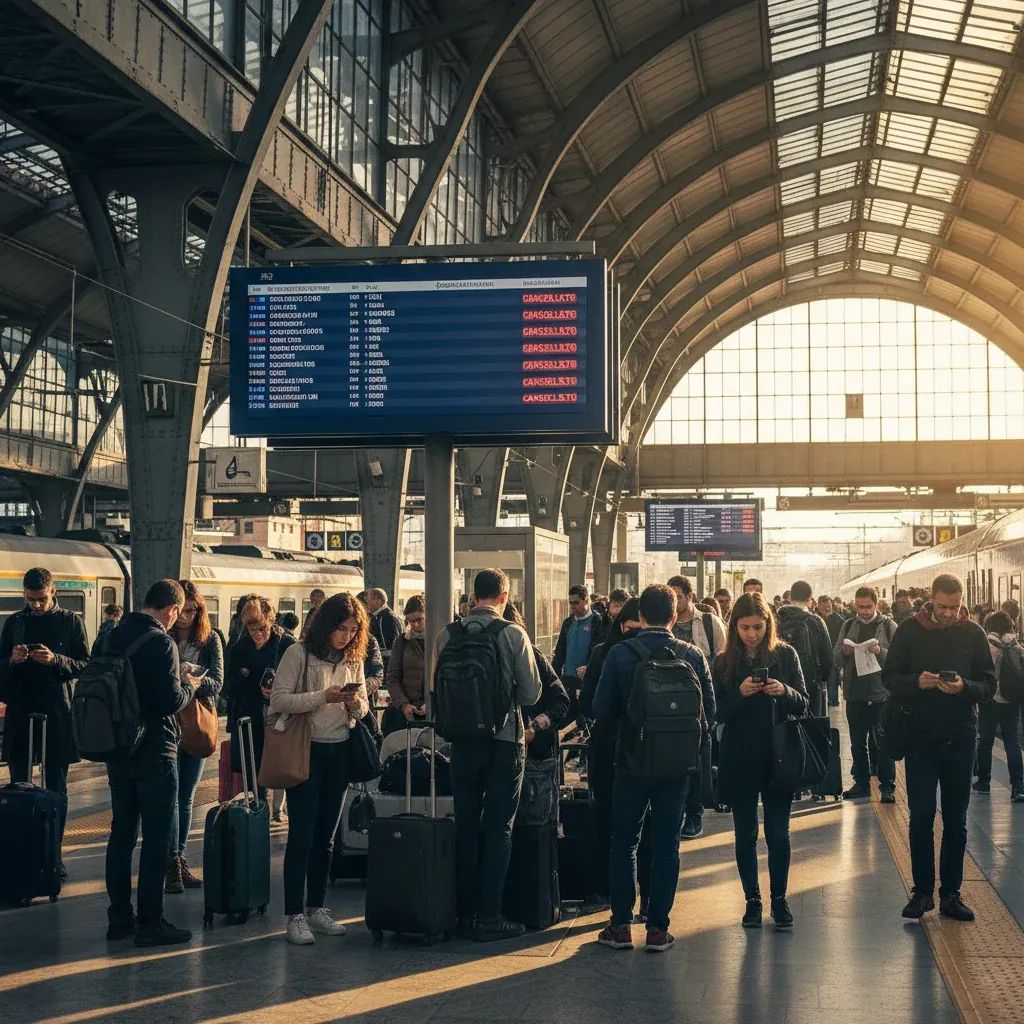
The Italian transport network faces widespread disruption today as the Unione Sindacale di Base (USB) labor federation executes a 24-hour nationwide strike—a move that will halt trains, buses, and trams across the country while leaving air travel largely untouched. The stoppage, which began at 21:00 Sunday and runs through 20:59 tonight, marks the latest escalation in organized labor's campaign against Italy's military spending trajectory and foreign policy alignment.
Why This Matters
• Rail chaos: Trenitalia, Italo, and Trenord services are operating only during guaranteed windows (6:00–9:00 and 18:00–21:00). Check apps before traveling.
• City transit varies: Rome's Atac follows similar protections (service until 8:29, then 17:00–19:59). Milan's ATM reports normal operations across all lines.
• Healthcare and schools: Emergency rooms remain open, but non-urgent appointments may cancel. Class suspensions depend on teacher participation at each institute.
• Political context: USB demands the government redirect €3.5B in planned defense increases toward salaries, healthcare, and housing—citing Italy's 2026 military budget of €32.4B as a record high.
Why USB Called the Strike
The timing is deliberate. USB frames today's action as solidarity with the Global Sumud Flotilla, an international convoy attempting to deliver humanitarian aid to Gaza. The union's proclamation explicitly links Italy's €9.2B in arms export authorizations for 2025—a 19% year-over-year jump—to what it calls "an economy of death."
"No worker should be dragged into this system," the federation stated, demanding legislation that permits employees to refuse participation in the production, transport, or sale of military materiel. The union insists that "not a single nail for war" should leave Italian factories, framing the issue as both a labor right and a moral imperative.
Joining USB are smaller federations including USB PI and FI-SI, though major unions like CGIL and UIL have not formally endorsed this particular strike. The absence of broader labor coalition suggests USB's platform—centered on foreign policy rather than traditional workplace grievances—may not command universal support within Italy's fragmented union landscape.
What This Means for Residents
If you commute by rail, expect delays beyond the official strike window. The FS Group warns that cancellations and schedule changes often persist "before and after" the formal stoppage due to crew positioning and equipment logistics. The Trenitalia app, the toll-free 800892021 hotline, and station self-service kiosks offer real-time updates—though historically these channels become overwhelmed during major strikes.
Urban transport follows local rules. In Rome, Atac's guaranteed service protects the morning rush (until 8:29) and early evening (17:00–19:59), leaving midday travelers stranded. Milan residents face no such disruption; ATM confirmed all metro, bus, and tram lines run normally, suggesting lower USB membership within that city's transit authority.
Parents should verify school status directly with their child's institute. Legally, principals must notify families if teacher absences force closures, but the decentralized reporting system—where data gets uploaded to the Education Ministry by May 19—means today's impact remains opaque in many districts.
Italy's Defense Spending Under Scrutiny
USB's critique centers on numbers that reveal Italy's accelerating military investment. The €32.4B defense budget for 2026 represents a 3.5% increase over 2025, with weapons procurement now consuming 40% of that total. Independent watchdog Osservatorio Milex calculates "pure" military spending at €34B when indirect costs like base infrastructure are included—a historic peak.
Yet Italy remains shy of NATO's 2% GDP target. Official statistics place the country at 1.46% to 1.51% depending on accounting methodology. Last year, NATO "certified" Italy at 2.01%, but that figure hinges on controversial reclassifications—adding €14B in military pensions and Carabinieri policing functions to the ledger. Critics argue this is statistical creativity rather than genuine defense capacity expansion.
The disconnect becomes starker in European context. Poland dedicates 4.5% of GDP to defense, while Latvia and Estonia each exceed 3.6%. Germany's budget surged 24% in 2025 to €97B, vaulting Berlin into fourth place globally. Spain boosted spending by 50%, crossing the 2% threshold for the first time since the 1990s. Italy's trajectory—while upward—lags behind the continental trend.
The Arms Export Boom
Italy's position as the sixth-largest arms exporter worldwide represents a dramatic climb from tenth place just five years ago. SIPRI data shows a 157% increase in weapons deliveries during 2021–2025 compared to 2016–2020. The €9.2B in export authorizations issued in 2025 breaks the previous year's record by 19%.
Kuwait alone absorbed €2.6B via a single naval contract, illustrating how megadeals skew annual totals. The broader Middle East accounts for 37% of Italian arms flows, with 62% of all sales going outside the EU and NATO blocs. That raises friction with Law 185/90, Italy's 1990 statute prohibiting sales to countries at war or guilty of severe human rights violations.
Parliamentary amendments currently under Senate review—feared by advocacy groups like Rete Italiana Pace Disarmo—could weaken transparency requirements and ease restrictions on sensitive destinations. Meanwhile, Ukraine receives substantial deliveries despite active conflict (justified as defensive aid), and Israel continues receiving shipments under pre-existing licenses, a legal gray zone that activists highlight as inconsistent enforcement.
Past Strikes and Their Limited Policy Impact
USB draws inspiration from October 2025's larger mobilization, when CGIL reported 2M participants across 100 cities protesting "the genocide economy." That strike achieved 60% average participation nationally, with transportation and logistics hitting 80% in some regions. Rome alone saw 300,000 demonstrators.
The tangible policy outcomes, however, remain elusive. Polling from late 2024 shows 55% of Italians oppose boosting defense budgets, and 65% favor taxing arms manufacturers' excess profits—yet the 2026 budget reflects neither preference. The government approved €3.5B in new weapons programs in December, and parliament transmitted 14 additional procurement plans worth €5.3B.
What strikes achieve is sustained visibility. They force political parties to articulate positions, create electoral pressure in swing districts, and offer unions a bargaining chip in separate contract negotiations. But the pathway from one-day stoppages to legislative reversals is indirect and uncertain, particularly when economic impact estimates—€1B per general strike, according to industry groups—fail to move policymakers accustomed to absorbing such costs.
Looking Beyond Today
Travelers should anticipate service normalization by Tuesday morning, though residual delays on complex routes (Milan–Sicily, for instance) sometimes extend into midweek. Those with flexible schedules might reschedule non-urgent trips; commuters lacking alternatives should budget extra time and prepare backup options like carpools or remote work arrangements.
The strike's broader question—whether Italy's military modernization serves national interest or diverts resources from a strained welfare state—remains unresolved. With healthcare waiting lists stretching months, teacher salaries lagging European averages by 15%, and housing costs in major cities consuming 40%+ of median income, USB's framing resonates with voters even when specific foreign policy positions (like severing Israel ties) poll as divisive.
The union has signaled "further mobilizations" without specifying dates, suggesting today's action is one installment in a sustained campaign. For now, residents should focus on immediate logistics: confirm travel plans, verify school status, and keep emergency room visits to genuine crises. The political debate will outlast the disruption.


