
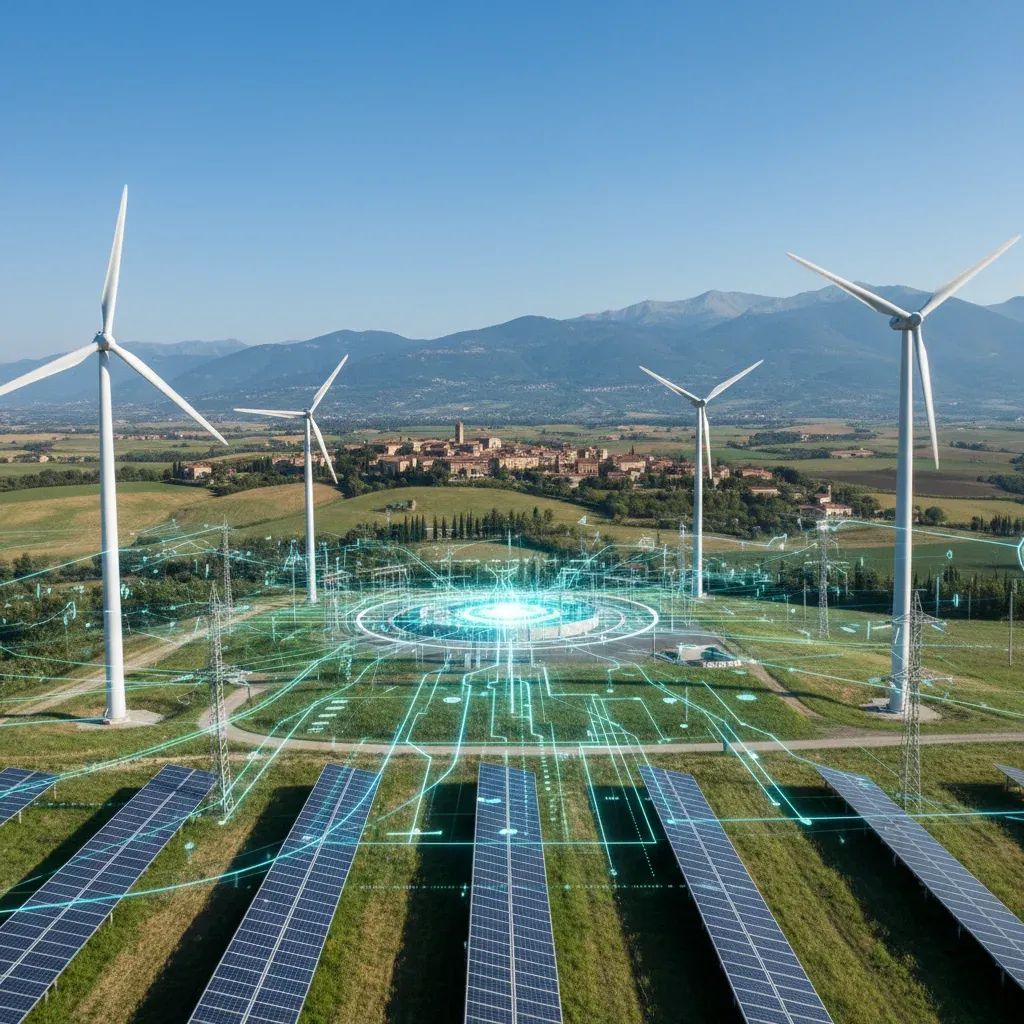
Italy's state-owned grid operator Terna is overhauling the national transmission network with a €23 billion investment plan through 2034, designed to unlock the country's renewable energy potential and strengthen its role as a Mediterranean energy hub. The overhaul includes undersea cables, HVDC technology, and cross-border links that will reshape how electricity flows across the country.
Why This Matters:
• Grid capacity improvements are planned to support greater renewable energy integration across Italian regions.
• The plan aims to absorb substantial new solar and wind capacity by the mid-2030s—a significant expansion of clean energy infrastructure.
• CO2 emissions reductions from the power sector are targeted as renewable penetration increases and grid congestion eases.
• Italy's cross-border electricity exchange capacity is expected to expand, enhancing energy security and market integration.
A Network Built for Decentralized Power
Maria Antonietta Sidoni, Terna's Director of Grid Planning and Authorizations, outlined the strategy at an ANSA-Enel energy forum, emphasizing that transmission infrastructure is "at the center of the energy transition." The Development Plan 2025–2034 responds to a fundamental shift: Italy's power system is moving from a handful of large fossil plants to thousands of distributed solar farms and wind turbines scattered across regions with different generation profiles.
The grid investments align with the National Integrated Energy and Climate Plan (PNIEC), which mandates aggressive decarbonization targets in line with EU commitments. Without expanded transmission, renewable electricity generated in sun-rich regions cannot efficiently reach demand centers, forcing reliance on fossil plants and driving up costs.
Terna's strategy addresses key challenges: interregional capacity (moving power between zones), interconnection capacity (integrating with neighboring grids), and grid resilience (withstanding extreme weather and operational disruptions). Expanding transmission is expected to reduce market prices by enabling cleaner energy sources to compete more effectively with fossil generation.
Major Projects: Tyrrhenian Link and Adriatic Link
Terna is advancing two significant subsea HVDC cable projects.
Tyrrhenian Link is a subsea cable system connecting Sicily, Sardinia, and mainland Italy. Work has progressed on multiple branches, with significant cable installation phases completed. Onshore conversion stations are under construction at multiple locations. The project is scheduled for completion in the late 2020s.
Adriatic Link, an HVDC line bridging Marche and Abruzzo across the Adriatic seabed, received ministerial authorization in January 2024 and has attracted substantial financing support from international institutions and domestic banks. Marine cable production and civil works are underway, with converter stations under development in both regions. The project is targeted for completion in the late 2020s.
Both projects utilize High Voltage Direct Current (HVDC) technology, which reduces transmission losses over long distances and is the standard solution for deep-water submarine cables. This approach also reduces electromagnetic fields and land footprint compared to traditional overhead lines, easing permitting in populated or sensitive areas.
The Hypergrid Architecture: Modernizing the Grid
In parallel, Terna is developing Hypergrid, an architecture that overlays HVDC systems onto the existing 380 kV and 220 kV AC backbone. Sidoni noted that this approach "leverages existing infrastructure" while introducing strategic DC corridors spanning the peninsula to channel renewable power efficiently.
Hypergrid includes selective conversion of aging AC lines to HVDC technology where justified, and deployment of advanced power electronics to stabilize grid operations. This capability is critical as fossil fuel plants retire and the grid becomes increasingly dependent on renewable sources.
The architecture enables a hybrid AC/DC operational model, allowing system operators to dynamically route electricity along the most efficient paths and manage congestion. Terna's control operations are being enhanced with advanced digital tools and forecasting capabilities to optimize system performance and maintenance.
Cross-Border Links: Regional Integration
Italy's position as a Mediterranean peninsula makes it a natural energy bridge. Terna is developing international interconnectors designed to strengthen ties with neighboring countries and expand energy exchange capacity.
Projects include an Italy–Greece interconnector adding capacity to existing links, and ELMED, linking Italy and Tunisia, which is scheduled for energization in 2030. An upgraded Sardinia–Corsica–Tuscany interconnection received approval and construction has commenced. An enhanced Italy–Austria link was completed in 2023.
These interconnectors do more than diversify supply; they integrate Italy into the pan-European balancing mechanism, allowing renewable surpluses from neighbors to displace fossil generation and improve overall system efficiency. Improved cross-border capacity is expected to support competitive electricity pricing and resource optimization.
What This Means for Residents
For households and businesses, the Development Plan is designed to support lower electricity bills in the medium term as renewable energy penetration rises and grid bottlenecks are reduced. Removing transmission constraints should enable more efficient electricity markets and reduce reliance on expensive backup fossil plants.
The plan also strengthens energy security. Greater interconnection reduces Italy's vulnerability to fossil-fuel price shocks and supply disruptions—lessons underscored by recent energy crises. Meanwhile, increased renewable capacity and grid efficiency contribute to Italy's climate commitments under EU law.
Communities hosting new infrastructure projects will see construction activity and operational jobs. Terna has introduced streamlined permitting processes aimed at accelerating project timelines, though securing local consent remains important in areas with landscape or cultural considerations.
Resilience and Innovation
Terna is investing in grid resilience measures, including systems to protect overhead lines in alpine regions and exploring alternatives to traditional greenhouse-gas-intensive equipment. The company is also developing models to anticipate and address emerging climate risks such as extreme weather events.
Innovation initiatives include testing of distributed flexibility resources—such as aggregated electric vehicles, smart systems, and home batteries—to provide grid services traditionally supplied by fossil plants. This distributed approach could reduce the need for new conventional generation capacity.
Timeline and Risks
The 2025–2034 horizon represents an ambitious modernization effort with inherent challenges. Permitting processes, supply-chain considerations for specialized equipment, and materials cost fluctuations could affect project schedules. Environmental and cultural heritage concerns continue to require careful project planning and community engagement.
Financing appears supported through commitments from European institutions, domestic banks, and EU co-funding mechanisms for cross-border projects. Terna operates under a regulated model that provides revenue stability for long-term infrastructure investment.
Terna's leadership has signaled commitment to maintaining momentum on the updated Development Plan. For anyone tracking Italy's energy transition or investing in energy-intensive sectors, Terna's grid modernization is an essential foundation—less visible than renewable energy installations themselves, but equally critical to achieving climate goals and energy security.


