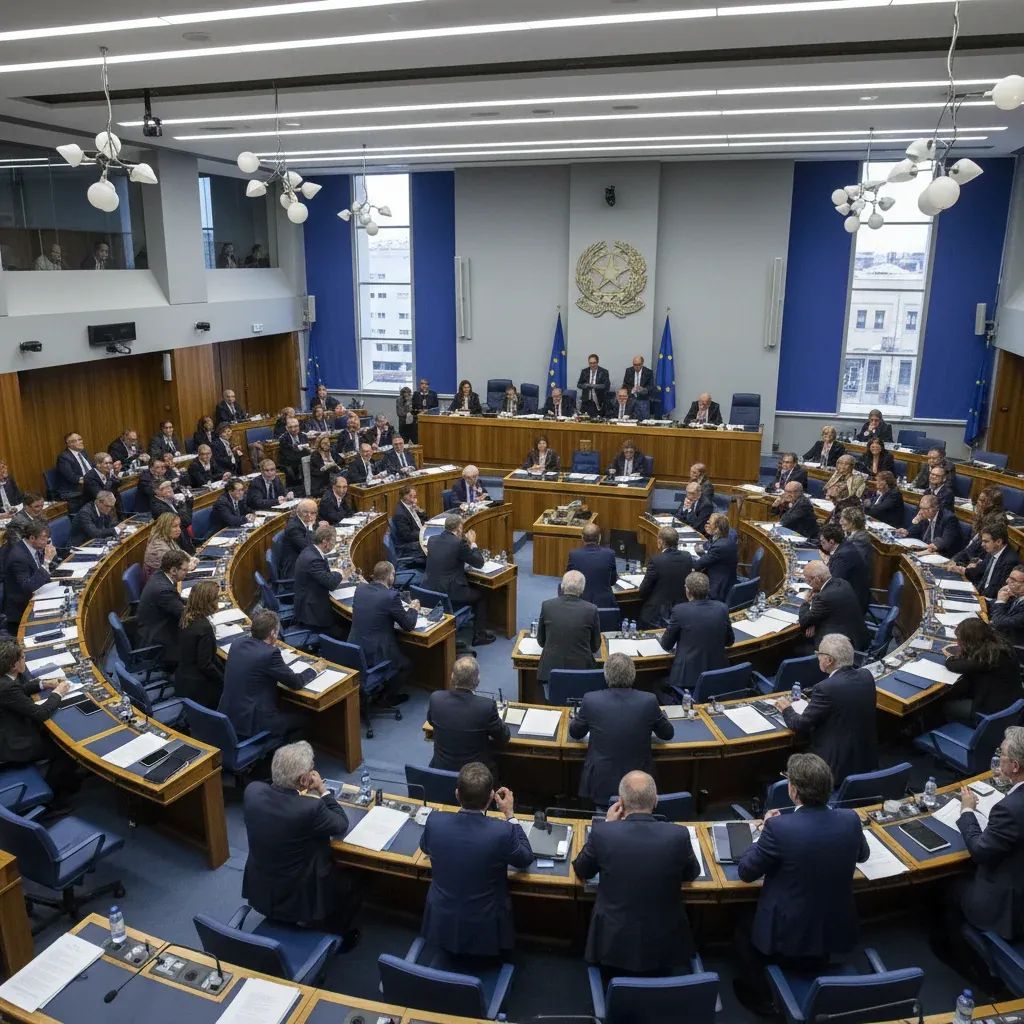
The Italian Cabinet has approved a draft law that flips the legal presumption for teenagers accused of crimes, requiring defense lawyers to prove their clients lack maturity rather than prosecutors demonstrating they understand their actions. The bill, which awaits parliamentary approval and has not yet become law, represents one of the most significant shifts in juvenile justice policy since the current framework took effect.
Why This Matters
• Legal burden reversed: Minors aged 14 to 18 will now be presumed capable of criminal intent unless proven otherwise in court.
• Not yet law: The measure cleared cabinet, but still faces debate and votes in Parliament before becoming enforceable.
• Part of broader crackdown: This follows expanded arrest powers, stricter knife possession rules, and harsher penalties for group vandalism targeting youth offenders.
• Critics warn of constitutional risk: Opposition parties, child welfare groups, and juvenile justice experts argue the inversion violates developmental psychology principles and fair trial guarantees.
The Mechanics of the Change
Under Italy's existing criminal code, judges must individually assess whether a teenager between 14 and 18 possesses the mental and emotional capacity to understand right from wrong before imposing criminal liability. This case-by-case evaluation considers family background, educational trajectory, psychological maturity, and social context—an approach rooted in decades of developmental psychology research showing that adolescent brains remain in flux.
The new proposal modifies Article 98 of the Penal Code, establishing what Justice Minister Carlo Nordio described as a "relative presumption" of criminal responsibility. In practice, this means courts will assume a 15-year-old charged with armed robbery or a 17-year-old accused of assault understands the consequences of their actions. The burden then falls on defense counsel to affirmatively demonstrate diminished capacity through expert testimony, psychiatric evaluation, or social work reports.
Nordio emphasized the law does not lower Italy's minimum age of criminal responsibility, which remains fixed at 14, nor does it increase maximum sentences. "We are not making the punishments harsher," he told reporters at Palazzo Chigi. "We are inverting the burden of proof to facilitate investigations." He characterized the measure as the "final piece" of a policy sequence that began with the so-called Caivano Decree, enacted after a spike in youth crime in that Naples suburb became a national flashpoint.
Political Calculus and Public Messaging
Prime Minister Giorgia Meloni framed the bill in uncompromising terms. "Those who make mistakes must answer for their actions. Even when they are minors," she said in a video statement posted to social media. "Those who assault, who rob, who destroy must always pay—even at 15 or 16." She argued that "firmness without alternatives is insufficient, but alternatives without firmness do not solve the problem."
Meloni pointed to preliminary results she claims validate the government's harder line, though she did not cite specific metrics. Her administration has already enacted mandatory arrest for minors caught with weapons, tightened controls on knife sales, and increased penalties for group property damage. The latest bill, she said, represents "a further step" toward accountability, adding that "a just state has the courage to change rules that do not work and the duty to be severe with those who err—but also present with those at risk of losing their way, because there is no true freedom without responsibility."
The Numbers Behind the Debate
Italy's youth crime statistics present a complex picture. Between 2023 and 2024, total reports of minors arrested or investigated jumped 16%, reaching 38,247 cases—a 30% increase since 2019. Certain offenses showed particularly sharp climbs: reports for brawling nearly doubled from 2019 to 2024 (1,021 cases), while minors arrested or investigated for robbery (3,968), personal injury (4,653), and threats (1,880) all surged compared to a decade earlier. Weapons possession among juveniles climbed from 778 incidents in 2019 to 1,946 in 2024.
The share of homicides committed by minors rose from 4% in 2023 to 11% in 2024, suggesting an increase from approximately 14 to 35 cases. By the end of 2025, the population in Juvenile Penal Institutes (IPM) reached 572, up from 381 at year-end 2022—a 50% rise in three years.
Yet context matters. Italy records 363 juvenile arrests per 100,000 residents, nearly half the European average of 648, placing it among the continent's lowest-crime nations for this age group. Moreover, the long-term trend shows a three-decade decline punctuated by recent oscillations. Sentencing data also challenge the government's premise: cases where judges declared minors aged 14 to 18 immature and thus not criminally responsible plummeted from 256 in 2004 to just 60 in 2024, suggesting current law already produces accountability in the vast majority of prosecutions.
What This Means for Residents
For families living in Italy, the practical implications depend on parliamentary action and eventual court interpretation. If enacted, the law would shift legal strategy in any criminal case involving a teenager. Defense attorneys would need to proactively gather psychological assessments, school records, and family history to argue incapacity—efforts that require time, expertise, and money. Families without resources may face disadvantages navigating the rebuttable presumption.
The bill does not alter sentencing ranges or create new offenses, so a convicted 16-year-old would face the same penalties as under existing law. However, by streamlining the pathway to conviction, it could accelerate case processing and increase the proportion of minors entering the penal system, potentially swelling already crowded youth detention facilities.
For foreign residents and expatriate families in Italy, it is important to note that this law would apply equally to minors of all nationalities if enacted. Parents unfamiliar with the Italian legal system should seek guidance from legal professionals fluent in both Italian law and their home country's procedures to understand how this framework affects their family's rights. Legal aid resources and immigrant advocacy organizations can provide guidance on navigating these changes.
For communities concerned about safety, proponents argue the measure sends a deterrent signal and closes perceived loopholes. For educators, social workers, and mental health professionals working with at-risk youth, the change raises questions about whether the justice system will continue prioritizing rehabilitation over punishment—a philosophical tension at the heart of juvenile law across Europe.
Opposition and Expert Pushback
The proposal ignited immediate backlash. Matteo Mauri, the Democratic Party's security spokesman, accused the government of "criminalizing an entire generation" and choosing "propaganda and repression instead of addressing the real causes of youth distress." Chamber of Deputies group leader Chiara Braga criticized what she called a pattern: "Weak with the strong, strong with the weak. Yesterday immigrants, today minors. There is never a limit to the desire to provide a scalp rather than solve a problem."
Angelo Bonelli, a lawmaker with the Green-Left Alliance (AVS) and co-spokesperson for Europa Verde, labeled the move an "authoritarian drift." He noted that despite six prior security decrees and the Caivano legislation, "the government admits youth crime has increased. This is proof of the failure of right-wing policies: more propaganda, more repression, less security."
Save the Children Italy issued a pointed statement: "Youth violence represents a complex challenge that cannot be addressed by modeling juvenile justice on adult systems. Treating minors over 14 as automatically responsible risks sending a dangerous message: that the criminal response to adolescent mistakes should equal that for adults." The organization highlighted the steep decline in immaturity findings as evidence the current system already works, questioning the need for inversion.
Magistrates specializing in juvenile justice and developmental psychologists have raised constitutional concerns, arguing that presuming maturity contradicts established science showing variable adolescent brain development. They contend the burden shift undermines fair trial guarantees and the individualized approach that has defined Italian juvenile jurisprudence for generations.
European Context and Comparative Law
Italy's minimum age of criminal responsibility—14—sits near the European middle. England and Wales set the threshold at 10, while France permits sanctions only above 13 (with administrative measures for ages 10 to 13). Germany, Bulgaria, Cyprus, and Spain also use 14, whereas Greece and Sweden raise it to 15. Most European systems emphasize detention as a last resort, in line with the 2016 EU Directive on Procedural Safeguards for Children and the UN Convention on the Rights of the Child, both of which prioritize rehabilitation and require individualized assessment.
The Italian proposal stands out not for its age floor but for its procedural presumption. Most peer nations maintain the requirement that prosecutors affirmatively demonstrate a minor's capacity, reflecting consensus among child development experts that maturity varies widely within the 14-to-18 bracket. Germany's "limited responsibility" framework for this age group and France's tiered administrative measures exemplify alternative models that balance accountability with recognition of adolescent vulnerability.
What Happens Next
The draft law now enters Parliament, where coalition parties hold a majority but face potential amendments and debate. Opposition lawmakers have signaled they will challenge the measure on constitutional grounds, potentially delaying passage or prompting revision. Even if enacted swiftly, the law would trigger a transition period during which defense attorneys, judges, and social services adapt to the new evidentiary standard.
Meanwhile, a separate government proposal to alter Law 231—which governs corporate liability for workplace safety violations—appears shelved. Labor Minister Marina Calderone stated her ministry "has nothing in the drawer" on the matter, dismissing speculation about reduced penalties for employers who meet safety benchmarks as baseless.
For residents and policymakers, the juvenile justice overhaul underscores a broader tension between public demand for order and evidence-based approaches to youth rehabilitation. Whether Italy's Parliament ratifies the shift—and whether courts uphold it—will shape not only legal doctrine but the life trajectories of thousands of teenagers who encounter the criminal system in the years ahead.