
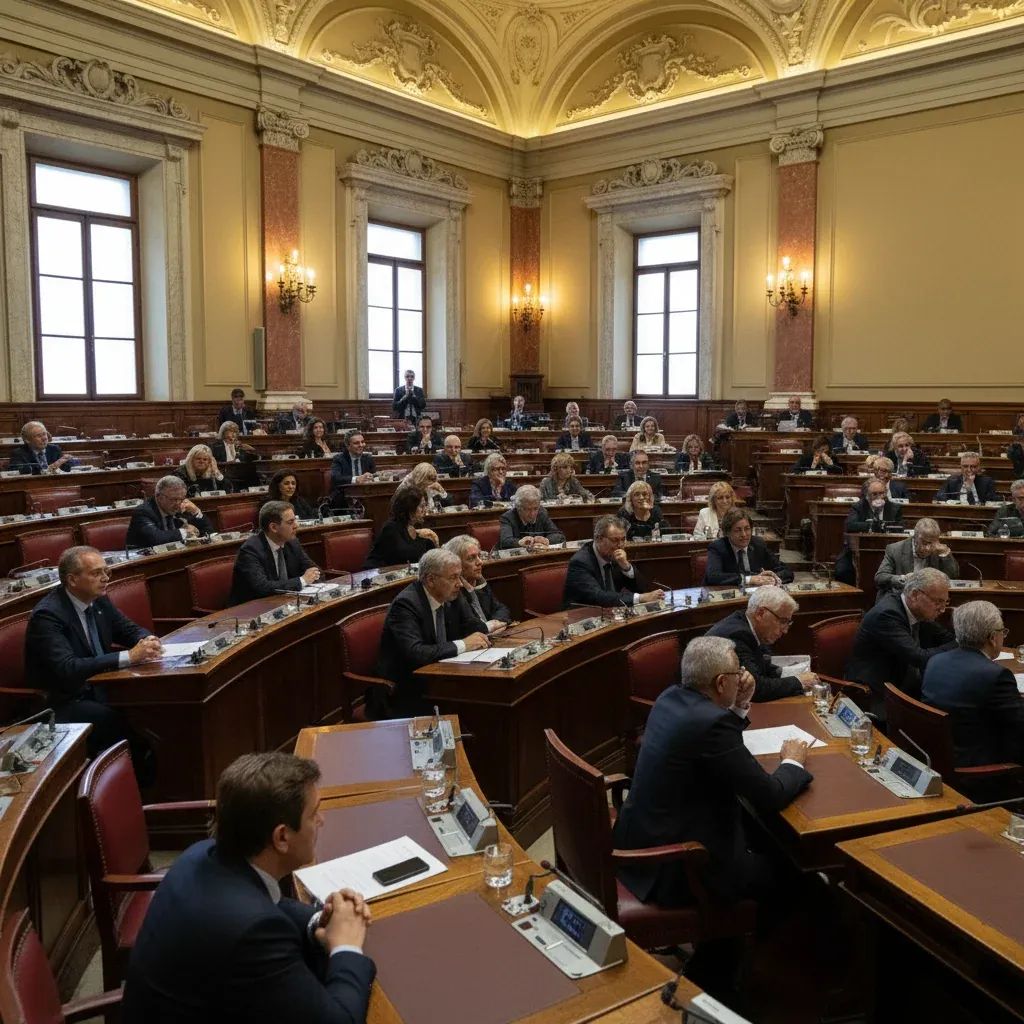
The Italian Chamber of Deputies has postponed parliamentary voting on a controversial electoral law overhaul until July 14, officially citing transport disruptions but fueling speculation that the ruling coalition remains divided over fundamental design questions that could reshape how Italians elect their government.
Why This Matters:
• Voting method at stake: The proposal would eliminate direct candidate preferences and impose party-controlled closed lists, removing voters' ability to choose individual representatives.
• Majority bonus mechanics: Any coalition clearing 42% of the vote would receive an extra 70 Chamber seats and 35 Senate seats, potentially inflating parliamentary share to 60%.
• Constitutional uncertainty: Over 160 constitutional scholars have warned the reform violates core democratic principles, raising the prospect of another Corte Costituzionale veto—the third electoral law struck down in two decades.
The Delay and What It Signals
The Conferenza dei Capigruppo at Montecitorio announced the postponement during a July 1 meeting, shifting the floor vote originally scheduled for the week of July 7. Official communications blamed anticipated rail strikes and construction work near Florence, arguing that deputies would struggle to reach Rome.
Yet opposition leaders and some coalition insiders view the explanation as cover for unresolved policy friction. Chiara Braga, the Partito Democratico chamber leader, dismissed the transport rationale as a pretext, stating that "the real disruption is political, not logistical." The Ministero delle Infrastrutture, led by Matteo Selvini, acknowledged ongoing works but denied they would create insurmountable obstacles for legislators.
Behind closed doors, the coalition appears split over whether to permit preferential voting. Fratelli d'Italia, the largest party in Prime Minister Giorgia Meloni's government, has publicly advocated for allowing voters to rank candidates, citing consistency with its historical stance against leadership-imposed slates. Meanwhile, Lega and Forza Italia resist the change, fearing it could erode party discipline and complicate list management. The two-week breathing room may be an attempt to broker a compromise before members cast recorded votes in front of the entire chamber.
What the Reform Would Change
The proposal—variously nicknamed "Stabilicum" and "Melonellum" in political shorthand—received approval from the Commissione Affari Costituzionali on June 24 and entered floor debate two days later. If enacted, it would replace the current Rosatellum hybrid system with a proportional framework augmented by a governability premium.
Under the draft text, any coalition or single list surpassing 42% of valid votes nationwide would automatically secure an additional allocation: 70 Chamber seats (capped at 220 total) and 35 Senate seats (capped at 113 total). If no group reaches the threshold, Parliament would be distributed by pure proportional representation. Coalitions face a 10% barrier, individual lists a 3% floor, with a fallback provision to rescue the strongest coalition partner that misses the cut.
Crucially, ballots would feature liste bloccate—pre-ordered slates with no option to express individual preferences. Party headquarters would determine candidate ranking, and voters would choose only the coalition symbol. The legislation also mandates that each coalition name its candidate for Prime Minister when registering its logo, embedding a quasi-presidential element into the parliamentary system.
Constitutional Scholars Sound the Alarm
A coalition of 126 to 160 constitutional-law academics released a joint statement titled "Torniamo alla Costituzione" (Return to the Constitution), cataloguing what they describe as severe structural flaws. Their critique centers on three points:
Disproportionate seat bonus. The group warns that awarding 70 extra Chamber seats could push a coalition's parliamentary share to 60% even if it captures only 42% of votes, distorting the link between popular will and legislative power. They cite previous Corte Costituzionale rulings that invalidated outsized premiums in 2013 and 2017, emphasizing that any bonus must be proportionate and tied to a credible minimum threshold.
Erosion of voter agency. By mandating closed lists without preferential voting, the law concentrates candidate selection in party leaderships, weakening the constitutional principle of direct representation. Scholars argue that multi-district candidacies—whereby a single figure appears on ballots nationwide—further dilute accountability.
Incompatibility with regional Senate elections. Article 57 of the Constitution specifies that the Senate is elected "su base regionale" (on a regional basis). Awarding a national premium to the Senate, critics contend, violates that territorial logic and creates a mismatch between the two chambers that could complicate bicameral procedures.
The academics warn that if Parliament enacts the text, a constitutional challenge is all but certain, potentially triggering another round of judicial invalidation and electoral limbo.
What This Means for Residents
For voters, the immediate consequence is reduced granularity in candidate choice. Instead of selecting or ranking individuals, electors would pick a coalition emblem, entrusting party officials to decide who fills the resulting seats. Supporters argue this model clarifies government formation—voters know which leader they are empowering—while critics counter that it transforms legislators into appointees rather than representatives.
The 42% threshold introduces a winner-take-most dynamic. A coalition polling just above the line could govern with a legislative supermajority, controlling committee chairs, agenda-setting powers, and the appointments required for constitutional amendments. Conversely, fragmented results below 42% would revert to proportional distribution, likely forcing post-election negotiations and multi-party cabinets.
The timeline matters because speculation continues around early elections in spring 2027, six months ahead of the natural October 2027 end of term. If the reform passes and snap polls follow, the new rules would govern the next Parliament, potentially entrenching the current coalition's structural advantages or, if the electoral winds shift, amplifying an opposition wave.
Opposition Strategy and Next Steps
Opposition benches have filed more than 770 amendments in committee, nearly half of them emendamenti soppressivi designed to delete entire sections. The Movimento 5 Stelle has signaled it will petition the Corte Costituzionale if the law is enacted, while Alleanza Verdi e Sinistra, Azione, Italia Viva, and +Europa have called for an inclusive reform process rather than a majority-imposed statute.
Elly Schlein, secretary of the Partito Democratico, accused Prime Minister Meloni of prioritizing power consolidation over policy substance, pointing to unresolved challenges in healthcare funding and wage stagnation. The opposition has also criticized the contingentamento—time limits on debate—arguing that such a consequential reform deserves extended scrutiny.
When the chamber reconvenes on July 14, expect a protracted floor fight. Each article will face separate votes, and the minority may deploy procedural tactics to extend debate and spotlight perceived defects. Even if the text clears the Camera, it must still navigate the Senato, where the coalition's margin is narrower and where regional senators may balk at a national Senate premium.
Broader Context: Italy's Electoral Instability
Italy has cycled through multiple electoral systems since the early 1990s, oscillating between majoritarian, proportional, and mixed formulas. The Corte Costituzionale invalidated significant portions of laws in 2013 (Porcellum) and 2017 (Italicum), each time citing excessive distortion of the vote-to-seat ratio or inadequate thresholds. The current Rosatellum, a 2017 compromise, blends single-member districts (37% of seats) with proportional lists (63%), but critics on both left and right complain it produces weak coalitions and opaque post-election bargaining.
The Stabilicum represents the right-of-center coalition's bid to lock in governability, reflecting a broader European trend toward mechanisms that favor stable majorities over fragmented pluralism. Yet Italy's constitutional architecture—bicameral symmetry, regional Senate representation, and reinforced quorums for certain appointments—imposes constraints that many peer democracies do not face, making any reform a high-stakes legal and political gamble.
Whether the July 14 session yields a vote or another delay will offer the clearest signal yet of the coalition's internal cohesion and the opposition's capacity to force compromise or judicial review.


