
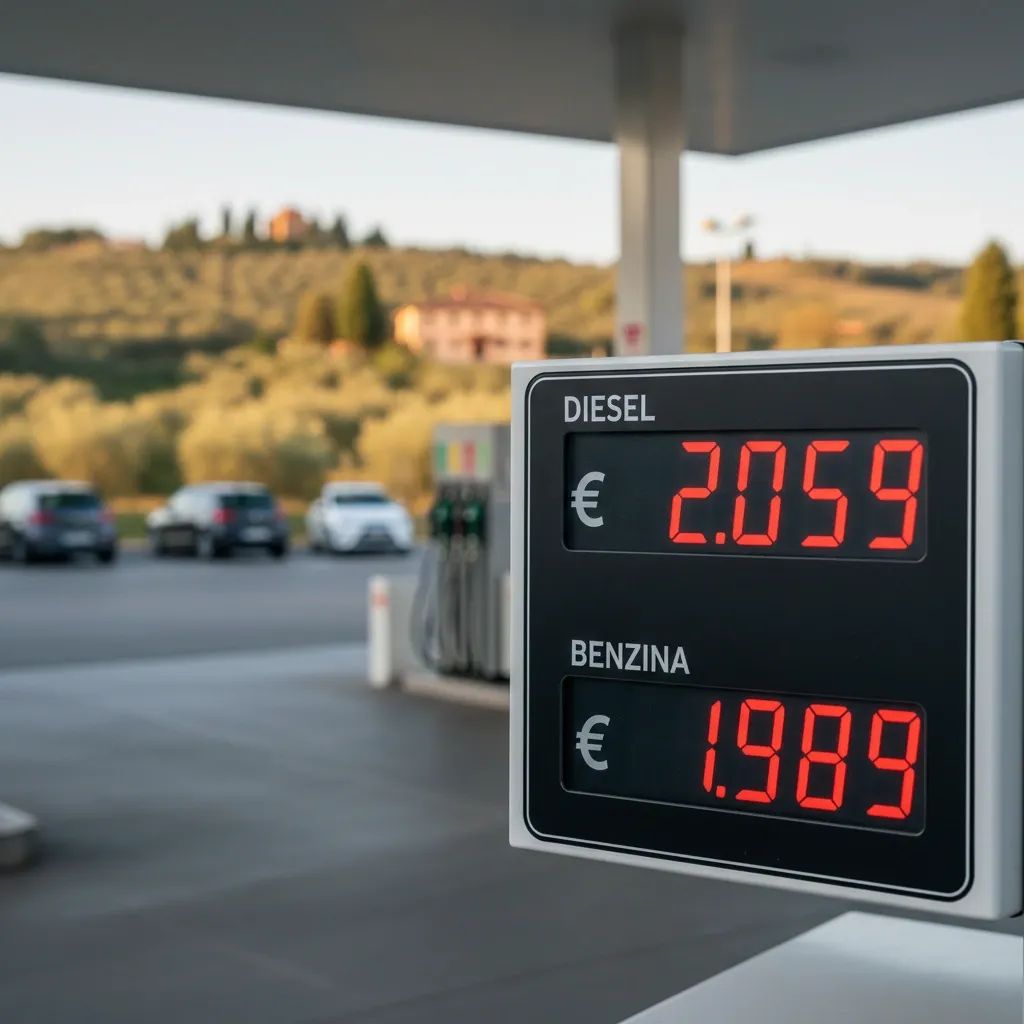
The Italy Ministry of Business and Made in Italy has recorded another day of declining fuel prices, with self-service gasoline now sitting at €1.862 per liter on national roads—a modest but welcome relief for motorists across the country. For diesel users, the price has dipped to €1.963 per liter, continuing a downward trend that began earlier this month and shows no immediate signs of reversing.
Why This Matters
• Daily momentum: A driver filling a 50-liter tank weekly now saves roughly €3.60 compared to early June prices of €1.934 per liter, reflecting the cumulative trend throughout the month.
• Global crude oil dynamics: Recent adjustments in international crude oil markets, alongside shifts in global supply expectations, have contributed to the decline in wholesale costs for refiners and distributors operating in Italy.
• Highway premiums persist: Motorway stations still charge roughly €0.09 more per liter for both fuels compared to regular roads.
Relief at the Pump, But Context is Key
Residents watching fuel costs closely will recognize this as part of a progressive decline throughout June. Just yesterday, self-service gasoline stood at €1.872 per liter, meaning today's figure represents a 1-cent drop in a single day. Diesel followed the same trajectory, falling from €1.974 to €1.963 per liter. Since the start of the month, when gasoline hovered near €1.934 per liter and diesel at €1.994, the cumulative decrease has been substantial enough to ease household budgets and logistics costs for businesses reliant on road transport.
On Italy's motorway network, where prices traditionally run higher due to convenience premiums and operational costs, self-service gasoline now costs €1.956 per liter, down from €1.964 yesterday. Diesel at highway stations dropped to €2.052 per liter from €2.060. For frequent long-distance travelers and commercial hauliers, these reductions—while incremental—compound over hundreds of kilometers.
Alternative fuels have remained relatively stable. LPG is priced at €0.775 per liter on regular roads and €0.883 on motorways, while methane sits at €1.561 per kilogram nationally and €1.584 on highways. These options continue to offer a cost advantage for drivers whose vehicles are equipped to use them.
What Drove Prices Down
The primary catalyst for this month's decline stems from adjustments in global crude oil markets. Brent crude, the international benchmark, has fallen to just over $80 per barrel following various geopolitical and market developments that have shifted supply expectations. Energy analysts caution that market shifts take time to fully translate into pump prices, as supply chains adjust and global trade patterns recalibrate.
A key factor supporting lower prices is the extension of Italy's partial excise duty cuts. The government has maintained a reduction of approximately 5 cents per liter on both gasoline and diesel through July 3, 2026. This fiscal measure, originally introduced to cushion consumers from volatile energy costs, has directly translated into lower prices at the pump.
Additionally, the International Energy Agency (IEA) has revised downward its forecast for global oil demand in 2026, projecting a decline of 1.1 million barrels per day year-on-year. Higher fuel prices and supply disruptions in the second quarter led to a collapse in deliveries, contributing to a bearish sentiment that has further pressured crude prices.
How Italy Compares to the Rest of Europe
Italy's fuel costs remain above the European Union average but are far from the continent's most expensive. As of early June, the EU average for gasoline stood at €1.786 per liter, while diesel averaged €1.804 per liter. Italy's current prices, therefore, sit roughly 4-5% higher than the bloc's median.
Malta enjoys the lowest prices in the EU, with gasoline at €1.340 per liter and diesel at €1.210 per liter in early June. Spain also undercuts Italy significantly, with gasoline at €1.478 per liter and diesel at €1.562 per liter as of mid-June, aided by a temporary 10% VAT reduction on fuels.
On the other end of the spectrum, Denmark leads the EU with gasoline prices hitting €2.392 per liter, while France and Germany hover close to Italy's levels. In France, gasoline was recorded at €2.009 per liter and diesel at €2.014 per liter on June 8. Germany's prices were similar, with gasoline at €1.944 per liter and diesel at €1.870 per liter around the same date. Switzerland, though not an EU member, consistently ranks among the priciest, with gasoline exceeding €2.08 per liter.
For Italy-based motorists, this means fuel costs are roughly on par with major Western European economies but substantially higher than in Southern European neighbors like Spain or island nations like Malta.
What This Means for Residents
For households, the current decline offers tangible budget relief. A typical Italian family driving 15,000 kilometers annually in a mid-sized sedan consuming 6 liters per 100 kilometers can expect to save approximately €65 to €70 from early June through mid-June as prices have dropped from €1.934 per liter to €1.862 per liter. For commercial operators—delivery services, freight companies, and ride-hailing drivers—the savings scale proportionally with mileage, easing operational pressures.
However, the reprieve may be temporary. The Italy excise duty cut expires on July 3, and unless the government extends the measure, prices could jump by approximately 5 cents per liter overnight. Additionally, the introduction of the Emissions Trading System (ETS) for transport and buildings, set to take effect in 2027, is expected to add upward pressure on fossil fuel prices, potentially exceeding €45 per ton of CO₂.
Energy analysts hold varied views on the outlook for the remainder of 2026 and into 2027. Some forecasts suggest a significant supply surplus in 2027, with global production increasing by 8 million barrels per day while demand grows by only 2 million barrels per day, which could lead to further price declines. Others warn that geopolitical instability, OPEC production decisions, and global economic conditions introduce considerable uncertainty.
The Bigger Picture
This month's fuel price decline reflects a combination of market corrections, global energy dynamics, and fiscal intervention. Yet the structural factors that have kept Italy's energy costs elevated—high taxation, geographic isolation from major refining hubs, and dependence on imported crude—remain unchanged.
For now, drivers can enjoy the modest relief at the pump. But with excise cuts set to expire imminently and longer-term environmental levies on the horizon, prudent residents should plan for volatility in the months ahead. Those considering vehicle purchases or fleet renewals may want to weigh the advantages of LPG, methane, or electric alternatives, which offer greater insulation from crude oil price swings.
The current trend is positive, but sustainability depends on factors largely beyond Italy's control: global energy markets, the global economic outlook, and the pace of the energy transition. For the moment, at least, motorists can fill up a little cheaper than they did at the start of June.


