
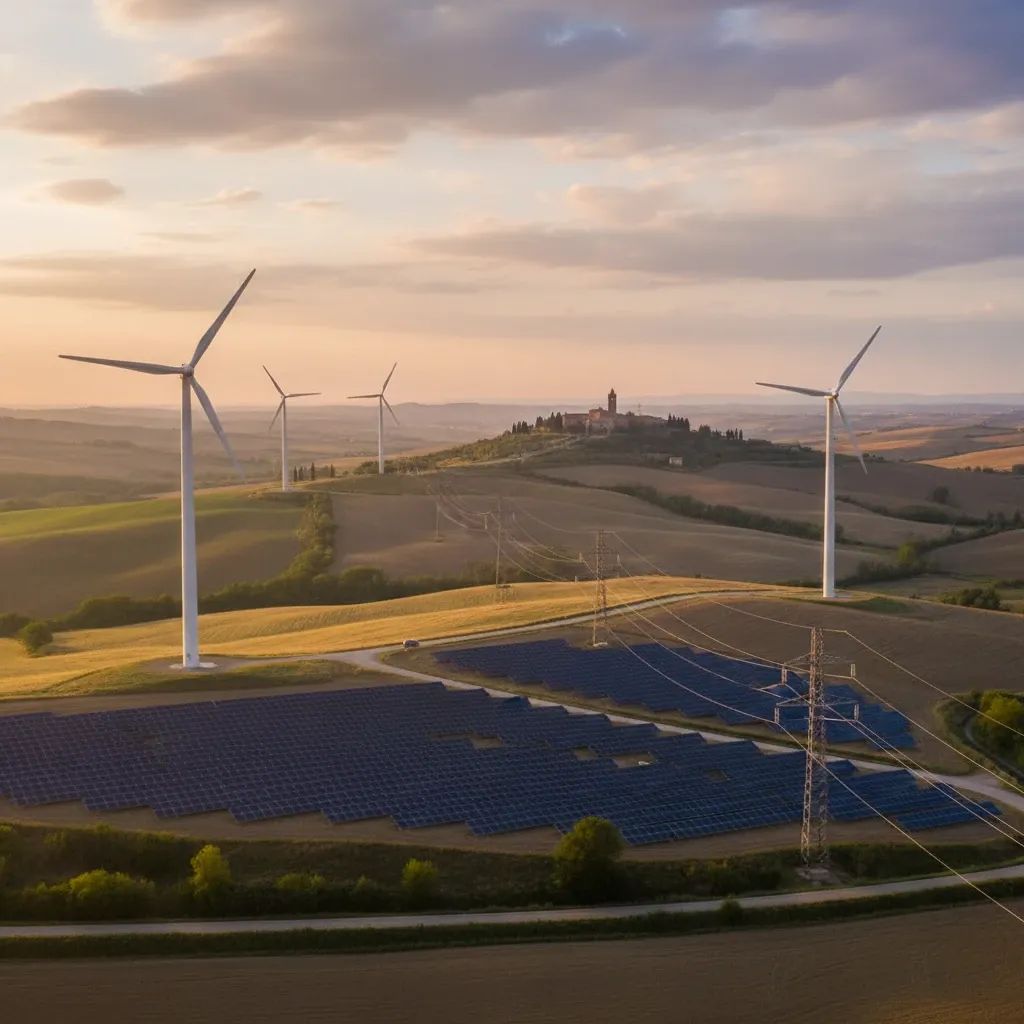
Residents hoping for government help with high energy bills face disappointment. The European Commission has rejected Italy's request for expanded fiscal flexibility to subsidize energy costs. Instead, Brussels is pressuring Rome to spend €95 billion in unused EU energy funds before a June 2026 deadline—or lose them entirely.
Why This Matters for You
• No new government subsidies: Italy asked the EU to allow budget flexibility for energy investments, similar to defense spending exemptions. The request was denied, meaning any relief must come from existing funds, not new government support.
• The money exists, but it's not reaching you yet: €95 billion has been allocated for energy projects, but remains unspent. This means waiting for solar installations, grid upgrades, and efficiency improvements to actually get built before energy prices fall.
• Time is running out: With a June 2026 deadline, local projects and renewable initiatives face intense pressure to deliver—miss the cutoff and funding is lost.
Brussels Says: Spend What You Already Have
In a recent letter to Commission President Ursula von der Leyen, Prime Minister Giorgia Meloni argued that energy security deserves the same budget flexibility as military defense. She specifically requested activation of the "national escape clause"—essentially, permission to spend beyond normal budget limits—for energy investments, warning that without it, Italy's citizens would bear the burden of high energy bills while the government's hands remained tied.
The Commission declined. A spokesperson responded that the priority is "fully exploiting already available EU financing, which is truly substantial." The message was clear: no new money, no expanded budget room. Europe's energy crisis is real, but Italy must solve it within existing constraints.
This signals a hardening Brussels stance: the reformed Stability and Growth Pact has limits, even for crises. Member states can't simply invoke flexibility for every challenge; they must make existing commitments work.
€95 Billion Sits in Three Major Programs
According to European Commission President Ursula von der Leyen, the EU has allocated approximately €300 billion for energy investments across three channels: Next Generation EU, cohesion policy funds, and the Modernisation Fund. Of that total, around €95 billion remains unspent.
For Italy, the gap between promises and reality is particularly stark. The country's National Recovery and Resilience Plan (PNRR) has met numerous formal milestones, yet actual spending lags. By December 2024, just 30% of Italy's €194.4 billion PNRR envelope had been deployed—leaving €135.8 billion to be spent by 2026, a massive challenge given bureaucratic delays and execution bottlenecks.
When you strip out tax-credit schemes like the Superbonus (which attract easy applications but don't necessarily accelerate real construction), progress on the green-energy mission drops from 69% to just 36%—a sobering reality check on implementation capacity.
Where the Money Is Supposed to Go (But Often Gets Stuck)
Renewable Energy Communities (CER): Your neighborhood could install community solar panels or wind turbines. Initially allocated €2.2 billion, this program was slashed by 64% to €795.5 million. Municipalities have until June 2026 to complete installations; missing that deadline means losing grants and repaying advances. Many local projects are racing against this clock.
Energy Efficiency Tax Credits (Transizione 5.0): Designed to help businesses and factories cut energy use, this program has only attracted around €500 million in reservations against a €6 billion allocation—a sign either that eligibility rules are too strict or that awareness is too low. If you run a small business, verify your eligibility soon.
REPowerEU Chapter: Added in December 2023 specifically to accelerate the shift from fossil fuels to renewables, this program reported zero expenditure as of March 2025. Money exists, but it's not moving yet.
Cohesion and Modernisation Funds: Italy has redirected €396 million toward energy priorities, with €100 million earmarked for efficiency upgrades in low-income households. However, rollout remains uneven across regions, with southern Italy receiving 40% of a €320 million fund for small businesses installing solar or mini-wind systems.
The practical reality: Billions are allocated, but actually getting projects built, permitted, and connected to the grid is proving far slower than deadlines allow.
What This Means for Your Household
The Commission's rejection means one clear thing: don't expect direct government subsidies for your energy bills anytime soon. Any relief must come from completed infrastructure—operational solar farms, upgraded grid systems, heat-pump installations—that gradually lowers costs over time.
If you were hoping for direct state support like past energy subsidies, that pathway has narrowed significantly. The government can only act within its existing budget constraints or redirect already-committed PNRR resources—both politically difficult moves as deadlines loom.
If you're involved in a local renewable energy community: Complete your projects and grid connections before June 2026, or lose the funding.
If you're a small business owner: Check eligibility for the Transizione 5.0 tax credit immediately. Uptake is underwhelming, suggesting either confusion or missed opportunities.
For renters and homeowners: Watch announcements on streamlined permitting and renewable-community rollout. Real bill relief depends on whether Italy can finally translate billions in promised investment into actual infrastructure that generates and distributes cheaper power.
How Other European Countries Are Getting It Right
Some EU members are moving faster. Poland has slashed coal dependency from 90% to 53% and now counts over 1.6 million prosumers (citizens generating their own renewable power). Estonia aims for 100% renewable electricity by 2030, with projects like the Sopi-Tootsi wind farm already covering 10% of demand. Germany and Sweden have aggressively deployed cohesion funds for building efficiency, with Sweden's renewable share now at 66%.
Across the EU, aggregate clean-energy investment reached nearly $390 billion in 2025. Renewables generated 50% of EU electricity in 2024—double fossil-fuel output. Efficiency measures saved an estimated €120 billion on energy bills in 2023 alone.
Yet the picture is uneven: several member states remain below 16% renewable penetration, and a recent audit revealed that over 25% of the €4.2 billion Modernisation Fund allocated between 2021 and 2024 financed fossil-gas infrastructure—locking in unsustainable systems.
Italy's €95 billion has real potential. The question is whether Rome can convert commitments into completed, operational infrastructure before June 2026.
What Comes Next
The Commission indicated it "continues to follow developments closely and is ready to act accordingly," language that leaves the door open to future adjustments but offers no immediate relief. For now, responsibility rests entirely with Rome.
Watch for announcements on:
• Streamlined permitting for renewable energy projects
• Revised timelines for renewable-community grants
• Reallocation of underutilized programs like Transizione 5.0
• Partnerships between government and major utilities (ENI, Enel, Snam, Terna) to accelerate project pipelines
Any meaningful impact on your energy bills in the near term will depend not on new fiscal space from Brussels, but on whether Italy can finally translate billions in promised investment into operational wind farms, solar arrays, grid reinforcements, and efficiency retrofits that actually generate and distribute cheaper power. The €95 billion is there. The clock is ticking. The question now is whether it will be spent.


