
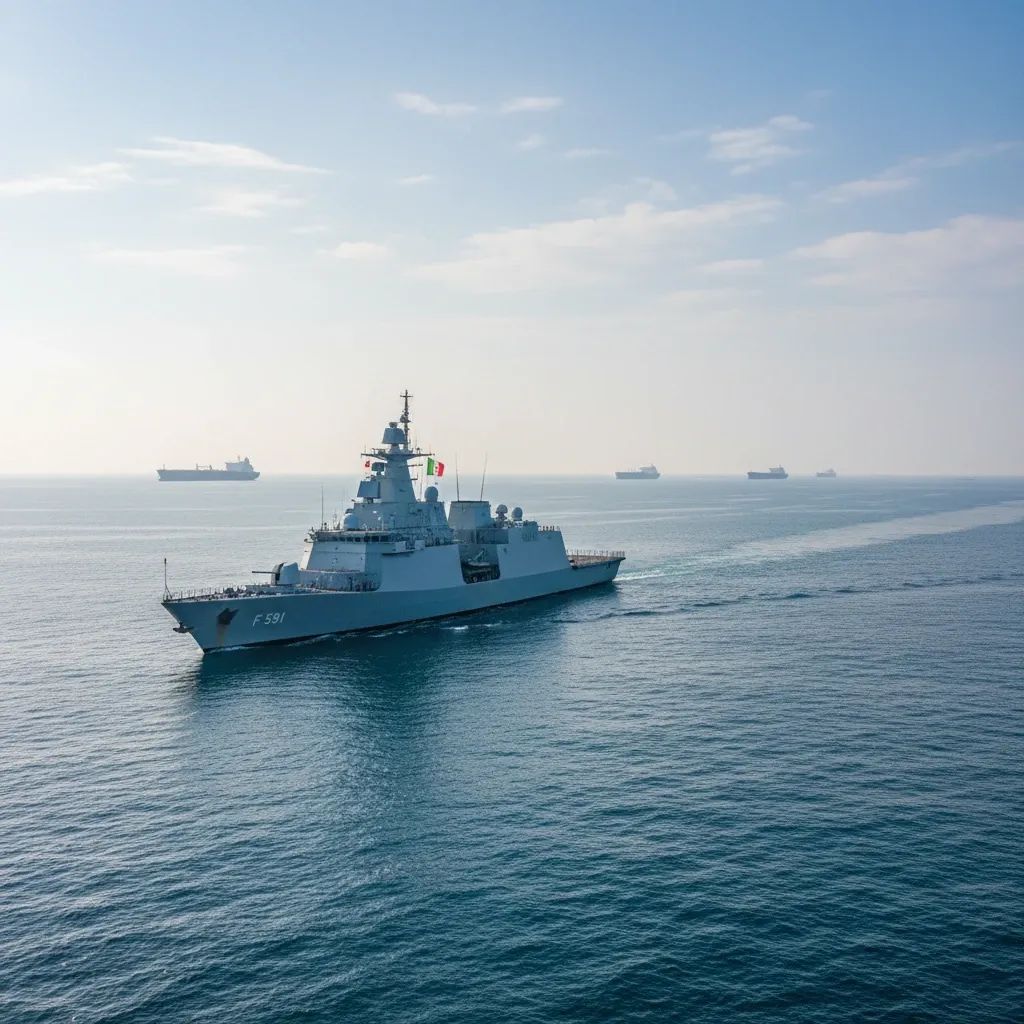
The Italian Cabinet has signaled it will seek parliamentary authorization within 60 days for a potential naval mission to the Strait of Hormuz, a move that would deploy up to 500 Italian military personnel to support international mine-clearing operations following a recent U.S.-Iran peace agreement. Prime Minister Giorgia Meloni, speaking after the G7 summit in Évian-les-Bains, France, described the level of consensus reached among leaders as "not a given" and "excellent news" for Italy's strategic positioning.
Why This Matters:
• Parliamentary debate ahead: The Italian Parliament will review the Hormuz mission proposal within two months, with Defense Minister Guido Crosetto and Foreign Minister Antonio Tajani having already briefed joint committees on May 13.
• Naval assets ready: Two Italian minesweepers, the Crotone and Rimini, are already stationed in Djibouti and could reach the Strait in 5-6 days once authorized.
• Budget implications: The deployment would involve 400-500 service members and support vessels for at least six months, requiring new parliamentary appropriations.
• Strategic priorities confirmed: Italy secured priority access to Canadian critical mineral reserves, a key win for domestic industry and energy transition goals.
What Meloni Secured at the Summit
The Italian Prime Minister returned from the three-day summit with concrete commitments that extend beyond the headline diplomatic language. Most notably, Italy has locked in preferential access to Canadian critical mineral stockpiles, a strategic asset as Europe seeks to reduce dependence on Chinese supply chains for battery materials, rare earths, and defense components.
Meloni also claimed victory in embedding migration management as a permanent fixture of G7 discussions, describing it as a lasting legacy of Italy's 2024 presidency. The French-led summit produced eight thematic declarations, including specific language on combating human trafficking networks and narcotic smuggling—issues that resonate deeply with Italian voters concerned about irregular arrivals via Mediterranean routes.
For the first time in G7 history, leaders adopted principles for digital safety of minors, addressing parental anxieties about online harms. The declaration calls for age-appropriate AI chatbot language and stronger enforcement mechanisms against exploitative content, areas where Italian regulators have been particularly active in recent months.
The Hormuz Question: Timeline and Conditions
Italy's potential participation in the Strait of Hormuz mission hinges on multiple variables, none of which are yet guaranteed. Defense Minister Crosetto has outlined three non-negotiable conditions: full implementation of the U.S.-Iran peace framework, acceptance of the international mission by all regional parties, and explicit approval from the Italian Parliament.
The Marina Militare (Italian Navy) has pre-positioned significant assets in the region. The minesweepers Crotone and Rimini, currently attached to the EU's Operation Aspides in the Red Sea, are equipped with advanced sonar systems and remotely operated vehicles capable of neutralizing naval mines at depths up to 600 meters. The proposed task force would also include the logistics support ship Atlante and an escort frigate, likely the Montecuccoli or Luigi Rizzo.
Military analysts estimate the mine-clearing operation could take no less than six months, reflecting the density of ordnance laid during years of regional tensions. Italy would join a "coalition of the willing" led by France and the United Kingdom, with participation from Germany, Japan, Canada, Australia, Greece, and Cyprus.
The parliamentary authorization process will unfold over the next 60 days, though Meloni declined to specify when exactly the government would formally request approval. The May 13 briefing to the joint Foreign Affairs and Defense committees represented an initial consultation, but binding votes in both the Chamber of Deputies and Senate are still required before deployment can proceed.
Convergence Amid Fractures
Meloni's emphasis on "convergences not taken for granted" reflects the underlying strain visible throughout the summit. While the final communiqué presented a unified front, French President Emmanuel Macron publicly acknowledged "differences with Trump on Ukraine over the past year," and transatlantic tensions over trade policy remain acute. The U.S. administration has threatened 100% tariffs on French wine in retaliation for digital services taxes, a dispute that has broad implications for Italian exporters facing similar vulnerabilities.
On Ukraine, the G7 reaffirmed support for President Zelensky and committed to expanding deliveries of air defense systems, interceptors, and long-range strike capabilities. The group also pledged to tighten sanctions on Russian oil and gas sectors, though enforcement mechanisms remain contentious. Meloni noted that direct negotiations between Zelensky and Russian President Putin remain an objective, but "serious signals from Moscow" have yet to materialize.
The Middle East portion of the summit centered on the U.S.-Iran agreement, which aims to reopen the Strait of Hormuz and de-escalate regional tensions. G7 leaders also backed efforts to disarm Hezbollah in Lebanon, accelerate humanitarian aid to Gaza, and halt violence in the West Bank. Italy's bilateral meeting with UAE President Sheikh Mohamed bin Zayed Al Nahyan focused specifically on Strait security and energy cooperation.
Economic Realignment and China
The French presidency made global economic imbalances the thematic centerpiece, with pointed discussions on Chinese export practices, industrial overcapacity, and state subsidies. The G7 called for more rigorous monitoring by the International Monetary Fund of external imbalances, a move that implicitly targets Beijing's trade surpluses.
For Italy, the focus on critical minerals translated into tangible outcomes. The expanded Alliance for Resilience and Critical Mineral Production provides a framework for reducing dependency on Chinese refining and processing, which currently controls over 70% of global lithium and cobalt supply chains. Canadian guarantees of priority access offer Italian manufacturers—particularly in automotive and aerospace sectors—a measure of supply security as the energy transition accelerates.
Artificial intelligence governance also featured prominently, with European Commission President Ursula von der Leyen stressing the need for a robust transatlantic partnership on AI regulation. The G7 declaration includes provisions for safe deployment of AI systems and adaptation of algorithms for child users, areas where Italy has already implemented some of Europe's strictest rules.
What This Means for Residents
Italian citizens should anticipate parliamentary debates on the Hormuz mission within the next two months, with potential budgetary implications depending on the mission's scope and duration. Taxpayers will ultimately fund the deployment, though exact costs have not been disclosed.
The agreement on critical minerals could stabilize input costs for Italian manufacturers, particularly in the automotive sector, where battery supply chain disruptions have caused production delays. Priority access to Canadian stockpiles may help insulate Italian firms from price volatility seen in lithium and rare earth markets over the past year.
On migration, the continued G7 focus on trafficking networks aligns with Rome's domestic priorities, though practical enforcement will depend on cooperation from North African transit countries. The digital safety measures for minors may lead to stricter requirements for social media platforms operating in Italy, building on existing regulations.
Trade tensions with the United States remain a wildcard. Italy's wine, cheese, and luxury goods exporters are closely monitoring the French tariff dispute, aware that any escalation could broaden to include other EU member states. The government has not publicly outlined contingency plans should Washington impose punitive measures on Italian exports.
The summit also introduced a new G7 health priority: cancer mortality reduction. Leaders committed to enhanced research collaboration, data sharing, and prevention programs. For Italy, which has universal healthcare coverage but faces budgetary constraints, this could mean increased access to international research findings and shared pharmaceutical development costs.
Broader Geopolitical Context
Italy's positioning at Évian reflected Meloni's effort to balance Atlantic alliance commitments with pragmatic engagement on Mediterranean and Middle Eastern security. The bilateral meetings with U.S. President Donald Trump and Canadian Prime Minister Mark Carney underscore Rome's desire to maintain close ties with Washington and Ottawa, even as European unity shows signs of strain.
The summit's inclusion of Brazil, Egypt, India, Kenya, and South Korea as partner countries signals a recognition that the G7's traditional economic dominance is eroding. For Italy, engagement with these emerging powers offers alternative markets and diplomatic leverage, particularly in Africa where Rome has invested heavily in energy infrastructure and migration management partnerships.
The Ebola outbreak response, which secured over $1 billion in international funding, demonstrates the G7's continued capacity for rapid coordination on acute crises. Italy contributes both financial resources and medical personnel to such efforts, maintaining a visible role in global health security.
As the 60-day parliamentary consultation window opens, Italian lawmakers will weigh the strategic value of Hormuz participation against domestic budget priorities and the political risks of military deployment in a volatile region. Meloni's characterization of the summit outcomes as "excellent news" suggests the government believes it has secured sufficient concessions to justify the costs, but parliamentary arithmetic will ultimately determine whether Italian ships join the mine-clearing coalition.


