
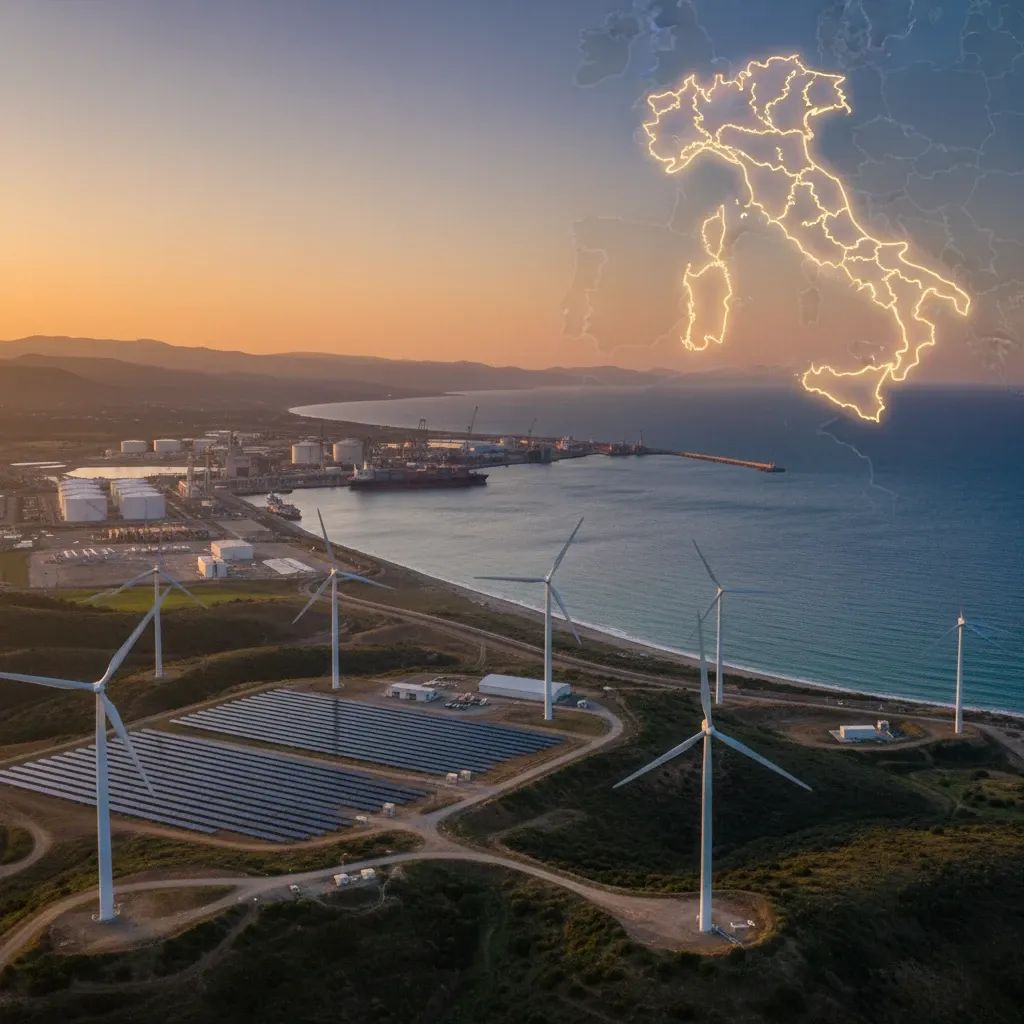
Italian households have abandoned energy idealism in favor of hard-nosed pragmatism, according to research published yesterday by Censis and Confcooperative. Facing volatile electricity costs and geopolitical uncertainty, more than half of surveyed families now support new-generation nuclear plants, while nearly 50% would reopen gas imports from Russia if it meant lower bills.
Why This Matters:
• Wallet beats planet: 53% of Italian families prefer cheap energy over environmental investment when forced to choose.
• Nuclear comeback: Despite anti-nuclear sentiment, 54.5% now back next-generation reactors to stabilize costs.
• Price anxiety: Nearly 88% of those expecting hikes anticipate paying an additional €50-100 per month.
The survey, titled "Primum vivere: il pragmatismo energetico degli italiani" and conducted on a representative sample of 1,000 households, paints a picture of a nation caught between green aspirations and economic survival. Maurizio Gardini, president of Confcooperative, described Italian families as having become "pragmatic to the point of recklessness," willing to embrace "all possible roads—renewables, yes, but also new-generation nuclear, a return to Russian gas, and even coal" to extinguish the fire in household budgets.
What This Means for Italian Residents
The research reveals a sharp internal contradiction in Italian energy attitudes. While 82.2% want to accelerate renewable energy without nuclear, pragmatism overrides principle when money is on the line. The 54.5% who now endorse small modular reactors (SMRs) represent a dramatic shift for a country that voted to ban nuclear power in a 1987 referendum and reaffirmed that choice in 2011 following Fukushima.
This isn't abstract policy debate. With electricity prices jumping 4.6% from July 1, reaching €0.3163 per kilowatt-hour (including taxes), and wholesale power costs (PUN) hitting €161.23 per megawatt-hour in late July—the highest level this year—Italian households face immediate financial pressure. Nearly 80% expect further price increases, and among this group, 87.9% anticipate an extra burden of up to €100 monthly.
For context, that upper range equals roughly a week's groceries for a typical Italian family or half the monthly cost of urban public transport in Rome or Milan. The financial squeeze is real, and it's reshaping energy politics from the bottom up.
The Russian Gas Dilemma
Perhaps most striking is the 49.7% willing to resume Russian gas imports to secure affordable energy. This comes despite Italy having effectively eliminated Russian gas from its supply mix by 2025, relying instead on liquefied natural gas (LNG) from the United States, Norway, Algeria, and Azerbaijan.
The European Union has imposed a phased ban on Russian gas, with LNG imports prohibited by the end of this year and pipeline gas by November 2027. Yet even as Brussels tightens sanctions, some EU nations—including France, Spain, and Belgium—saw Russian LNG imports surge 15% in the first half of 2026. Italian industrial leaders, including Eni CEO Claudio Descalzi and Transport Minister Matteo Salvini, have floated the idea of suspending the ban to ease cost pressures, though Foreign Minister Antonio Tajani has firmly rejected any backsliding, emphasizing Italy's commitment to its diversification strategy.
The popular willingness to reconsider Russian supplies signals just how deeply energy costs have penetrated household consciousness. LNG now accounts for 32% of gas entering Italy's national network, and the country ranks third in the EU for regasification capacity. But LNG is expensive, and households know it.
Nuclear: From Taboo to Mainstream Option
Italy's nuclear conversation has shifted dramatically in less than a year. The Chamber of Deputies approved a framework bill on "sustainable nuclear energy" in early June, and the Senate is expected to finalize the legislation this summer, with implementing decrees anticipated before year-end. The law doesn't greenlight construction immediately but establishes the regulatory foundation for licensing small modular reactors (SMRs) and advanced modular reactors (AMRs).
Environment Minister Gilberto Pichetto Fratin has suggested the first authorizations could arrive by the late 2020s, with operational reactors possible by 2033-2035. Italy's national energy research agency, ENEA, is already working on the EAGLES-300 SMR, a lead-cooled fast reactor recognized as one of Europe's most promising projects in this category.
However, expectations should be tempered. The Politecnico di Milano estimates nuclear won't contribute meaningfully to Italy's energy mix until 2040, with a target of 8 gigawatts of capacity by 2050, covering roughly 11% of national demand. Western SMR prototypes remain in early development, and full commercial maturity is at least a decade away. Meanwhile, Italy still lacks a national repository for radioactive waste—a gap that must be filled before any reactor goes live.
Local municipalities will be consulted and may volunteer to host plants in exchange for economic compensation, but finding willing communities in a historically anti-nuclear country remains uncertain.
The Green Paradox
Italian households remain broadly supportive of environmental goals in principle. 77.1% favor a balanced mix of renewable and traditional energy sources, and 65.4% say they're willing to pay more to strengthen national energy independence. Yet when asked directly whether they'd accept higher bills to fund green investments, 53.1% say no.
This is the paradox of Italian energy politics in mid-2026: environmental values are widely held but thinly defended when tested against immediate financial pain. The Censis-Confcooperative research suggests that after years of price volatility—including the spike following Russia's invasion of Ukraine in 2022 and ongoing instability linked to tensions in the Strait of Hormuz—Italian families have entered survival mode.
Renewables are expanding rapidly in Italy. Solar photovoltaic installations accounted for nearly 58% of new capacity in recent months, and the EU as a whole generated 48% of its electricity from renewables in 2025, with wind and solar surpassing fossil fuels for the first time at 30% of the grid. But renewable deployment takes time, and households are paying bills today.
Europe as the Last Consensus
In a country split on nuclear, Russian gas, and even coal, one point of agreement endures: Italians still trust the European Union to manage energy policy. 77.4% want EU climate policies revised and improved, not abandoned, and 58.8% prefer energy decisions to be made at the EU level rather than nationally.
This reflects a pragmatic calculation. Italy imports the vast majority of its energy and has little leverage alone. The EU, by contrast, is the world's largest LNG importer and can negotiate collectively with suppliers. European demand for LNG is projected to reach 145 million tonnes in 2026, up 19% from 2025, with the United States supplying two-thirds of it.
Italy's energy independence dream, enshrined in campaign rhetoric and ministerial speeches, remains largely aspirational. The country's wholesale gas prices (PSV) have fluctuated wildly—from €35 per megawatt-hour in February to over €60 in July—driven by global market forces largely beyond Rome's control.
The Path Forward
The Censis-Confcooperative survey captures a pivotal moment. Italian energy policy is being rewritten not by politicians or activists but by millions of households reconciling their values with their bank accounts. The willingness to embrace nuclear, reconsider Russian gas, and even tolerate coal—an energy source many thought consigned to history—illustrates the limits of climate ambition when divorced from cost management.
For residents, the immediate future looks expensive. A new "Bonus Bollette Straordinario" will offer discounts of up to €60 for families with incomes between €9,796 and €25,000 starting in August, and a €115 emergency payment was distributed in February to recipients of the existing social electricity bonus. But these are band-aids, not solutions.
The real test will come in the next 12 to 18 months. If SMR regulation progresses and site selection begins, nuclear could become a tangible option rather than an abstract debate. If EU sanctions hold and LNG infrastructure continues expanding, Russian gas may fade as a temptation. If renewables scale faster than expected, the green transition might regain momentum.
For now, Italian households are betting on everything at once—a hedging strategy born not of confusion but of clear-eyed realism about the fragility of their energy security and the weight of their monthly bills.


