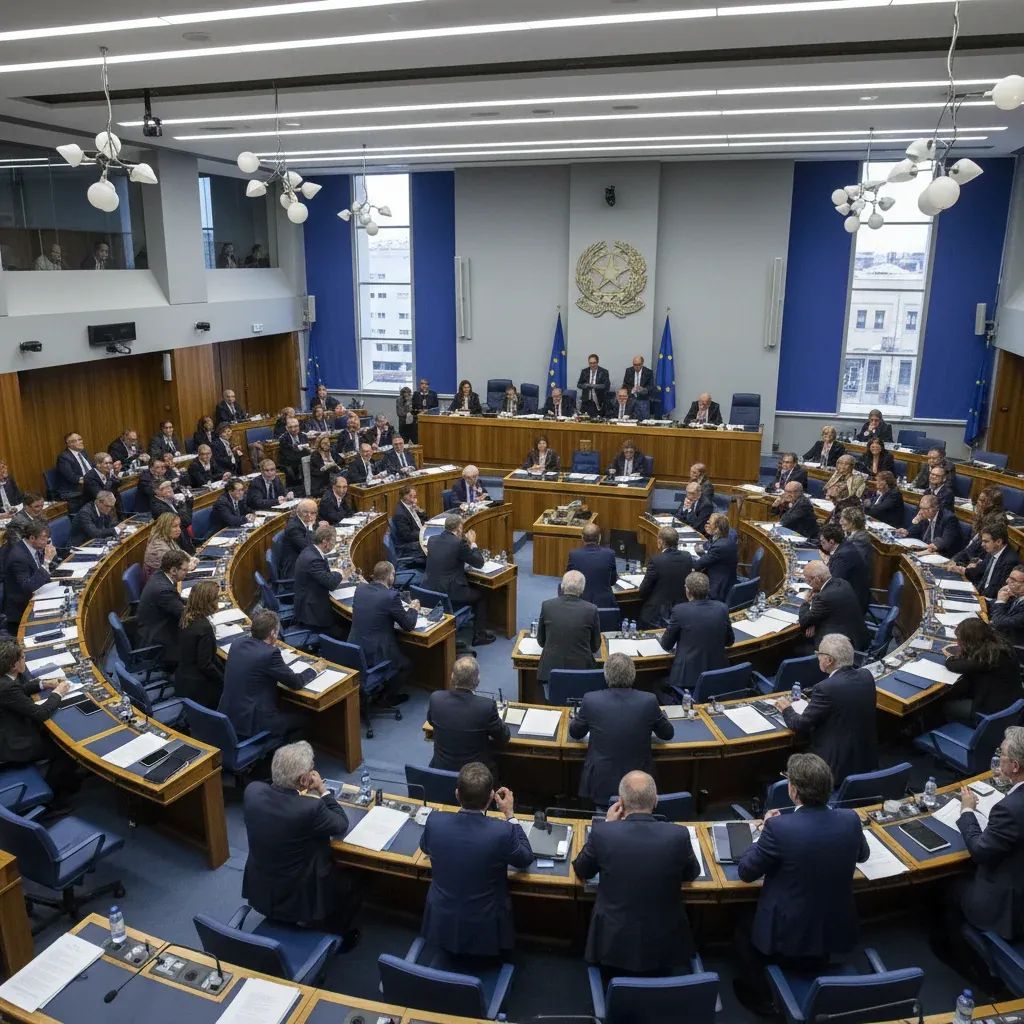
Valerio De Molli, CEO of The European House – Ambrosetti (TEHA Group), has challenged the prevailing narrative of European decline during his opening address at the 52nd Forum di Cernobbio. Speaking from the historic Villa d'Este on Lake Como, De Molli reframed the EU as a "gentle superpower"—not a weak or naive entity, but a unique global model that successfully combines economic strength, technological capability, security, welfare, sustainability, and respect for human dignity.
Why This Matters
• Reframing the narrative: The speech directly counters the catastrophism that dominates much of Italy's public debate about Europe's future.
• Data-backed optimism: De Molli cited concrete statistics—13 of the world's 20 most livable cities are European, and 48% of EU energy production comes from renewable sources.
• Political resonance: Italian President Sergio Mattarella reinforced the message, defending multilateral cooperation against rising "power politics" globally.
A Counter-Narrative from Lake Como
The annual Ambrosetti Forum, held this year from September 4-6 in the elegant lakeside town of Cernobbio, serves as a key thermometer for Italy's economic and political climate. De Molli used the platform to deliver what he called a necessary corrective to the "pessimistic narratives and catastrophic predictions" that he believes damage the European project.
"We are tired of narratives that only criticize and destroy the European design," the TEHA CEO told assembled policymakers, business leaders, and analysts. He acknowledged the continent's real challenges—complex institutions, slow decision-making, regulatory excess, and technological delays—but insisted these weaknesses obscure a more compelling story of achievement.
The concept of a "gentle superpower" deliberately contrasts with the hard-power politics emerging from Washington, Beijing, and Moscow. De Molli argued that Europe's influence stems not from military might or coercive economics, but from its ability to export a model of development that other regions envy: one that delivers prosperity without sacrificing social cohesion or environmental sustainability.
Nine Pillars of European Identity
Central to De Molli's address was a framework of nine elements that, he argued, should make Europeans proud of their continent. These include the construction of security through a great democratic project, economic integration that has bound former enemies together, and the preservation of permanent dialogue among member states.
He emphasized that Europe has successfully combined peace and economic prosperity with a quality of life unmatched elsewhere. The region boasts strong social cohesion and inclusion, alongside deep respect for both individuals and the environment.
Perhaps most striking was the comparative data on inequality. De Molli highlighted that Europe's Gini coefficient—a standard measure of income inequality—stands at 29.4%, significantly better than the 41.8% recorded in the United States. This statistical difference translates into a lived reality where the gap between rich and poor remains manageable rather than destabilizing.
"No other area of the planet has managed to combine peace, economic prosperity, quality of life, social cohesion and inclusion, respect for people and the environment," De Molli stated, noting that this synthesis emerged from "the rubble of the Second World War" as "the most ambitious political, economic, and social union project in modern history."
What the Numbers Actually Show
Beyond rhetoric, the TEHA chief marshaled substantial evidence to support his claim of European exceptionalism. On quality of life, he noted that 13 of the top 20 most livable cities globally are European. In higher education, nearly 500 of the world's 1,500 best universities are located on the continent, creating a knowledge foundation that few regions can match.
Environmental performance formed a core pillar of his argument: the EU accounts for only 6% of global emissions while generating substantial economic output. The 48% renewable share in EU energy production demonstrates that the transition away from fossil fuels is not abstract policy but operational reality.
These figures matter for Italy specifically, where public discourse often oscillates between Euro-skepticism and resignation. De Molli's intervention suggests that Italians—and Europeans more broadly—should judge their continent not by what it lacks compared to the raw growth numbers of China or the tech dominance of America, but by a broader suite of metrics that capture human flourishing.
Presidential Validation
The message received implicit endorsement from Italy's highest office. President Sergio Mattarella sent a message to the forum that, while not using De Molli's exact phrasing, reinforced the underlying thesis. The Head of State defended the post-war multilateral order against what he called "politics of power" and a "coercive vision of interdependence."
Mattarella's intervention aligned with De Molli's vision of an Europe that projects influence through values and cooperative development rather than through force or domination. The President framed the EU as a model to be strengthened, not dismantled—a clear signal to those within Italy's political sphere who regularly question European integration.
What This Means for Italy
For Italians navigating an uncertain global landscape—one marked by trade tensions, climate disruption, and geopolitical realignment—De Molli's thesis offers a different lens. Rather than viewing Europe as a constraint on national sovereignty, the "gentle superpower" concept suggests the EU may be Italy's best instrument for navigating a volatile century.
The practical implications extend beyond abstract philosophy. Italy benefits disproportionately from European integration: access to the single market, structural funds for southern development, and the stability of the euro during financial turbulence. When Italian businesses export to Germany or France, they benefit from a regulatory environment that standards across 27 member states have harmonized.
Moreover, for Italian citizens concerned about social stability, the inequality data De Molli cited should provide reassurance. The European model—even with its imperfections—has prevented the extreme wealth concentration seen in the United States and the authoritarian capitalism practiced in China. That "gentleness" translates into concrete protections: universal healthcare, robust worker rights, and environmental standards that keep air breathable and water drinkable.
Beyond Catastrophism
De Molli's intervention arrives amid growing despondency in Italian media and political circles about Europe's relative decline. Headlines routinely proclaim the continent's irrelevance in a world dominated by US-China rivalry. The TEHA executive challenged that fatalism directly.
"I ask you to observe the EU not through what it lacks, but through what it has been able to construct," he urged. It was a call for shared confidence—a recognition that pessimism can become a self-fulfilling prophecy, and that narratives of decline may blind citizens to genuine achievements.
As the forum concluded along the peaceful shores of Lake Como, the message was unmistakable: Europe's strength lies not in mimicking the great powers of the past, but in pioneering a new form of influence—one measured in human welfare rather than territorial conquest. Whether Italy's political class embraces that vision remains an open question, but the case has now been made with data, clarity, and presidential weight behind it.