
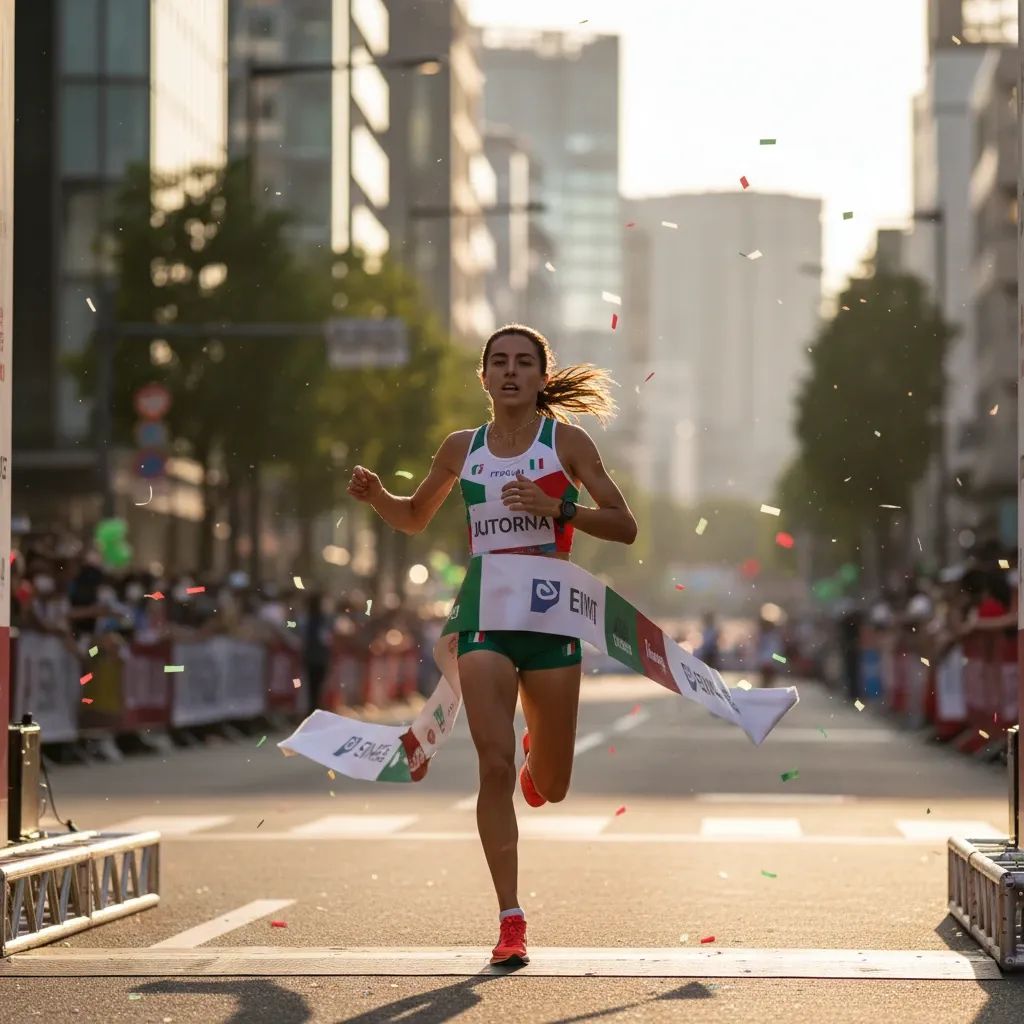
The Italian athletics scene witnessed a historic moment on April 12, 2026, when Yeman Crippa stormed to victory at the Paris Marathon, clocking 2:05:18 and becoming the first Italian to ever claim the iconic 42.195 km race through the French capital—a competition that hadn't seen a European winner in 24 years.
Why This Matters:
• Historic first: No Italian runner has ever won the Paris Marathon since its modern format launched in 1976
• Elite time: Crippa's 2:05:18 marks a personal best and positions him among Europe's fastest active marathoners
• European drought ends: The last European victory came in 2002 via France's Benoit Zwierzchiewski
• Near-60,000 participants: One of the world's five largest marathons by field size
A Calculated Attack at Kilometer 39
Crippa executed a textbook negative split strategy, running the second half faster than the first—a tactic reserved for the most confident and fit competitors. He covered the opening 21.097 km in 1:03:14, then accelerated through the second half in 1:02:04, a pace that proved unsustainable for his East African rivals.
The decisive move came around the 39 km mark, when Crippa surged clear of the lead pack threading through the streets near the Bois de Vincennes. He held form through the final kilometers, crossing the finish line on Avenue Foch with a 5-second cushion over Ethiopia's Bayelign Teshager (2:05:23) and a 10-second margin on Kenya's Sila Kiptoo (2:05:28).
For context, Crippa's winning time sits just 57 seconds shy of the course record of 2:04:21, set by Kenya's Elisha Rotich in 2021. In a field where sub-2:06 performances are increasingly common but victories rare, Crippa's combination of speed and tactical awareness proved decisive.
From Trentino Trails to European Podiums
Born in Dessie, Ethiopia, in 1996, Crippa was adopted by an Italian family at age seven and raised in Trentino, a mountainous region in northern Italy known for producing endurance athletes. He initially pursued football before discovering his natural aptitude for distance running, particularly in cross-country disciplines where the region's rugged terrain offered ideal training conditions.
His career trajectory has been one of steady progression across distances. Crippa holds Italian records across an extraordinary range: the 3,000 m (7:37.90), 5,000 m (13:02.26), 10,000 m (27:10.76), and half-marathon (59:01, set in Naples in February 2026). That half-marathon time made him the first Italian to break the one-hour barrier for the distance.
At the 2022 European Championships in Munich, Crippa claimed gold in the 10,000 m and bronze in the 5,000 m, cementing his status as Italy's premier middle- and long-distance runner. He followed that with gold in both the individual and team half-marathon events at the 2024 European Championships in Rome, a performance that signaled his readiness to tackle the full marathon distance.
His marathon debut came in Seville in 2024, where he ran 2:06:06—at the time the second-fastest Italian marathon ever. Though that record has since been surpassed by compatriot Yohanes Chiappinelli, Crippa's April 2026 Paris performance reclaims his position at the top of Italy's marathon hierarchy and places him firmly among the continent's elite.
What This Means for Italian Athletics
Crippa's victory arrives at a moment when Italian distance running is experiencing a renaissance. Iliass Aouani captured bronze in the marathon at the 2025 World Championships in Tokyo, marking Italy's return to the global marathon podium after decades in the wilderness.
The last time Italian marathoners regularly competed for—and won—major international titles was the 1980s and 1990s, when Orlando Pizzolato (twice), Gianni Poli, and Giacomo Leone conquered the New York City Marathon, and Franca Fiacconi claimed victory in the women's race in 1998. Since then, Italian success at the highest levels of marathon running has been sporadic at best.
Crippa's Paris triumph in April 2026—combined with Aouani's worlds medal—suggests Italy may be building the infrastructure, coaching networks, and competitive culture necessary to sustain a new generation of world-class marathoners. For a nation with a proud athletics tradition but limited recent success in endurance events, this represents both symbolic validation and practical progress.
The Paris Marathon's Place in the Global Calendar
The Schneider Electric Marathon de Paris ranks among the five largest marathons worldwide by participation, drawing nearly 60,000 runners in 2026. Its modern iteration dates to 1976, though the race's origins trace back to a 40 km event held in 1896, just days after the first modern Olympic Games in Athens.
The course is a runner's dream: it begins on the Champs-Élysées, winds past the Louvre, Place de la Bastille, through the Bois de Vincennes, along the Seine, and finishes on Avenue Foch. The scenic route combined with enthusiastic crowds and near-perfect April weather conditions have made it a bucket-list event for recreational and elite runners alike.
Approximately 33% of participants are international, and the race has seen steady growth in female participation, reaching 31% of finishers in 2025. The 2026 edition set a new record for total finishers, approaching the scale of the New York City Marathon.
Elite competition has been dominated by East African athletes for decades, with Kenyan and Ethiopian runners claiming nearly every edition since the turn of the century. The last European winner before Crippa was Frenchman Benoit Zwierzchiewski in 2002, a drought of 24 years that underscores the significance of today's result.
"My Career as a Marathoner Starts Today"
In his post-race comments on April 12, 2026, Crippa framed the victory not as a culmination but as a beginning. "My career as a marathoner starts today," he declared, suggesting he views the marathon as a long-term project rather than a one-off achievement.
This mindset aligns with the trajectory of many successful marathoners, who often require multiple races to fully adapt to the physiological and psychological demands of the 42.195 km distance. Crippa's track pedigree—particularly his ability to close hard in the final kilometers—translates well to marathon racing, where the decisive moves often come late.
With the 2027 World Championships and 2028 Paris Olympics on the horizon, Crippa's April 2026 Paris victory positions him as a legitimate medal contender on the global stage. His ability to run a sub-2:06 marathon while executing a negative split in a tactical race suggests he has the speed to compete with East African rivals and the tactical maturity to win championship-style races.
For Italian athletics officials, sports media, and fans, Crippa's Paris performance offers something increasingly rare in European distance running: a homegrown champion capable of winning the biggest races against the world's best. Whether this marks the start of a sustained Italian resurgence in marathon running remains to be seen, but for now, the celebration is well-earned.


