
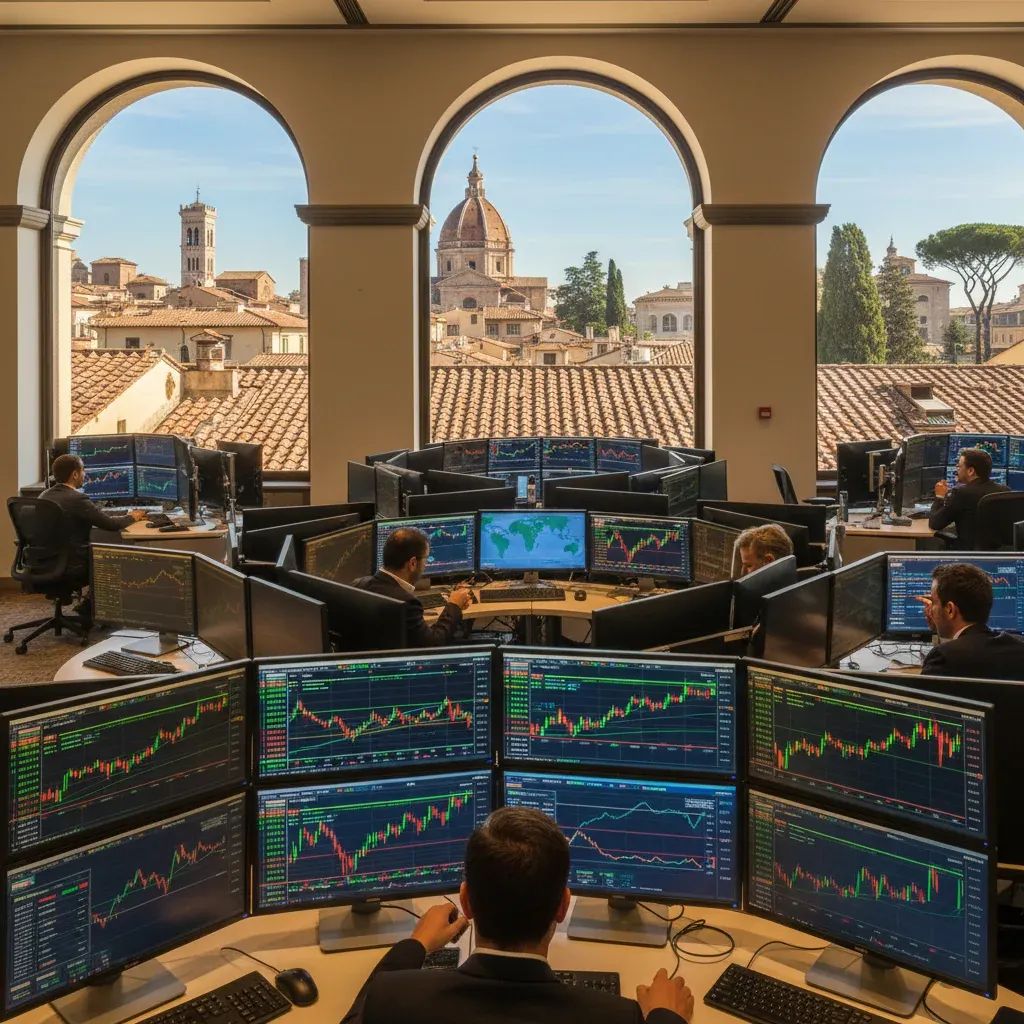
Italy's main equity benchmark started the morning session with a 0.59% gain, driven by a surge in shares of the country's embattled automaker and strong performances from financial and healthcare names, as investors digested corporate governance updates and positioned ahead of key central bank decisions.
Why This Matters
• Stellantis rallied nearly 3% on the day of its shareholder assembly, signaling investor relief despite the company's €22.3B loss in 2025.
• The FTSE Mib reached levels unseen since 2000, extending a mid-April rally that has pushed the benchmark back into positive territory year-to-date.
• Banking and healthcare stocks led gains, with Mediobanca and Amplifon posting advances above 1% amid strategic developments and margin recovery expectations.
The Italy FTSE Mib opened at 47,806 points, continuing a resilient stretch that has seen the index climb more than 5% since the start of the month. The rally marks a sharp reversal from early-year volatility, when concerns over geopolitical tensions, elevated energy costs, and weak GDP forecasts weighed heavily on Italian equities.
Stellantis Leads as Shareholders Approve Reset Strategy
Stellantis NV, the Italy-based automotive giant born from the merger of Fiat Chrysler and PSA Group, climbed 2.9% as its annual general meeting in Amsterdam concluded with broad approval of all management proposals. The April 14 assembly, which saw 64.16% shareholder participation, confirmed John Elkann as executive director and chairman, while naming Juergen Esser as a new non-executive board member, expanding the board from 11 to 12.
The company's 2025 financial results were grim: a net loss of €22.3B, attributed to strategic overhauls and evolving regulatory frameworks across key markets. As a result, no dividend will be paid for 2026, suspending a payout policy that had been a fixture for shareholders. CEO Antonio Filosa emphasized that the extraordinary charges announced in February involved no cash outflow and that the balance sheet remains robust. He described the restructuring as a "painful but necessary reset" aimed at restoring profitable growth.
Despite the stark losses, equity markets appeared to reward the clarity and decisiveness of the turnaround plan. Investors are betting that the worst is behind the automaker, which has struggled with overcapacity in North America, sluggish EV adoption in Europe, and fierce competition from Chinese manufacturers.
Mediobanca and Amplifon Extend Gains
Mediobanca, one of Italy's leading private and investment banks, advanced 1.39% ahead of its shareholder meeting. The institution has been buoyed by a strategic plan running through 2030 that projects revenues climbing from €3.6B to €4.8B, while net income is forecast to rise from €1.2B to €1.9B. Return on tangible equity is expected to reach 18% by decade's end, up from 13% currently.
The bank's first-quarter results for fiscal 2025/2026 showed net profit of €291.2M and customer loans up 4.6% year-over-year. Management has committed to a 90% payout ratio, signaling confidence in capital generation and a focus on shareholder returns. The stock has also benefited from broader consolidation chatter in Italy's banking sector, even as regulators and politicians debate the optimal structure for the country's fragmented financial system.
Amplifon, the global leader in hearing aid distribution, jumped 1.79%, extending a recovery rally that followed a sharp selloff in March. The company's €2.3B acquisition of GN Hearing, announced earlier this spring, initially spooked investors concerned about leverage. The deal transforms Amplifon from a pure retailer into a vertically integrated manufacturer and distributor, a strategic shift that management argues will unlock pricing power and margin expansion.
Barclays analysts forecast that first-quarter 2026 margins will improve, driven by the company's "Fit4Growth" restructuring program and portfolio optimization. Revenue for 2026 is projected at €2.44B, with adjusted operating margins climbing to €562.6M and earnings per share reaching €0.76, a meaningful increase from the prior year. S&P Global Ratings reaffirmed Amplifon's 'BB+' rating, suggesting that while leverage will rise, the company's fundamentals remain sound.
What This Means for Residents and Investors
For Italian savers and retail investors, the FTSE Mib's resurgence offers a rare bright spot amid an otherwise subdued economic outlook. GDP growth forecasts for 2026 have been repeatedly revised downward, with the IMF projecting just 0.5% expansion and the Bank of Italy echoing that pessimism. Inflation climbed to 1.7% in March, fueled by a rebound in energy costs and fresh food prices, while core inflation cooled to 1.9%.
The European Central Bank is widely expected to announce a policy decision on April 30, with markets pricing in a potential rate hike between now and June. Persistent inflation—particularly in energy—and concerns about "second-round effects" are pushing policymakers toward tightening, even as growth remains anemic. For mortgage holders and small businesses, this means higher borrowing costs; for savers, it signals improved returns on deposit accounts.
Italy's public debt hit a record €3,139.9B in February, equivalent to nearly 140% of GDP. The country must refinance 17% of GDP in debt this year, making any uptick in borrowing costs especially painful. The combination of weak growth and elevated debt raises questions about fiscal sustainability, though robust equity performance suggests investors remain willing to take on Italian risk—at least for now.
Broader Market Context and Outlook
The FTSE Mib's performance in April has been among the strongest in recent years. The index posted a 5.18% gain in the first week of the month, the best weekly result in 50 weeks, pushing the year-to-date return into positive territory at 1.51%. Since then, the benchmark has traded within a range of 48,000 to 48,300 points, with session-to-session moves driven by corporate news, energy price fluctuations, and shifting rate expectations.
Energy remains a wild card. Brent crude has frequently traded above $100 per barrel amid tensions in the Middle East, particularly between the United States and Iran. European natural gas prices, measured by the TTF benchmark, spiked above €56 per megawatt-hour in mid-March before settling near €47.85 in mid-April. The International Monetary Fund has warned that a prolonged conflict could trigger the "largest energy crisis of modern times," further crimping global growth and stoking inflation.
For now, Italian equities are benefiting from a combination of corporate discipline, sector rotation into financials and healthcare, and a broader relief rally as investors reassess the risks posed by geopolitical shocks and monetary tightening. Whether this momentum can be sustained will depend on earnings delivery, energy price stability, and the ECB's next moves.
Banking Sector Gains Traction
Beyond Mediobanca, other Italian banks have posted solid gains in recent sessions. Banco BPM, Generali Assicurazioni, and Monte dei Paschi di Siena have all shown strength, reflecting improved sentiment toward a sector that has historically been weighed down by non-performing loans and thin margins. The ongoing debate over banking consolidation—whether through domestic mergers or cross-border tie-ups—has added an element of takeover speculation that tends to support valuations.
Consumer credit trends have also improved, with personal loans, salary-backed financing, and auto/moto lending all showing growth. This is a tailwind for banks like Mediobanca, whose Compass consumer finance arm is a key driver of profitability.
Laggards and Sector Divergence
Not all sectors participated in the morning's rally. DiaSorin, ENI, Nexi, and Campari traded lower, reflecting divergent outlooks within the broader index. Energy names like ENI remain sensitive to crude price swings and European demand dynamics, while payment processors such as Nexi face headwinds from elevated investment needs and competitive pressure.
Campari, the spirits giant, has been hampered by concerns over slowing demand in key export markets and inventory adjustments following pandemic-era overordering.
Unemployment and Labor Market Dynamics
Italy's unemployment rate edged up to 5.3% in February 2026, from 5.2% in January, driven by a modest decline in employment (down 29,000 positions month-over-month). Youth unemployment, however, fell to 17.6%, suggesting some improvement in entry-level hiring. The labor market remains a mixed picture: stable but not robust, with little sign of the wage pressures that have complicated central bank decision-making elsewhere in Europe.
Positioning for the ECB and Beyond
As the calendar moves toward the end of April, all eyes will be on the ECB's April 30 meeting. Markets are pricing in a hawkish tilt, with policymakers under pressure to respond to inflation prints that remain above target and energy costs that refuse to retreat. A rate hike would represent a reversal of the easing cycle that many investors had anticipated earlier this year, and could trigger fresh volatility across European equities.
For Italian investors, the key question is whether domestic equities can maintain their resilience in the face of tighter monetary policy, elevated sovereign debt, and sluggish growth. The answer may lie in corporate execution: companies like Stellantis, Mediobanca, and Amplifon are betting that strategic resets, margin discipline, and bold M&A moves can drive returns even when the macro backdrop is challenging.
The FTSE Mib's climb back to levels last seen more than two decades ago is a testament to that resilience—but also a reminder that market momentum can shift quickly when the fundamentals are fragile.


