
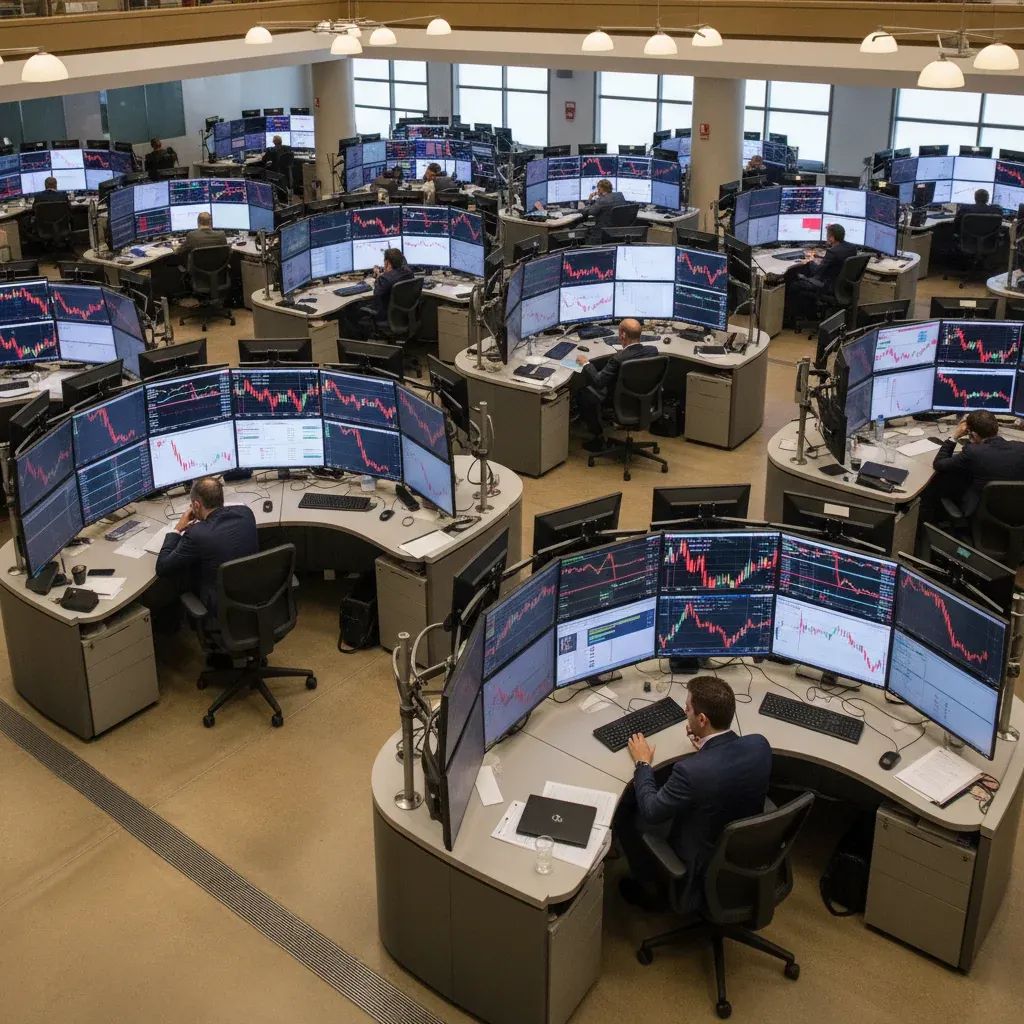
European stock markets extended their losses as geopolitical tensions in the Middle East triggered a sharp sell-off across the continent, with Milan's FTSE MIB closing down 1% amid a broader retreat driven by soaring energy prices and mounting concerns over global supply chains. The collapse of US-Iran peace negotiations held in Islamabad over the weekend, according to reports, has set off a cascade of market volatility, pushing oil above $100 per barrel and reigniting inflationary fears that could complicate the European Central Bank's policy trajectory.
Why This Matters
• Energy shock hits portfolios: Crude oil jumped 7.8% (WTI) to $104.10/barrel and natural gas surged 8.6% to €47.41/MWh, directly impacting heating and fuel costs.
• Italy's borrowing costs rise: The BTP-Bund spread widened to 80 basis points, with Italian 10-year yields climbing 5 basis points to 3.89%.
• Luxury and auto sectors hammered: Italian brands Cucinelli (-4.6%) and Moncler (-3.4%) led sectoral declines, while Stellantis dropped 3.4% following a cautious UBS report on the automotive industry.
• Defense and energy stocks rally: Italy's Leonardo gained 1.25% and ENI rose 0.5% as investors rotated into sectors benefiting from geopolitical tension.
Market Reaction Across the Continent
Madrid's IBEX 35 led European losses with a 1.75% decline, followed by Frankfurt's DAX (-1.45%), Paris's CAC 40 (-1.05%), and London's FTSE 100 (-0.55%). The Euro Stoxx 50 shed nearly 0.81% from the prior session, with futures indicating further weakness ahead. The sell-off reflects a sharp risk-off sentiment as President Trump's announcement of a naval blockade on Iranian ports—particularly the strategically vital Strait of Hormuz—raised the specter of prolonged supply disruptions.
The Strait of Hormuz accounts for roughly 20-25% of global seaborne oil trade, funneling approximately 20 million barrels per day. According to analysts at Emden Research, as long as the strait remains a flashpoint for military risk, elevated oil prices will exert persistent downward pressure on global financial markets. Energy forecasters have warned that a prolonged disruption could push WTI prices as high as $132 per barrel in the coming quarters, potentially trimming global GDP growth by an estimated 2.9 percentage points in Q2 2026 alone.
Currency markets also reflected the strain. The US dollar strengthened to €0.8555, ¥159.77, and £0.7447, as investors sought safe-haven assets. European government bond yields climbed across the board: German Bunds rose 3.65 basis points to 3.09%, and French OATs increased 4.4 basis points to 3.75%, underscoring market expectations that the ECB may face renewed pressure to keep rates elevated despite growth concerns.
Sectoral Divide: Winners and Losers
The market's response was sharply bifurcated. Cyclical sectors tied to discretionary spending and global trade bore the brunt of the downturn. Italy's luxury goods manufacturers—bellwethers for consumer confidence and international demand—suffered notable declines. Brunello Cucinelli fell 4.6%, Moncler shed 3.4%, while French conglomerate Kering dropped 3.3%. Swiss watchmakers Swatch and Richemont lost 2.3% and 2.2%, respectively, reflecting investor anxiety over weakening demand from Asia and Europe's affluent consumers.
The automotive sector, already grappling with a structural crisis marked by slowing electric vehicle adoption and intensified competition from Chinese manufacturers, extended its slide. Stellantis—the multinational giant with deep Italian roots—fell 3.4% after a UBS report underscored the industry's eroding margins and overcapacity challenges. Ferrari declined 1.9%, Renault 1.8%, Volkswagen 1.7%, and Continental 2.52%. Pirelli showed relative resilience with a modest 0.9% dip, buoyed by news that the Italian government would maintain its "golden power" veto over the tire maker's Chinese shareholders (CNRC-Sinochem) until their stake falls below 10%.
The financial sector also retreated. Italian banks were broadly lower: Mediobanca (-2.05%), UniCredit and BPER Banca (both -1.9%), Monte dei Paschi (-1.5%), Intesa Sanpaolo (-1.35%), and Banco BPM (-1.25%). French lender Société Générale dropped 2.3%, and Commerzbank fell 1.9%, as rising sovereign yields and recession fears clouded the outlook for loan growth and asset quality.
By contrast, energy and defense stocks surged. Shell climbed 1.5%, TotalEnergies 1.4%, and BP 1.25%, capitalizing on the oil price spike. Italy's Saipem (+0.6%) and ENI (+0.5%) also advanced, as did Spanish integrated energy company Repsol (+0.7%). The defense sector drew fresh buying interest: Italy's Leonardo rose 1.25%, Germany's Rheinmetall gained 1%, and France's Thales added 0.8%, reflecting expectations of elevated security spending and heightened demand for military equipment in an increasingly volatile geopolitical landscape.
What This Means for Residents
For Italians with investment portfolios, the immediate effect is clear: equity holdings in consumer discretionary and industrial names are taking a hit, while diversification into energy and defense may cushion losses. Those holding Italian government bonds (BTPs) are seeing yields rise—good news for new buyers seeking higher returns, but painful for existing bondholders whose positions are losing market value as prices fall.
On the cost-of-living front, the surge in oil and gas prices will likely translate into higher fuel costs at the pump and increased heating bills in the coming weeks. Natural gas prices jumped more than 8.6%, a direct threat to household budgets and business operating costs, particularly for energy-intensive industries. The inflationary pulse could also delay or reverse any near-term rate cuts from the ECB, keeping mortgage and loan rates elevated for longer.
Small and medium-sized enterprises (SMEs)—the backbone of Italy's economy—face compounded risks. Shipping costs, already sensitive to energy price shocks, could rise by as much as 20-30% if fuel surcharges increase. Delays in containerized goods from Asia, where manufacturing hubs depend on energy transiting the Persian Gulf, could lead to inventory shortages and margin compression.
Expert Outlook: Caution and Volatility Ahead
Market strategists are advising clients to brace for continued turbulence. Christian Henke, chief analyst at IG, noted that while a US-Iran deal was never widely anticipated, the formal failure of talks in Islamabad will drive markets lower in the near term. Timo Emden of Emden Research emphasized that as long as the Strait of Hormuz remains a military flashpoint, elevated commodity prices will sustain pressure on global equities.
Michael Field, a CFA at Morningstar, observed that European stock markets have seen significant monthly performance declines, with certain sectors now appearing undervalued. Mike Coop, Chief Investment Officer for EMEA at Morningstar, suggested that while energy stocks may be overheated, bonds, gold, and technology could lead the next recovery phase.
Central bank watchers are split. Markets are currently pricing in multiple potential rate adjustments by the ECB before year-end, representing a dramatic shift from earlier expectations of rate cuts. The dilemma facing policymakers is acute: support growth in the face of geopolitical shocks, or tighten further to contain a potential second wave of inflation driven by energy and logistics costs.
Broader Economic Implications
The failed negotiations and blockade threat have reignited fears of stagflation—a toxic mix of stagnant growth and rising prices—particularly in Europe, which relies heavily on imported energy. A sustained closure of the Strait of Hormuz would remove nearly 20% of global oil supply, potentially triggering a mild recession across multiple regions if prices remain near elevated levels for an extended period.
Supply chain disruptions extend beyond energy. Nearly 20% of global liquefied natural gas (LNG) trade also passes through the strait, affecting exports from Qatar and the UAE. Manufacturing centers in China, Japan, Taiwan, and South Korea could face production slowdowns, leading to shortages and higher prices for electronics, appliances, chemicals, and textiles—goods Italy imports in significant volumes.
Credit markets are already showing strain. Analysts expect credit spreads to widen, particularly in high-yield bonds, as corporate earnings estimates are revised downward and financing conditions tighten. For Italy, with its elevated public debt, any sustained increase in borrowing costs could complicate fiscal planning and crowd out spending on infrastructure and social programs.
The Road Ahead
Investors, businesses, and policymakers in Italy are now navigating a more uncertain landscape. The immediate priority is monitoring developments in the Persian Gulf and assessing whether diplomatic channels can be reopened before the blockade materializes. In the meantime, portfolio diversification, energy hedging, and close attention to ECB communications will be critical.
For households, the message is practical: expect higher fuel and utility bills, and prepare for potential delays in goods shipments. For businesses, supply chain resilience and cost management are paramount. And for the Italian government, the challenge is maintaining fiscal discipline while supporting growth in an environment where external shocks are increasingly frequent and severe.


