
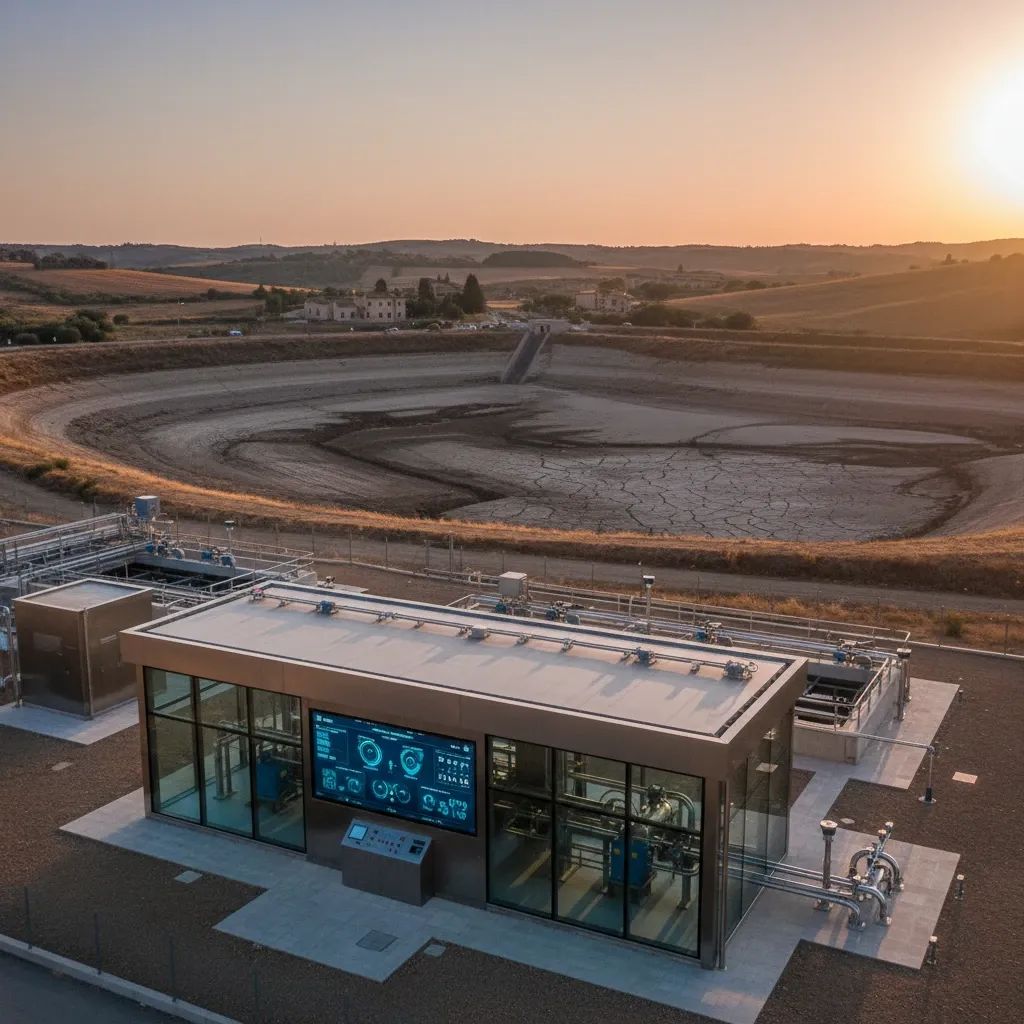
Hera, Italy's second-largest multiutility by market capitalisation, has posted a 3.9% rise in net profit to €464.3 M for the fiscal year 2025, while shareholders approved a dividend hike to €0.16 per share—a 6.7% bump that signals confidence in infrastructure-led growth. More importantly for residents across Northern Italy, the company has accelerated capital expenditure by 19.5% to €1.03 billion, a €1.8 billion five-year commitment that will bring tangible water-service improvements to households and businesses in Emilia-Romagna, Marche, and Veneto starting in 2026.
What This Means for Your Water Service: Concrete Changes Coming
For households and firms in Bologna, Ferrara, Ravenna, Modena, and Rimini—Hera's core service territories—the €1.03 billion investment surge translates into specific, measurable upgrades over the next twenty-four to thirty-six months. Here's what residents will actually see:
Water Supply Improvements (2026-2029)
• Automated district metering and 24/7 remote monitoring will detect leaks faster, reducing water losses below the 50% national average Hera already achieves
• Accelerated pipe replacement in aging sections of Bologna, Ferrara, and Ravenna, beginning mid-2026
• New treatment plant in Bubano (Bologna province) to increase reserve capacity and improve supply reliability during dry seasons
• 13-municipality network optimisation across Ravenna and Imola districts to modernise infrastructure dating back decades
Wastewater and Environmental Services (2026-2029)
• €10 M storm-water tank in Cattolica to protect Adriatic beaches during heavy rainfall—completion targeted 2027
• Upgraded Ferrara treatment plant with ultrafilter membranes enabling treated water reuse for agriculture and industry, reducing environmental discharge
• Vignola facility (Modena province) receiving new equipment to cut energy consumption and improve nitrogen removal, with benefits visible in effluent quality by late 2027
• Biodigestion expansion at Spilamberto to convert organic waste into biomethane—reducing landfill reliance by 2026
What You'll Pay: Tariff RealityThese improvements will require tariff adjustments. While Italy's ARERA regulatory authority phases increases over time, residents should expect gradual rises on water bills beginning 2027-2028—typically 2-3% annually through 2029—as the €1 billion investment feeds into regulated tariff calculations. The regulator applies increases gradually and requires public consultation, so bills won't spike overnight. Hera management has emphasized affordability protections for vulnerable households.
Timeline: When You'll See Results
June 2026: Dividend payment begins for shareholders (€0.16 per share). Dividend yield of roughly 4% for HER share-holders.
Mid-2026 onwards: Water-network upgrades launch across major cities; pipe replacement and automated monitoring systems roll out in phases.
2026-2027: First treatment-plant upgrades complete; wastewater quality improvements measurable in discharged effluent.
2027-2029: Full five-year capital plan unfolds; leak-reduction targets met; smart-bin rollout across waste-collection zones increases separate-waste collection toward 75% target.
2028-2029: Tariff impacts fully embedded in customer bills, reflecting the €1.03 billion annual investment pace.
Why This Matters: The Regulatory and Financial Context
The dividend hike to €0.16 per share reflects management confidence, but it's backed by genuine investment discipline. Here's what ensures the money gets spent as promised:
Regulatory Accountability: Italy's ARERA regulator directly approves tariffs and monitors capital deployment. If Hera doesn't spend as committed, tariff increases won't materialize either—but the regulator has teeth to enforce performance.
European Compliance: Hera's €1.03 billion investment includes €1.8 billion earmarked for water-cycle improvements through 2029, aligned with the EU Urban Wastewater Treatment Directive, which tightened environmental standards on January 1, 2025. New nitrogen and phosphorus limits mean treatment upgrades are mandatory, not optional. Brussels estimates €255 billion continent-wide will be needed for compliance.
Balance-Sheet Strength: Hera's net-debt-to-EBITDA ratio stands at 2.57×—well within safe lending thresholds. Translation: the company can borrow affordably to fund these projects without financial strain. This matters because it means tariff increases won't balloon to cover debt-servicing costs.
PNRR Co-Financing: Hera has secured over €180 million in Italian National Recovery Plan (PNRR) co-financing for water-security and circular-economy projects through 2026. This means not all €1.03 billion comes from tariffs; some is covered by EU recovery funds, limiting customer-bill pressure.
Shareholder Assembly Confirms Leadership and Strategy
Meeting in Bologna, Hera shareholders reappointed Cristian Fabbri as executive chairman and Orazio Iacono as chief executive for a fresh three-year term. The board will steer the €5.5 billion five-year capital plan—40% heavier than the previous cycle—tilting decisively toward grid and environmental assets.
CEO Iacono told attendees that Hera aims to remain "l'utility del territorio, della porta accanto"—the neighbourhood utility—a pledge underscored by customer-satisfaction scores. Hera's internal survey reports a 73-point customer-satisfaction rating and a 70-point employee-engagement score, figures management described as indicators of service consistency across its sprawling franchise covering water, gas, electricity, district heating, and waste collection.
Operating Performance: Profits Up, but Expect Margin Pressure
Net profit attributable to shareholders climbed to €464.3 M. However, gross operating margin (EBITDA) slipped to €1.537 billion from €1.588 billion in 2024, reflecting the roll-off of one-time gains tied to Italy's now-expired ecobonus tax credits. Adjusted for those distortions, underlying EBITDA advanced 4.5%—solid performance given changes to energy-pricing regulations introduced by Rome.
Equity strengthened from €3.99 billion (end-2024) to €4.40 billion, bolstering the balance sheet as the firm embarks on its most ambitious infrastructure drive in a decade.
Service Quality and Engagement
Management highlighted customer and employee satisfaction as evidence that service reliability has held despite tariff adjustments and the complexity of managing seven distinct business lines. The 73-point customer-satisfaction index—stable year on year—derives from surveys covering response times, billing accuracy, outage frequency, and call-centre accessibility. For context, Hera's figure aligns with peer utilities in Northern Italy, though specialized water-only operators in Lombardy report slightly higher scores (75–78 range).
The utility publishes an annual "In Buone Acque" water-quality report consolidating over one million laboratory tests on potability parameters. Independent audits verify compliance with Italian drinking-water standards, which in many respects exceed EU minimum thresholds.
Five-Year Strategy: Regulated Returns Over Commodity Trading
The €5.5 billion industrial plan through 2029 allocates 57% to networks (electricity, gas, water, district heat) and 23% to environmental services, underscoring Hera's shift toward regulated-return infrastructure and away from volatile commodity-margin businesses. For residents, this means:
• Predictable tariff increases rather than sudden spikes tied to energy markets
• More reliable service investment, as regulated returns incentivize long-term spending rather than short-term profit-taking
• Better ESG performance, with 64% of 2025 capex meeting green-finance criteria and 78% (€811 M) qualifying as shared-value investments that track social and environmental benefits
Credit-rating agencies affirm Hera's investment-grade profile, citing predictable cash flows and the diversification benefit of multi-commodity operations—meaning the company will access affordable borrowing to fund upgrades without passing excessive costs to customers.
The Bottom Line for Residents
Hera's €1.03 billion annual investment commitment is real, backed by regulator oversight, strong finances, and European environmental mandates. Water-service improvements will roll out across Bologna, Ferrara, Ravenna, Modena, and Rimini through 2026-2029. Residents should expect gradual tariff increases beginning 2027-2028 (typically 2-3% annually) as the investment is reflected in regulated bills, but these increases are phased, subject to public consultation, and partially offset by PNRR co-financing. The trade-off: better water quality, fewer leaks, faster fault response, and more reliable service during climate stress.


