
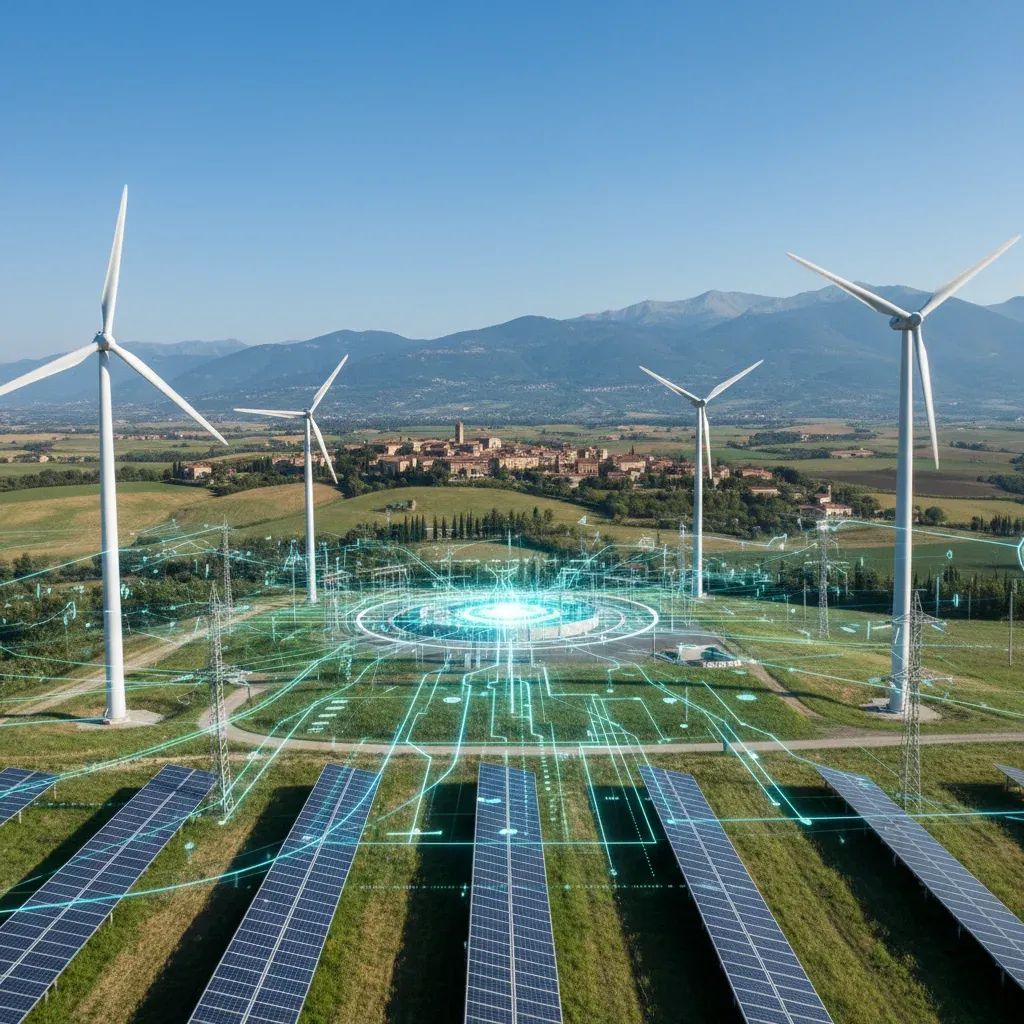
Italy's largest utility has rolled out a capital expansion plan that will pump €53 billion into infrastructure between now and 2028, a move that signals one of the steepest investment accelerations in the European energy sector and positions the country as a central hub for renewable power and smart grid technology.
Why This Matters
• Grid modernization accelerates: Over €26 billion will upgrade Italy's electricity networks, accounting for roughly 55% of total grid spending — the largest single-country allocation in Enel's global portfolio.
• Renewable capacity surge: Nearly €20 billion will fund new solar, wind, and battery storage projects, adding 15 GW of clean power capacity by 2028.
• Shareholder payouts rise: Earnings per share are forecast to climb to between €0.80–0.82 by 2028, up from €0.69 in 2025, with dividends growing at 6% annually and a new €1 billion share buyback program launching today.
A Strategic Pivot Toward Scale and Stability
The Italy-based energy giant Enel unveiled its 2026-2028 strategic roadmap during a Capital Markets Day in Milan, marking a €10 billion increase over the previous three-year plan. Chief Executive Flavio Cattaneo described the blueprint as "ambitious and credible," emphasizing that the company's financial discipline over recent years has created the flexibility needed to invest aggressively in markets with surging electricity demand.
The plan divides capital almost evenly between two pillars: Integrated Business (encompassing renewables and retail) and Networks, with each receiving just over €26 billion. This dual focus reflects Enel's bet that Europe and the Americas will see explosive growth in power consumption driven by data centers, artificial intelligence workloads, industrial automation, and electric vehicle adoption — trends already visible in the United States and expected to accelerate across the European Union.
More than 90% of the projected cumulative EBITDA of €74 billion for 2026-2028 will come from regulated or long-term contracted activities, insulating earnings from volatile wholesale power prices. The company also expects to realize €700 million in additional operational efficiencies by 2028, building on the €1 billion in cost savings delivered a year ahead of schedule under the prior plan.
Italy Remains the Anchor
For residents and businesses across Italy, the most immediate implication lies in the grid investment surge. Of the €26 billion earmarked for network infrastructure, approximately €14.3 billion will flow into Italian distribution and transmission assets. This allocation — the highest share among Enel's operating countries — will fund smart meter rollouts, grid digitization, and capacity upgrades necessary to accommodate distributed solar generation and electric vehicle charging stations.
Iberia will capture just over 20% of network spending, while Latin America accounts for nearly 25%. The geographic split underscores Enel's strategy of concentrating capital in jurisdictions with stable regulatory frameworks and favorable returns. Italy's regulatory asset base (RAB) is projected to grow 22% to around €58 billion by 2028, up from roughly €47 billion at the end of 2025.
The company also confirmed that cloud migration will reach 100% by 2028, with artificial intelligence tools embedded across core operations to boost productivity. For consumers, this translates into faster fault detection, more reliable power supply, and potentially lower operational costs passed through in tariffs over time.
Renewable Push Targets Wind and Storage
Enel's renewable strategy marks a notable shift toward wind power and battery energy storage systems (BESS), which will comprise over 75% of the 15 GW of new capacity. Roughly 9 GW will come from greenfield projects — entirely new installations — while 6 GW will arise from brownfield conversions, including the repowering of aging plants and site hybridization.
Europe will receive half of the renewable capital expenditure, focused on auction-based projects, repowering, and grid-connected storage. The United States, classified as a Tier 1 geography, will absorb most of the remaining investment, backed by long-term power purchase agreements (PPAs) that lock in revenue streams. Latin America receives a smaller slice — around €3 billion — but remains strategically important for portfolio diversification.
By 2028, Enel's total installed renewable capacity is expected to exceed 80 GW, up from 68 GW at the close of 2025. The emphasis on programmable technologies like BESS reflects the grid's growing need for flexibility as intermittent solar and wind displace baseload fossil generation.
Financial Firepower and Shareholder Returns
To fund the expansion, Enel's board has authorized up to €12 billion in new debt issuance and bank financing through March 2027, structured to refinance maturing obligations and support growth initiatives. Despite the capital intensity, the company projects its leverage ratio will hold steady at around 3.0x debt-to-EBITDA — below the European utility sector average and a signal of continued financial discipline.
On the shareholder front, the board approved a fresh share buyback program worth up to €1 billion, capped at 150 million shares (roughly 1.48% of outstanding equity). The program runs from today through July 31, 2026, and follows a previous buyback completed in December 2025 that retired 122.5 million shares for approximately €1 billion. Combined, these initiatives are part of a broader €3.5 billion authorization from the May 2025 shareholder meeting.
Earnings per share (EPS) are forecast to grow at a compound annual rate of 6%, reaching €0.80–0.82 by 2028. Dividends are expected to track EPS growth at the same 6% CAGR, starting from a proposed €0.49 per share for 2025. This trajectory is underpinned by disciplined capital allocation and the expectation that international subsidiaries will contribute stronger returns as new projects come online.
Market Reception and Analyst Views
Milan's Piazza Affari responded positively to the announcement, with Enel shares climbing more than 3% in early trading. Equita Sim reaffirmed a "buy" rating with a price target of €10.30, noting that financial targets exceed consensus expectations. Barclays maintained an "overweight" stance with a €10 target, projecting 4% annual EPS growth through 2030. Mediobanca Research also kept an "outperform" rating, citing the credibility of the plan and the company's track record of early execution.
Analysts highlighted the balance between growth ambition and risk management, particularly the decision to concentrate capital in Tier 1 geographies with transparent regulatory regimes and contractually secured cash flows. The accelerated rollout of AI-driven operations and data center partnerships — where Enel can bundle site access, grid connection, and long-term power supply — emerged as a new value driver in analyst notes.
What This Means for Residents
For households and businesses in Italy, the strategic plan translates into several tangible outcomes over the next three years:
• Grid reliability improvements: Expect faster restoration times during outages and enhanced capacity to handle rooftop solar exports and EV charging loads.
• Renewable energy integration: The surge in wind and storage capacity will help stabilize power prices by reducing reliance on imported fossil fuels, though the direct tariff impact depends on regulatory pass-through mechanisms.
• Job creation and local investment: The concentration of network spending in Italy will support domestic contractors, engineering firms, and supply chains, particularly in regions hosting new renewable installations or grid upgrades.
• Shareholder benefits: For the roughly 3.6 million retail and institutional investors holding Enel shares, the combination of rising dividends and buybacks offers a clearer path to enhanced returns, assuming the company delivers on execution.
The plan also reflects Italy's pivotal role in Europe's energy transition. With the European Union targeting net-zero emissions by 2050 and phasing out coal, Enel's commitment to domestic grid modernization and renewable capacity aligns with national energy security goals and climate commitments under the Green Deal.
Competitive Context in European Energy
Enel's investment scale positions it alongside continental heavyweights like Iberdrola, RWE, Engie, and E.ON, all of which are channeling capital into grids and renewables. Iberdrola aims to exceed 52 GW of renewable capacity by 2025, while Engie targets 80 GW by 2030 in select markets. Enel's 80 GW goal by 2028, combined with its leadership in battery storage deployment, places it in the top tier of European utilities by both installed capacity and technology diversity.
The focus on data center partnerships is particularly forward-looking. As hyperscale cloud providers and AI firms scout for reliable, low-carbon power, utilities with land, grid access, and long-term supply contracts hold a structural advantage. Enel's industrial sites and renewable portfolio position it to capture this emerging revenue stream, which is already accelerating in the United States and expected to gain traction in Europe as data sovereignty concerns drive onshoring of compute infrastructure.
Operational Efficiency Through Technology
Enel's commitment to migrate 100% of applications to the cloud by 2028 and embed AI tools across core processes represents one of the most ambitious digital transformations in the European utility sector. The company has already achieved its 2023-2025 efficiency target of €1 billion a year early, using predictive maintenance algorithms, automated grid management, and optimized procurement.
The additional €700 million in efficiencies planned through 2028 will likely stem from further automation, reduced downtime, and improved asset utilization. For customers, this could mean more proactive communication during planned maintenance, dynamic pricing pilots, and eventually, more granular control over energy usage through digital platforms integrated with smart meters.
Looking Ahead
Enel's strategic plan arrives at a moment when European utilities face a complex landscape: volatile gas prices, regulatory pressure on consumer tariffs, geopolitical supply risks, and the capital demands of decarbonization. By prioritizing regulated assets, contractually secured revenues, and geographies with proven regulatory stability, Enel is hedging against these uncertainties while positioning for long-term growth.
For Italy, the message is clear: the country will remain a strategic hub for one of Europe's largest energy companies, benefiting from sustained infrastructure investment, renewable capacity expansion, and the operational improvements that come with digitalization. Whether the plan delivers on its financial promises will depend on execution — but the capital commitment, geographic focus, and market response suggest confidence is running high.


